WIPI1 rabbit pAb from ELK Biotechnology
Know who made it. See the evidence. Buy through one marketplace.
WIPI1 rabbit pAb is a research-use antibody from ELK Biotechnology for studying WIPI1 in WB, ELISA workflows with listed reactivity for Human. Specifications and supporting documents below should be reviewed when planning the experiment.
WD repeat domain, phosphoinositide interacting 1(WIPI1) Homo sapiens This gene encodes a WD40 repeat protein. Members of the WD40 repeat family are key components of many essential biologic functions. They regulate the assembly of multiprotein complexes by presenting a beta-propeller platform for simultaneous and reversible protein-protein interactions. Members of the WIPI subfamily of WD40 repeat proteins have a 7-bladed propeller structure and contain a conserved motif for interaction with phospholipids. Alternative splicing results in multiple transcript variants. [provided by RefSeq, Mar 2016],
| Specificity | WIPI1 Polyclonal Antibody detects endogenous levels of WIPI1 |
|---|---|
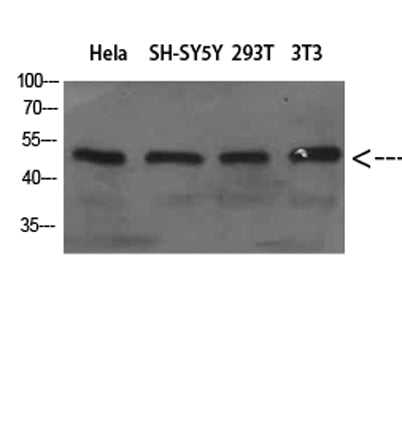
| Validation evidence captions | Western Blot analysis of Hela SH-SY5Y 293T 3T3 cells using WIPI1 Polyclonal Antibody diluted at 1:800. Secondary antibody(catalog#:RS0002) was diluted at 1:20000 |
Fully tested in-house by ABMIUM, or supported by an advanced validation report from a partner reviewed by ABMIUM. Highest confidence. Non-conformities fully supported under the ABMIUM Product Promise.
Quality verified. Independent collaborator or expected-performance data available. Product meets ABMIUM quality standards.
Expected to work based on structural and biochemical data. Not yet directly tested by ABMIUM or a collaborator. No non-conformity support for this combination.
Not recommended for this application or species/sample combination. This may indicate either evidence of unsuitability or that the combination has not been tested and therefore cannot currently be recommended.
Evidence status by application and model.
| Species | WB | IHC | IF | ELISA | IP | FCM | ChIP |
|---|---|---|---|---|---|---|---|
| Human |
This product is manufactured by ELK Biotechnology and sold through ABMIUM without relabelling.
ABMIUM supports global orders. Availability, shipping requirements and applicable import arrangements are confirmed before fulfilment where required.
Yes. Send your target, sample, application and experimental conditions through ABMIUM MATCH or technical support.
Unless the listing expressly states otherwise, ABMIUM products are supplied for research use only and are not for diagnostic or therapeutic use.