
IKKα/β (phospho Ser180/181) rabbit pAb from ELK Biotechnology Read more ›

IKKα/β (phospho Ser180/181) rabbit pAb is a research-use antibody from ELK Biotechnology for studying IKKα/β in WB, IHC, IF, ELISA workflows with listed reactivity for Human, Mouse, Rat. Specifications and supporting documents below should be reviewed when planning the experiment.
This gene encodes a member of the serine/threonine protein kinase family. The encoded protein, a component of a cytokine-activated protein complex that is an inhibitor of the essential transcription factor NF-kappa-B complex, phosphorylates sites that trigger the degradation of the inhibitor via the ubiquination pathway, thereby activating the transcription factor. [provided by RefSeq, Jul 2008],
| Specificity | Phospho-IKKα/β (S180/181) Polyclonal Antibody detects endogenous levels of IKKα/β protein only when phosphorylated at S180/181. |
|---|---|
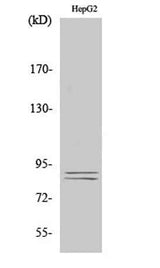
| Validation evidence captions | Western Blot analysis of various cells using Phospho-IKKα/β (S180/181) Polyclonal Antibody diluted at 1:1000 | Enzyme-Linked Immunosorbent Assay (Phospho-ELISA) for Immunogen Phosphopeptide (Phospho-left) and Non-Phosphopeptide (Phospho-right), using IKK-alpha/beta (Phospho-Ser180/181) Antibody | Immunohistochemistry analysis of paraffin-embedded human heart, using IKK-alpha/beta (Phospho-Ser180/181) Antibody. The picture on the right is blocked with the phospho peptide. | Western blot analysis of lysates from HepG2 cells treated with TNF 20ng/ml 5', using IKK-alpha/beta (Phospho-Ser180/181) Antibody. The lane on the right is blocked with the phospho peptide. |
| Collaborator | ELK Biotechnology |
| Partner model | ES1337 |
| Target | IKKα/β |
| Research areas | >>Antifolate resistance, >>MAPK signaling pathway, >>Ras signaling pathway, >>Chemokine signaling pathway, >>NF-kappa B signaling pathway, >>FoxO signaling pathway, >>mTOR signaling pathway, >>PI3K-Akt signaling pathway, >>Apoptosis, >>Osteoclast differentiation, >>Toll-like receptor signaling pathway, >>NOD-like receptor signaling pathway, >>RIG-I-like receptor signaling pathway, >>Cytosolic DNA-sensing pathway, >>C-type lectin receptor signaling pathway, >>IL-17 signaling pathway, >>Th1 and Th2 cell differentiation, >>Th17 cell differentiation, >>T cell receptor signaling pathway, >>B cell receptor signaling pathway, >>TNF signaling pathway, >>Adipocytokine signaling pathway, >>Alcoholic liver disease, >>Alzheimer disease, >>Epithelial cell signaling in Helicobacter pylori infection, >>Pathogenic Escherichia coli infection, >>Shigellosis, >>Salmonella infection, >>Yersinia infection, >>Chagas disease, >>Toxoplasmosis, >>Hepatitis C, >>Hepatitis B, >>Measles, >>Human cytomegalovirus infection, >>Influenza A, >>Human pap |
| Reactivity | Human,Mouse,Rat |
| Applications | WB,IHC,IF,ELISA |
| Conjugation | Unconjugated |
| Dilution range | Western Blot: 1/500 - 1/2000. Immunohistochemistry: 1/100 - 1/300. ELISA: 1/20000. Not yet tested in other applications. |
| Host | Rabbit |
| Clonality | Polyclonal |
| Isotype | IgG |
| Immunogen | The antiserum was produced against synthesized peptide derived from human IKK-alpha/beta around the phosphorylation site of Ser180/181. AA range:151-200 |
| Concentration | 1 mg/ml |
| Purification | The antibody was affinity-purified from rabbit antiserum by affinity-chromatography using epitope-specific immunogen. |
| Assay type | Antibody validation/application |
| Expression system | Widely expressed. |
| Purity | The antibody was affinity-purified from rabbit antiserum by affinity-chromatography using epitope-specific immunogen. |
| Species | WB | IHC | IF | ELISA | IP | FCM | ChIP |
|---|---|---|---|---|---|---|---|
| Human | |||||||
| Mouse | |||||||
| Rat |
| Species | Dilution | Notes |
|---|---|---|
| Human | Western Blot: 1/500 - 1/2000. Immunohistochemistry: 1/100 - 1/300. ELISA: 1/20000. Not yet tested in other applications. | — |
| Mouse | — | — |
| Rat | — | — |
| Species | Dilution | Notes |
|---|
| Species | Dilution | Notes |
|---|
| Species | Dilution | Notes |
|---|
Collaborator meets ABMIUM quality standards and overall product performance standards have been met.
Quality management certification.
For research applications. Not for diagnostic use.
No customer reviews yet.
