BLNK (phospho Tyr96) pAb de lapin d'ELK Biotechnology
Know who made it. See the evidence. Buy through one marketplace.
BLNK (phospho Tyr96) pAb de lapin est un anticorps d'ELK Biotechnology pour les flux de travail de recherche impliquant BLNK.
Ce gène code une protéine de liaison ou d'adaptation cytoplasmique qui joue un rôle essentiel dans le développement des lymphocytes B. Cette protéine assure la liaison entre l'activation de la kinase associée au récepteur des lymphocytes B et les voies de signalisation en aval, affectant ainsi diverses fonctions biologiques. La phosphorylation de cinq résidus tyrosine est nécessaire à cette protéine pour nucléer des effecteurs de signalisation distincts après l'activation du récepteur des lymphocytes B. Les mutations de ce gène entraînent une hypoglobulinémie et l'absence de lymphocytes B, une maladie dans laquelle la transition pro- à pré-lymphocytes B est bloquée sur le plan développemental. Une déficience de cette protéine a également été observée dans certains cas de leucémie lymphoblastique aiguë pré-B. Des variants de transcription épissés alternativement ont été trouvés pour ce gène. [fourni par RefSeq, mai 2012]
| Spécificité | L'anticorps polyclonal Phospho-BLNK (Y96) détecte les niveaux endogènes de protéine BLNK uniquement lorsqu'elle est phosphorylée en Y96. |
|---|---|
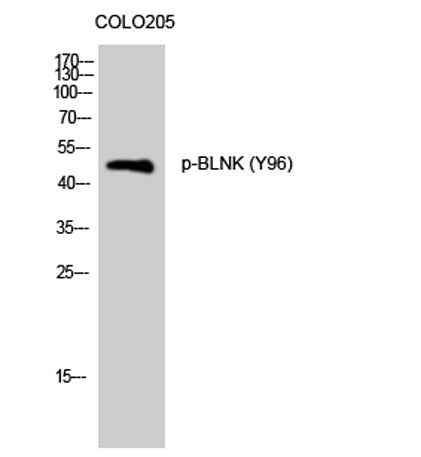
| Légendes des preuves de validation | Analyse par Western Blot de cellules COLO205 utilisant l'anticorps polyclonal Phospho-BLNK (Y96) | Immuno-sondage enzymatique (Phospho-ELISA) pour le phosphopeptide immunogène (Phospho-gauche) et le non-phosphopeptide (Phospho-droite), utilisant l'anticorps BLNK (Phospho-Tyr96) | Analyse immunohistochimique de ganglions lymphatiques humains inclus en paraffine, utilisant l'anticorps BLNK (Phospho-Tyr96). La photo de droite est bloquée avec le phosphopeptide. | Analyse par Western blot de lysats de cellules COLO205, utilisant l'anticorps BLNK (Phospho-Tyr96). La voie de droite est bloquée avec le phosphopeptide. |
Fully tested in-house by ABMIUM, or supported by an advanced validation report from a partner reviewed by ABMIUM. Highest confidence. Non-conformities fully supported under the ABMIUM Product Promise.
Quality verified. Independent collaborator or expected-performance data available. Product meets ABMIUM quality standards.
Expected to work based on structural and biochemical data. Not yet directly tested by ABMIUM or a collaborator. No non-conformity support for this combination.
Not recommended for this application or species/sample combination. This may indicate either evidence of unsuitability or that the combination has not been tested and therefore cannot currently be recommended.
Evidence status by application and model.
| Espèce | WB | IHC | IF | ELISA | IP | FCM | ChIP |
|---|---|---|---|---|---|---|---|
| Humain | |||||||
| Souris | |||||||
| Singe |
This product is manufactured by ELK Biotechnology and sold through ABMIUM without relabelling.
ABMIUM supports global orders. Availability, shipping requirements and applicable import arrangements are confirmed before fulfilment where required.
Yes. Send your target, sample, application and experimental conditions through ABMIUM MATCH or technical support.
Unless the listing expressly states otherwise, ABMIUM products are supplied for research use only and are not for diagnostic or therapeutic use.
B cell linker (BLNK), also known as B-cell linker protein, SLP-65 and BASH, is a cytoplasmic adaptor that couples activated B-cell receptor signalling to downstream pathways. BLNK is studied in B-cell development, antigen-receptor signalling, calcium mobilisation and lymphocyte activation.
Biological function: Following B-cell receptor activation, BLNK is phosphorylated and functions as a signalling scaffold that organizes downstream effectors, including phospholipase C gamma 2, to support calcium mobilisation and kinase signalling required for normal B-cell activation and differentiation.