

ElabscienceABMIUM Verified™
Protéine humaine recombinante β-actine/bêta-actine (étiquette His)
SKU: ABM17868-1Protéines recombinantes
- Target
- β-Actine
- Reactivity
- Humain
From£94.40£118.00
Save 20%
Available to orderABMIUM target intelligence
actin beta
Actin beta (ACTB) encodes actin, cytoplasmic 1, commonly called beta-actin or β-actin, a widely expressed non-muscle cytoskeletal actin. Human ACTB maps to NCBI Gene 60 and reviewed UniProtKB P60709; this target record links the verified target to related ABMIUM catalogue products.
Read full target overview





Research context & evidence
Target information is kept separate from product-level validation so you can review the biology and the reagent evidence independently.
ACTB is a highly conserved actin that polymerises from monomeric G-actin into F-actin filaments and cross-linked cytoskeletal networks. NCBI and reviewed UniProt describe roles in cell structure, motility and contraction; nuclear G- and F-actin also contribute to transcriptional regulation and repair of damaged DNA.
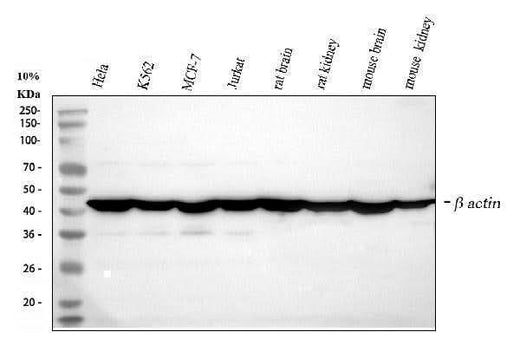
ACTB/beta-actin is studied in cytoskeletal organisation, cell morphology, adhesion, motility and contractile processes. It is also frequently measured as a reference protein, but suitability as a normalisation control should be validated for each experimental system rather than assumed. Select related ABMIUM research products only after confirming species, sample type, assay/application and product-level validation.
Names used across publications, databases and supplier catalogues.