

Custom ELISA development delivers a validated, matrix-optimised assay built around a matched antibody pair, an optimised protocol and a full validation report. Commission it when off-the-shelf kits fail on your sample matrix, when you need sensitivity or specificity a catalogue kit cannot reach, when a longitudinal study needs reagent continuity across years, or when regulatory pathways demand documented, IVD-grade evidence. Providers offer this alongside consultative sourcing, and acceptance criteria typically follow validation frameworks used across the immunoassay literature.
TL;DR:
- Custom ELISA development is essential when off-the-shelf kits fail or regulatory documentation is required for validation.
- The process usually takes 8 to 10 weeks, with clear phases including feasibility, antibody screening, optimization, validation, and scale-up.
- Pre-binned antibody pairs can reduce screening time by several weeks, crucial for fixed project deadlines.
- Validation reports must include detailed sensitivity, precision, linearity, and stability data with replicate runs and calibrator information.
- Choosing a provider with in-house epitope binning and comprehensive validation experience ensures more reliable assay development and reagent continuity.
Table of Contents
- What does a custom ELISA development service actually provide?
- What are the development phases from feasibility to scale-up?
- How is antibody pairing and detection chemistry optimised?
- What validation criteria and performance thresholds should you expect?
- How long does a custom ELISA development project take?
- How do you choose the right custom ELISA provider?
- [Some providers combine Custom ELISA Development with scientist-led sourcing services, so antibody pair selection, protocol design and validation sit alongside broader reagent guidance rather than as an isolated transaction. Such a consultative layer can give researchers traceability on antibody provenance and validation evidence before committing to a pairing decision. Controlling reagent sourcing and lot-to-lot validation this way supports the continuity that longitudinal studies depend on, since commercial kits can change formulations without notice. Relevant enquiries for feasibility review can be made through the custom services page.](#some-providers-combine-custom-elisa-development-with-scientist-led-sourcing-services-so-antibody-pair-selection-protocol-design-and-validation-sit-alongside-broader-reagent-guidance-rather-than-as-an-isolated-transaction-such-a-consultative-layer-can-give-researchers-traceability-on-antibody-provenance-and-validation-evidence-before-committing-to-a-pairing-decision-controlling-reagent-sourcing-and-lot-to-lot-validation-this-way-supports-the-continuity-that-longitudinal-studies-depend-onhttpslabsiqviacomcustom-assay-development-since-commercial-kits-can-change-formulations-without-notice-relevant-enquiries-for-feasibility-review-can-be-made-through-the-custom-services-pagehttpswwwabmiumcompagescustom-product)
- In-house development or outsourcing: which actually makes sense?
- How ABMIUM supports your next custom ELISA project
- Sources
- FAQ
What does a custom ELISA development service actually provide?
A proper custom ELISA development brief should end with more than a working plate. You are paying for a defensible package of evidence that lets you defend the assay in a manuscript, a regulatory submission or an internal audit.
Expect these deliverables from a competent provider:
- Feasibility summary covering target biology, candidate antibodies and anticipated matrix challenges.
- Matched antibody pairs selected through epitope binning, not guesswork.
- An optimised protocol specifying coating, blocking, detection chemistry and incubation conditions.
- Calibrators and quality control material matched to your sample matrix.
- Validation data and a technical dossier covering sensitivity, precision, linearity and interference.
- A lot-to-lot testing plan for reagent continuity across future manufacturing runs.
Research-grade projects usually stop at a validation summary and raw data tables. IVD-grade or clinical-adjacent work needs a fuller technical dossier, stability data and a documented quality management trail, because regulatory-facing validation carries a higher evidentiary bar than a research tool. Serum, plasma, cerebrospinal fluid, saliva and tissue lysates are the matrices that most often force a custom route, since each interacts differently with capture antibodies and blocking agents.
What are the development phases from feasibility to scale-up?
Custom ELISA development follows a fairly consistent sequence across providers, even when the terminology differs slightly. Knowing the phases lets you interrogate a quote line by line instead of accepting a lump-sum estimate.
- Feasibility (Phase 0). Define the analyte, confirm the sample matrices in scope, and agree acceptance criteria for sensitivity, specificity and precision before any wet-lab work starts.
- Antibody sourcing and screening (Phase 1). Candidates go through pairwise epitope binning using biolayer interferometry (BLI) or surface plasmon resonance (SPR) to find capture/detection pairs that bind non-competing epitopes. A typical screening round tests 6 to 12 monoclonal candidates before a pair is shortlisted.
- Optimisation (Phase 2). Coating strategy, blocking chemistry, detection system and calibrator matrix are refined, and a preliminary limit of detection (LOD) is established.
- Validation (Phase 3). Precision, linearity, spike recovery, interference and robustness are tested against pre-agreed thresholds.
- Scale-up and tech transfer. Lot-to-lot reproducibility, stability testing and manufacturing documentation are finalised for ongoing supply.
Pro Tip: Ask your provider whether any candidate pairs are already pre-binned from prior projects on the same target family. Pre-validated antibody pairs can cut several weeks off the screening phase, which matters if your grant timeline is fixed.
How is antibody pairing and detection chemistry optimised?
Pairing decisions made in week two determine whether the assay still performs in month twelve. A screening panel of 6 to 12 monoclonal candidates, binned by BLI or SPR, identifies which antibodies bind non-overlapping epitopes rather than competing for the same site on the target.
Several technical choices then shape sensitivity and background:
- Plate-binding strategy. Oriented capture using biotin/streptavidin chemistry generally outperforms passive adsorption for sensitivity, because it presents the capture antibody’s binding face consistently rather than at random orientations, as outlined in ELISA development guidance.
- Blocking agent. Bovine serum albumin, casein and commercial blockers each behave differently depending on target and matrix; the wrong choice raises background rather than reducing it.
- Detection chemistry. Standard horseradish peroxidase (HRP) or alkaline phosphatase detection suits most research applications; amplification methods, including digital ELISA formats, become relevant when the analyte sits at picogram-per-millilitre concentrations or lower.
- Calibrator matrix. Diluting calibrators in immunodepleted or charcoal-stripped serum, rather than plain buffer, reduces the matrix-driven underestimation that buffer-based calibrators can introduce.
A signal-to-blank ratio above 10 at 1 ng/mL is a common benchmark during preliminary pair screening, giving a fast go/no-go signal before full optimisation begins.
What validation criteria and performance thresholds should you expect?
A validation report earns its name only when it states numbers against pre-agreed thresholds, not general assurances that the assay “performed well.” Expect LOD to be determined statistically, not eyeballed from a standard curve, alongside intra-assay and inter-assay coefficient of variation (CV), spike recovery across the working range, linearity through dilution, and formal testing for the hook effect at high analyte concentrations.
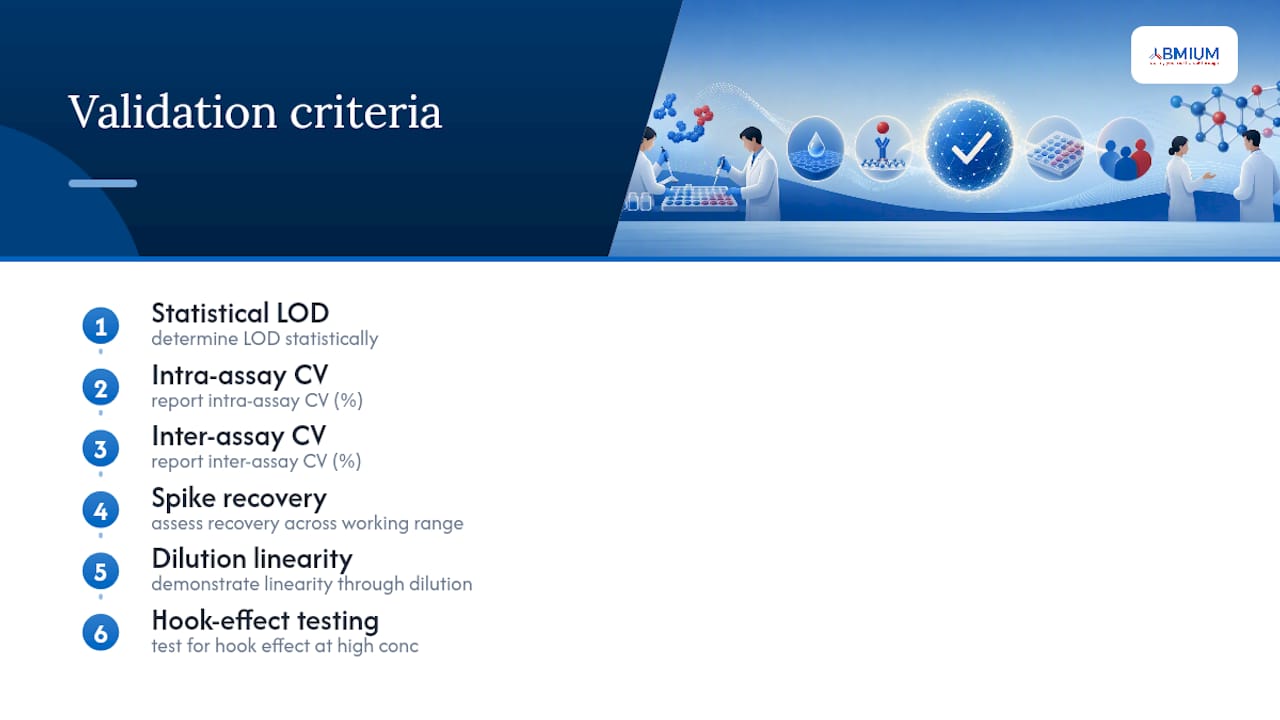
These thresholds broadly align with the acceptance ranges published in sandwich ELISA development guides and with the best-practice review on quantifying peptides and proteins, which notes that required sensitivity varies by application, from over 95% for some screening tests to over 99% for high-stakes diagnostic markers. A research-use report should include replicate run data and calibrator tables; regulatory or IVD submissions need that plus stability data, reagent sourcing documentation and a quality management trail.
How long does a custom ELISA development project take?
A realistic timeline protects your study schedule far better than an optimistic one from a sales deck. Full sandwich ELISA development, from feasibility to validated protocol, typically runs 8 to 10 weeks when antibody pairs are not already characterised.
- Weeks 1 to 2: Feasibility. Analyte review, matrix confirmation, acceptance criteria agreed. Go/no-go: feasibility summary approved.
- Weeks 2 to 4: Screening. Pairwise epitope binning across 6 to 12 candidates. Go/no-go: signal-to-blank benchmark met.
- Weeks 4 to 7: Optimisation. Coating, blocking and detection finalised; preliminary LOD established.
- Weeks 7 to 9: Validation. Precision, linearity, spike recovery and interference testing completed against thresholds.
- Weeks 9 to 10: Lot testing and sign-off. Reproducibility across lots confirmed, dossier delivered.
Extensions usually stem from unexpected matrix interference or a pair failing spike recovery late in optimisation. Pre-binned pairs from a provider’s existing library are the single biggest lever for compressing this schedule.
How do you choose the right custom ELISA provider?
A quote is only comparable to another quote when both providers answer the same questions. Before signing off, check the essentials.
- Does the provider have in-house access to BLI or SPR for epitope binning, or do they outsource it?
- Can they show a validation report from a comparable prior project, with real replicate data rather than summary claims?
- Do they offer a reagent continuity plan, such as single-lot manufacture or multi-supplier validation, for multi-year studies?
- Will raw data (calibrator tables, replicate runs, spike recovery values) be delivered, not just a summary certificate?
In a quote request, specify the number of antibody candidates to be screened, the calibrator matrix to be used, the number of validation replicates, and whether raw data will be included in the final dossier. Treat vague promises of “high sensitivity” without a stated LOD, or a validation report with no replicate data, as red flags.
Pro Tip: Request the calibrator matrix decision in writing before optimisation starts. A provider using plain buffer calibrators for a serum assay is setting up a matrix bias problem you will only discover during validation.
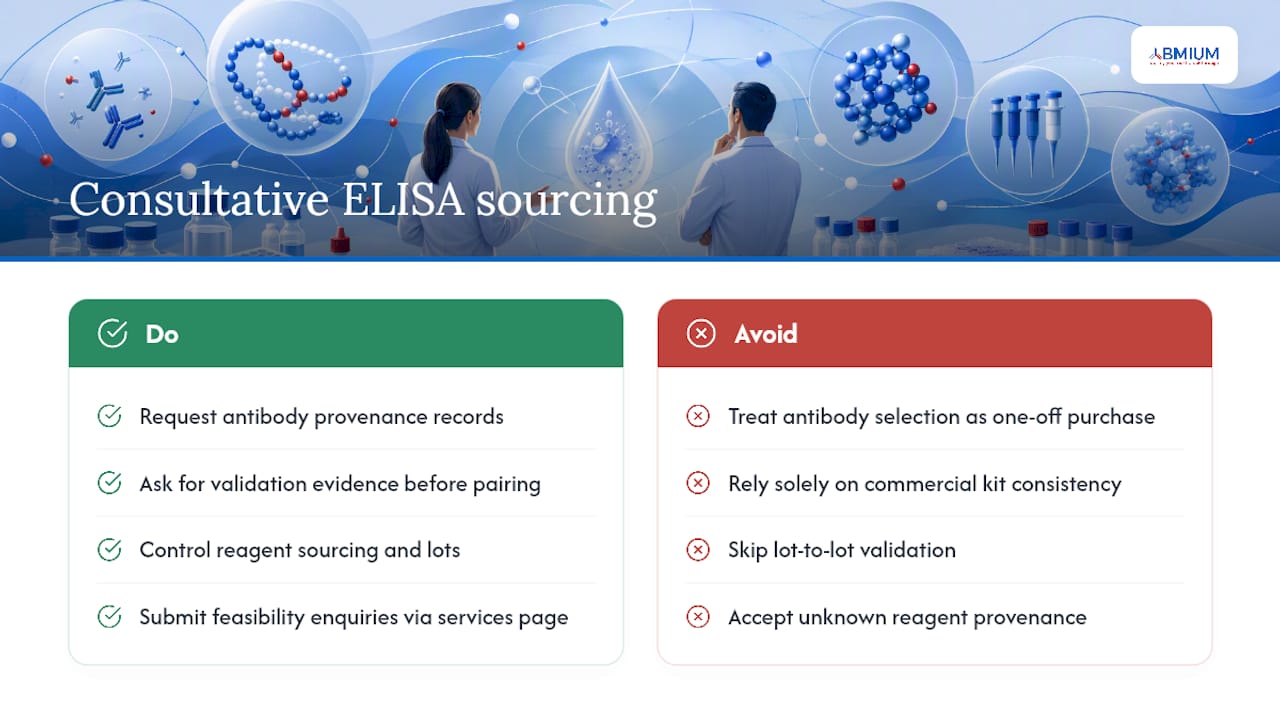
Some providers combine Custom ELISA Development with scientist-led sourcing services, so antibody pair selection, protocol design and validation sit alongside broader reagent guidance rather than as an isolated transaction. Such a consultative layer can give researchers traceability on antibody provenance and validation evidence before committing to a pairing decision. Controlling reagent sourcing and lot-to-lot validation this way supports the continuity that longitudinal studies depend on, since commercial kits can change formulations without notice. Relevant enquiries for feasibility review can be made through the custom services page.
In-house development or outsourcing: which actually makes sense?
Building an ELISA internally makes sense when your lab already owns BLI or SPR instrumentation and has spare capacity to run several screening rounds. For most labs, that combination does not exist, and the real cost is the six to eight weeks spent re-learning binning and blocking chemistry from scratch. Outsourcing tends to win when regulatory readiness, sample matrix complexity or study timelines leave no room for a failed first attempt.
— Veron
How ABMIUM supports your next custom ELISA project
An advantage of combining scientist-led sourcing consultation alongside custom ELISA development is that antibody pairing decisions are backed by traceable provenance and validation evidence rather than a black-box quote.

That matters most when a project moves through several phases, feasibility, screening, optimisation and validation, because a supplier who understands both the antibody catalogue and the assay chemistry can flag matrix problems before they cost you a validation cycle. ABMIUM also resells primary antibodies and ELISA kits directly, useful if part of your workflow can run on an existing component rather than a fully bespoke build.
To request a feasibility review, get in touch through the Custom ELISA Development page and include your target analyte, sample matrix, required sensitivity range and any existing antibody candidates you already hold. A clear brief at this stage is what keeps the 8 to 10 week timeline realistic rather than aspirational.
Sources
- An overview of ELISA: a review and update on best laboratory practices for quantifying peptides and proteins in biological fluids
- Sandwich ELISA development guide — Sekbio
FAQ
What Is Custom ELISA Development?
Custom ELISA development is the process of building a sandwich ELISA specifically matched to your target analyte and sample matrix, using screened antibody pairs, an optimised protocol and validation data rather than a catalogue kit. Some providers offer this as a dedicated service alongside consultative sourcing services.
How Long Does Custom ELISA Kit Design Take?
A full validated sandwich ELISA typically takes 8 to 10 weeks from feasibility through validation and lot testing. Pre-binned antibody pairs can shorten this by removing several weeks from the screening phase.
How Many Antibody Candidates Should Be Screened?
Most successful projects screen multiple monoclonal candidates through pairwise epitope binning before shortlisting a capture and detection pair. A signal-to-blank ratio above 10 at 1 ng/mL is a common benchmark for the initial cut.
What Validation Data Should a Custom ELISA Report Include?
A proper report includes limit of detection, intra- and inter-assay precision data, spike recovery and linearity assessments, alongside detailed replicate and calibrator data. Regulatory or IVD-facing work needs additional stability and quality documentation beyond a standard research-use report, as outlined in ELISA validation best practice.
Does ABMIUM Offer Custom ELISA Development Pricing Online?
ABMIUM does not publish fixed pricing for custom ELISA development, since project scope and matrix complexity vary by target. Current pricing is available by enquiry through the custom services page.