

Prioritise antibodies with knockout (KO) or knockdown (KD) validation and traceable provenance whenever you compare antibodies for a new assay. Vendor claims and third-party citations matter, but only orthogonal evidence, ideally a KO negative control, tells you whether a reagent binds its stated target. Provenance, clone history, and lot stability decide whether that performance holds up on your next order. ABMIUM curates catalogue antibodies with visible manufacturer identity and offers scientist-led sourcing through ABMIUM MATCH to shortlist candidates against this exact evidence standard.
TL;DR:
- Using KO or KD validation provides the most reliable evidence for antibody specificity, especially when selecting for applications like WB, IP, or IF.
- Confirm that antibody lot history and clone stability are documented, as hybridoma drift can cause inconsistencies between batches.
- Prioritize recombinant or sequence-defined antibodies with verified KO validation over unvalidated clones to ensure performance in your specific application.
- Always verify validation evidence shows performance in your intended sample type and species, avoiding reliance solely on vendor claims.
- Incorporate a minimal in-house validation step, like testing against known positive and negative controls, into your procurement process to reduce experimental costs.
Table of Contents
- Checklist: technical parameters to compare for every candidate antibody
- How antibody search engines and repositories present validation evidence
- Why KO/KD validation is the preferred evidence and how those protocols work
- Step-by-step workflow to compare candidates and reach a procurement decision
- Laboratory pitfalls and why provenance saves time
- How ABMIUM supports evidence-based antibody selection
- Sources
- FAQ
Checklist: technical parameters to compare for every candidate antibody
Comparing antibodies properly means working through the same technical checklist every time, not just scanning a datasheet for a green tick. The goal is antibody performance evaluation that survives contact with your actual sample type, not just the vendor’s demonstration blot.
Work through these parameters for each candidate before you commit budget:
- Specificity evidence: does the listing show KO/KD data, or only overexpression and peptide-blocking controls?
- Clonality and format: monoclonal, polyclonal, recombinant, nanobody, or fragment, each with different consistency and penetration trade-offs
- Application validation: confirmed for the assay you need (WB, IHC, IF, IP, flow, ELISA), not just “validated” in general
- Species reactivity and host: matches your sample and secondary detection system
- Conjugation, controls, and storage: conjugate stability, recommended positive/negative controls, and handling conditions
- Lot history and clone-lock status: whether the sequence is fixed (recombinant) or subject to hybridoma drift
Clonality choice is not a formality. Monoclonal antibodies generally give tighter lot-to-lot consistency, while polyclonals can produce stronger signal on some low-abundance or early-stage targets, according to a PMC review of antibody validation and selection considerations. That trade-off should shape which format you shortlist first.
Skipping this checklist has a measurable cost. Poorly validated antibodies are estimated to cost researchers around $800 million a year in wasted reagents and failed experiments, a 2016 estimate that still shapes how funding bodies talk about reproducibility.
Pro Tip: Keep a shared lab spreadsheet logging clone name, lot number, and validation evidence for every antibody in use. It turns a one-off purchase decision into a searchable record the whole team can check before reordering.
How antibody search engines and repositories present validation evidence
Antibody search engines let you filter by target, host, application, and species reactivity, but the filters only tell you what the vendor claims, not what has been independently confirmed. Treat every “validated” badge as a starting point for enquiry, not a verdict.
When scanning a repository listing, work through these checks before adding an antibody to your shortlist:
- Read whether validation images show your actual application (a WB image does not confirm IHC performance)
- Check if cited papers used the antibody for the same species and sample type you plan to use
- Look for citation counts tied to specific applications rather than generic “cited in X papers” totals
- Confirm the listing states lot number, catalogue history, and whether the clone is recombinant or hybridoma-derived
Vendor-claimed validation and independent, KO-based validation are not the same tier of evidence. A protocol snapshot showing a clean single band on a control lysate is reassuring, but it does not rule out cross-reactivity with a related family member. That distinction matters most when you are choosing between several antibodies clone equivalence candidates for the same target and need to know which one actually discriminates the isoform you care about.
Why KO/KD validation is the preferred evidence and how those protocols work
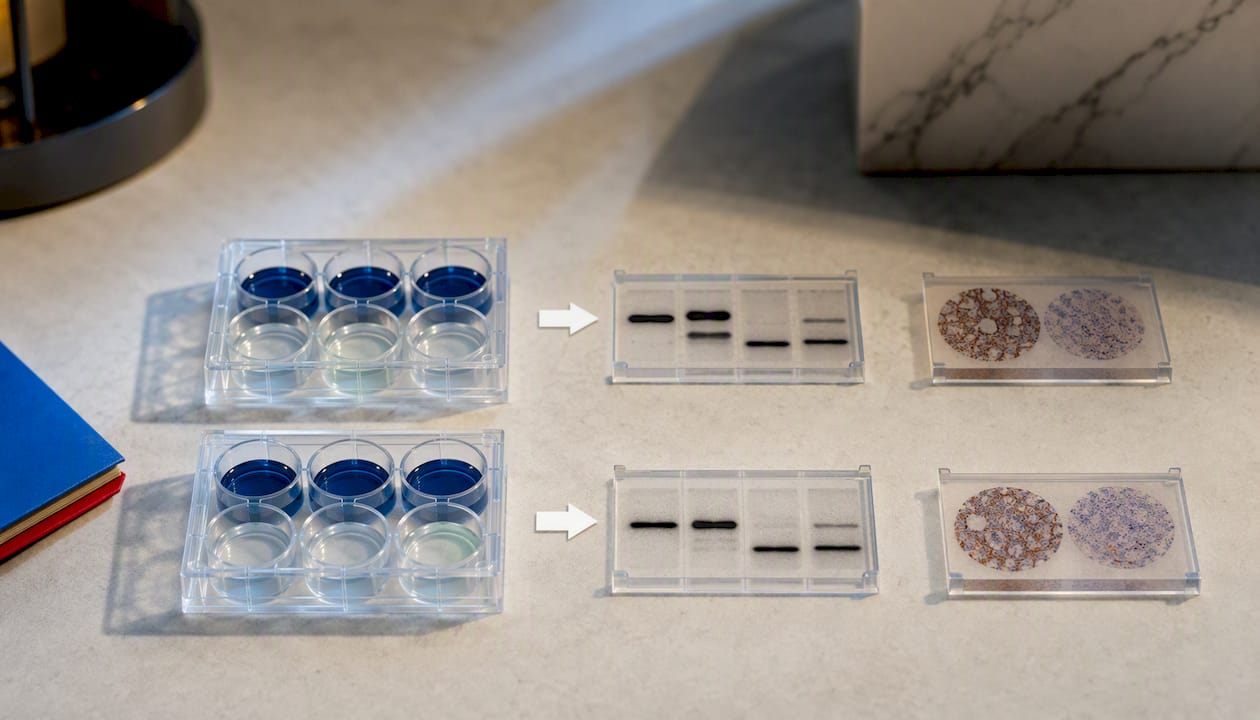
Knockout validation is increasingly treated as the gold standard for specificity because it provides a genuine negative control, something few other validation methods offer, according to a PMC review on KO-based validation and specificity. If an antibody still produces a band or signal in a cell line where the target gene has been deleted, that signal is off-target by definition.
A community consensus platform built around this principle, described in Nature Protocols, formalises how KO-based characterisation should be run across WB, IP, and IF. The protocol is designed so that mid-level graduate students can complete a single protein target’s characterisation in roughly a month, working part-time, which makes this kind of rigorous testing realistic for individual labs rather than only large consortia.
| Application | What KO validation confirms | Typical limitation |
|---|---|---|
| Western blot (WB) | Band disappears in KO lysate, confirming specificity at the expected molecular weight | Does not confirm performance in fixed tissue |
| Immunoprecipitation (IP) | Target is absent from KO pulldown, ruling out non-specific capture | Efficiency can vary by epitope accessibility |
| Immunofluorescence (IF) | Signal loss in KO cells confirms specificity in situ | Fixation and permeabilisation still need separate optimisation |
KO validation has limits. It confirms specificity in the cell system tested, not necessarily in your tissue type, fixation protocol, or species. When a target lacks a viable KO line, or when your application diverges sharply from the tested one, pair KO data with an orthogonal check such as peptide competition or a second antibody raised against a different epitope.
Pro Tip: When two candidate antibodies both carry KO validation, check which applications the KO data actually covers. A KO-validated WB antibody is not automatically KO-validated for IHC.
Step-by-step workflow to compare candidates and reach a procurement decision
A disciplined comparison workflow turns antibody selection from guesswork into a repeatable process, and it does not need to take longer than a careful literature search would anyway.
- Define success criteria first. Decide whether the assay needs high sensitivity, accurate quantification, or precise subcellular localisation, since each priority favours a different format.
- Collect provenance and validation records for every shortlisted candidate, including clone name, host, and any published KO or KD data.
- Rank KO-validated or sequence-defined recombinant antibodies above unvalidated clones, even if the unvalidated option is cheaper or more established in older literature.
- Request lot history or bridging data from the supplier, and plan a minimal in-house validation step, such as a single confirmatory blot against a known positive and negative sample.
- Reach a final decision: purchase directly, request a trial sample, or commission a validation service if no candidate meets your evidence bar.
Pre-analytical variables can undermine even a well-validated antibody, so confirm your sample preparation matches what the evidence was generated on. Guidance on choosing the right serum or plasma sample is a useful check before you blame the antibody for a failed result that actually traces back to sample handling.
Pro Tip: Build step 4 into your budget from the start. A £50 confirmatory blot is far cheaper than discovering a reagent failure three months into a funded study.
Laboratory pitfalls and why provenance saves time
Clone drift, mismatched conjugates, and application validation gaps are the failure modes that quietly drain lab budgets. A clone shared across suppliers can behave differently once hybridoma lineages diverge, as shown by studies comparing anti-Ki67 clones and hot-spot sizes with genuinely different results. When provenance is unclear or in-house validation stalls, escalate to a dedicated validation service rather than repeating the same failed experiment on faith.
— Veron
How ABMIUM supports evidence-based antibody selection
Choosing between antibody alternatives becomes far less risky when provenance and validation evidence sit alongside the product listing rather than buried in a separate PDF. ABMIUM’s catalogue of primary antibodies is built around visible manufacturer identity, so you can trace a clone’s origin before it reaches your bench, alongside ELISA kits, recombinant proteins, and PCR and RT-PCR kits sourced the same way.

When a target has no clean KO-validated option on the market, ABMIUM MATCH gives you scientist-led sourcing: submit your experimental requirements and get help comparing candidates against the evidence standards covered in this guide. For genuine evidence gaps, ABMIUM’s custom antibody and validation services can commission bespoke development or independent validation, including native mass spectrometry and spatial validation through specialist collaborators. Start by browsing the primary antibody catalogue for your target, or submit a request through ABMIUM MATCH if nothing on the shelf meets your validation bar.
Sources
- A consensus platform for antibody characterization | Nature Protocols
- The reproducibility cost of poor antibody validation
- Antibody validation and selection considerations (PMC review)
FAQ
What are the five types of antibodies?
The five immunoglobulin classes are IgG, IgA, IgM, IgD, and IgE, each with distinct structures and roles in immune response. Laboratory antibody reagents used for research applications are almost always derived from the IgG class, chosen for its stability and well-characterised structure.
What is the most common antibody used in research?
IgG is the most common antibody isotype used in laboratory reagents because of its stability, straightforward purification, and compatibility with most detection systems. Most catalogue primary and secondary antibodies, including those covering monoclonal and polyclonal antibody comparisons, are IgG-based.
What is the rule of three in antibody identification?
There is no single universal “rule of three” in antibody validation, and definitions vary depending on context. Some laboratories use a version requiring at least three independent lines of evidence (such as KO validation, an orthogonal antibody, and a functional assay) before accepting specificity as confirmed.
What diseases are linked to antibody problems?
Autoimmune conditions such as rheumatoid arthritis and lupus involve antibodies mistakenly targeting the body’s own tissues, while antibody deficiencies underlie conditions like common variable immunodeficiency. In the laboratory context, poorly validated antibodies are not linked to disease directly but to failed or misleading experimental results.
How much does ABMIUM’s antibody catalogue cost?
Pricing for individual antibodies, ELISA kits, and custom development services can be found directly on the ABMIUM website, as costs vary by target and format. Check the primary antibody catalogue for current listings.