

Store concentrated antibodies at 2 to 8°C for short-term use, up to several weeks, and move to minus 20°C or minus 80°C for anything longer. Aliquot the moment you receive a vial, before it ever sees a freezer, and check the datasheet for exceptions. Fluorophore and enzyme conjugates often break these rules entirely, so the label always overrides the general habit.
TL;DR:
- Short-term storage at 2 to 8°C is suitable for concentrated antibodies up to one month, but longer storage requires freezing at minus 20°C or below.
- Freezing diluted solutions damages the antibody structure, so aliquots should be prepared immediately upon receipt and thawed slowly on ice to minimize stress.
- Conjugated antibodies, especially fluorophore-labeled types, are best stored refrigerated protected from light rather than frozen, to preserve signal and stability.
- Glycerol stocks stored at minus 20°C are reliable for months, but glycerol should not be stored at minus 80°C due to unpredictable ice behavior.
- Proper freezer organization, clear labeling, and tracking freeze-thaw cycles help prevent antibody degradation caused by organizational or freezer cycle issues.
Table of Contents
- Antibody storage conditions by temperature: 4°C, minus 20°C or minus 80°C
- What glycerol, BSA and sodium azide actually do in storage buffer
- Aliquoting strategy: how to avoid freeze-thaw cycles for antibodies
- Storing conjugated and enzyme-linked antibodies: the exceptions that matter
- Long-term preservation: glycerol stocks, freezer type and lyophilisation
- Freezer placement and lab organisation that prevent avoidable losses
- Signs your antibody stock has degraded, and what to check
- Why verified sourcing and independent validation lower your storage risk
- A bench checklist worth pinning above the freezer
- Sources
- FAQ
Antibody storage conditions by temperature: 4°C, minus 20°C or minus 80°C
The temperature you choose depends on how soon you will use the antibody and how sensitive the format is to cold stress. Get this wrong and you will not see an obvious failure straight away. You will see a slow, quiet drift in signal strength that undermines a whole experiment series before anyone notices.
For short-term bench use, most concentrated antibodies tolerate 2 to 8°C storage for up to one month without meaningful loss of activity. This is the range for antibodies you are actively running through a project, not archiving.
Beyond short-term bench use, minus 20°C becomes the standard choice for long-term storage.
Minus 80°C is reserved for special cases:
- Precious or irreplaceable stocks where every microlitre matters
- Sensitive conjugates flagged as unstable at minus 20°C on the datasheet
- Antibodies you will not touch again for months
One rule has no exceptions worth mentioning: never freeze a diluted working solution. Water content in a dilute buffer forms damaging ice structures that a concentrated stock resists, and Bio-Rad’s storage guidance is explicit that diluted antibody should be treated as a same-day reagent, not a stock.
What glycerol, BSA and sodium azide actually do in storage buffer
Storage buffer additives are not filler. Each one solves a specific degradation problem, and each carries a compatibility cost somewhere downstream.
Glycerol is the workhorse cryoprotectant. The trade-off is contamination risk: glycerol-rich buffer supports microbial growth more readily than plain PBS, so filtration matters more, not less.
BSA (bovine serum albumin) reduces antibody loss through adsorption onto tube walls, a real problem at low concentrations. It becomes a liability the moment you are running a labelling reaction or a BSA-based blocking step, where the added protein competes and confuses your signal.
Sodium azide preserves antibody stocks by killing bacterial contamination, but it is a metabolic poison. It cannot go anywhere near live cell assays or enzyme-based detection chemistry.
- Glycerol: prevents ice damage, raises contamination risk
- BSA: reduces surface adsorption, interferes with labelling and some blocking protocols
- Sodium azide: preserves against microbial growth, toxic to live cells and incompatible with enzymatic assays
Pro Tip: Filter-sterilise glycerol-containing buffer through a low-protein-binding PES or PVDF filter before long-term storage. Standard filters strip out a meaningful fraction of your antibody along with the microbes.
Aliquoting strategy: how to avoid freeze-thaw cycles for antibodies
Every freeze-thaw cycle stresses antibody structure, and the damage compounds. The fix is procedural, not chemical: split your stock before it ever sees a freezer.
- Aliquot immediately on receipt, before the first freeze, into single-experiment volumes rather than splitting a stock later once it has already been through one cycle.
- Avoid volumes under 10 microlitres where practical. Labome’s guidance on antibody shelf life notes that very small aliquots are disproportionately vulnerable to evaporation and to adsorption onto tube walls, which quietly reduces your effective concentration.
- Use low-binding tubes for anything precious or dilute. Standard polypropylene tubes bind more antibody than low-adsorption polymer surfaces, particularly at low microgram concentrations.
- Thaw slowly on ice, never at room temperature or under warm water, and never refreeze a thawed aliquot.
- Pool aliquots with matched freeze-thaw history if you must combine stock, rather than mixing a fresh aliquot with one that has already been cycled twice.
Most unconjugated IgG tolerates a few freeze-thaw cycles without dramatic signal loss, but minimizing freeze-thaw cycles is recommended to preserve antibody quality.
Storing conjugated and enzyme-linked antibodies: the exceptions that matter
Everything above assumes an unconjugated antibody. Conjugates play by different rules, and applying the freezer defaults to them is one of the most common causes of dead signal in a fluorescence or ELISA workflow.
Fluorophore-conjugated antibodies are generally stored refrigerated at 2 to 8°C, protected from light rather than frozen. Freezing does not reliably damage the fluorophore, but the practical risk to conjugate stability and light exposure over repeated freeze-thaw makes refrigeration the safer default, according to Abcam’s storage and handling guidance.
Enzyme conjugates such as HRP or alkaline phosphatase are recommended to be stored refrigerated rather than frozen, since freezing may reduce enzymatic activity.
- Fluorescent conjugates: 2 to 8°C, foil-wrapped or amber tube, never frozen unless the datasheet says otherwise
- Enzyme conjugates (HRP, AP): refrigerated, not frozen, as the default
- New or unfamiliar conjugate formats: confirm stability data with the supplier before assuming general rules apply
When a datasheet contradicts general practice, the datasheet wins. Manufacturers test their specific formulation, and generic advice cannot account for every buffer variant.
Long-term preservation: glycerol stocks, freezer type and lyophilisation
Long-term preservation strategy depends on how valuable the stock is and how it will be used downstream. Frozen glycerol stocks at minus 20°C are the standard middle ground: fluid enough to avoid ice damage, stable enough for months of storage. Critically, glycerol stocks should not be pushed to minus 80°C, where glycerol concentration and ice behaviour interact unpredictably.
Freezer type matters more than most labs assume. Frost-free freezers cycle through periodic warming to clear ice buildup, which means samples near the door or front shelves experience repeated partial thaws without anyone opening the door. Store vials at the back or centre of a manual-defrost unit instead.
Lyophilisation suits antibodies destined for very long archival storage or shipping, using excipients such as sucrose or trehalose to protect structure during drying. Watch for Polysorbate 80 in reconstitution buffer, which can affect downstream assay compatibility.
- Glycerol stock at minus 20°C: routine long-term default, months of stability
- Lyophilised format: best for archival stocks or shipping stability
- Reserve minus 80°C for conjugates and stocks explicitly flagged as needing it
Freezer placement and lab organisation that prevent avoidable losses
Storage failures are as often organisational as chemical. A freezer that cycles warm, a mislabelled tube, or a vial left in the door pocket causes more antibody loss across a department than any buffer chemistry issue.
- Store antibody stocks on inner back shelves, away from the door, where temperature swings are smallest.
- Seal tubes properly and use secondary containment such as a labelled box, particularly for stocks shared across a team.
- Label every tube with lot number, date received, aliquot ID and a running freeze-thaw count.
- If a freezer defrosts unexpectedly, check contents immediately: refreeze quickly, note the incident against affected lots, and flag any precious stock for a fresh positive control before its next use.
Pro Tip: A simple laminated log taped to the freezer door, tracking freeze-thaw counts per aliquot ID, catches more degradation issues than any single storage rule. It turns an invisible variable into something you can actually see.
Signs your antibody stock has degraded, and what to check
Visual inspection catches some problems immediately. Turbidity, visible particulates or an unexpected colour shift are discard triggers on their own; do not run an experiment on a stock showing any of them.
Experimental quality control catches the rest. Run a fresh positive control alongside any stock older than a few months, and compare the signal against your historical baseline rather than assuming a weak band means a failed experiment elsewhere in the protocol.
- Cloudiness or visible aggregation: discard, do not attempt to filter and rescue
- Weakening signal against a known positive control: revalidate before continuing
- Ascites or serum-derived products degrade differently to purified IgG and often need more frequent QC checks
Roughly a third of failed immunoassays trace back to reagent-related issues rather than protocol error, which is exactly why keeping a record of lot numbers, freeze-thaw counts and QC results is the first line of defence when a result stops making sense. Without that log, tracing the failure back to a specific vial becomes guesswork after the fact.
Why verified sourcing and independent validation lower your storage risk
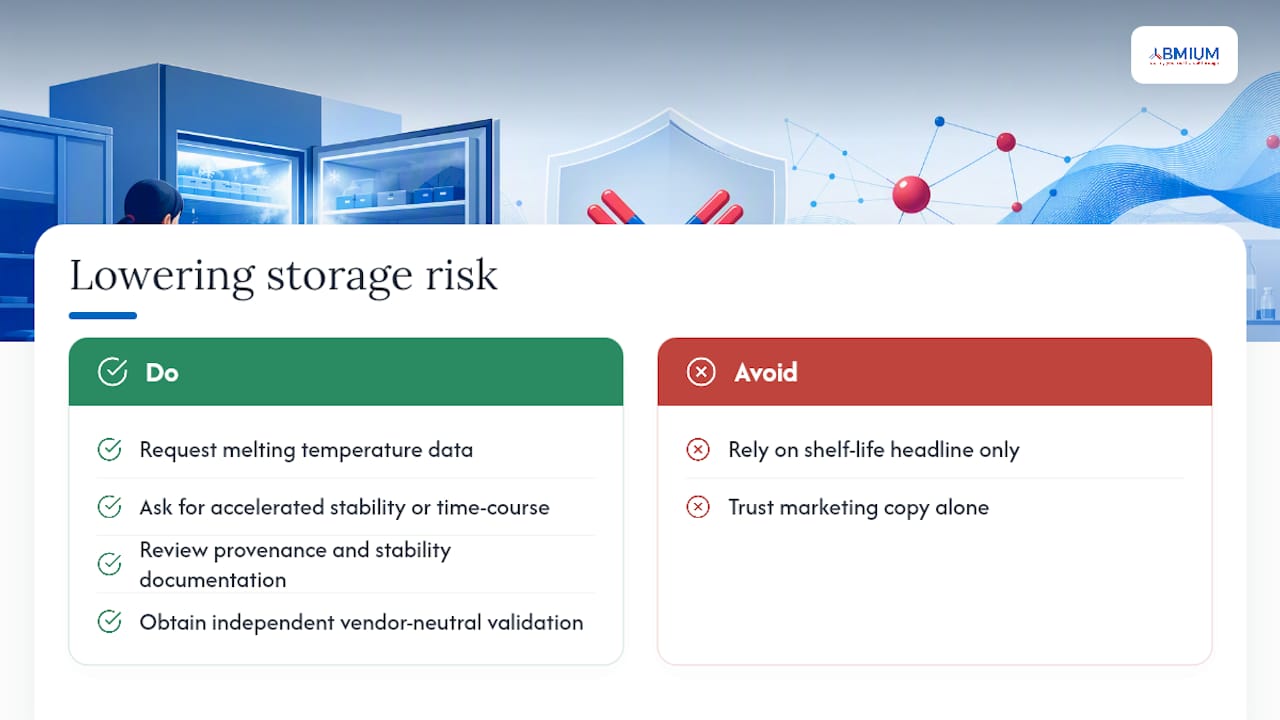
Storage discipline only protects an antibody that was reliable to begin with. Datasheet stability claims vary in how rigorously they were generated, and format details, excipient compatibility and real thermal tolerance are not always visible from marketing copy alone.
Thermal stability itself varies antibody to antibody, driven by variable domain structure, which is why supplier-provided melting temperature or stability time-course data is worth requesting before committing budget to a precious stock. Independent, vendor-neutral validation can surface storage vulnerabilities that a standard datasheet does not disclose, catching problems before they cost you a full experiment series. Before purchasing anything destined for long-term storage, ask the supplier directly for accelerated-stability data or a real time-course, not just a shelf-life headline figure. Reviewing how a manufacturer documents provenance and stability, as shown on product pages such as this primary antibody datasheet, gives a useful benchmark for what proper transparency looks like. For a broader look at how validation reduces wasted spend across biotech procurement generally, this field guide to de-risking lab assets covers similar ground from a procurement angle.
A bench checklist worth pinning above the freezer
Spin every new vial on receipt, read the datasheet before you touch a pipette, aliquot immediately, label clearly, and freeze at the temperature the supplier actually specifies. Keep working aliquots at 4°C only for the day’s use, run a positive control against anything older than a few months, and log every freeze-thaw cycle. Discard on suspicion, not just on proof.
— Veron
Sources
- Antibodies support—Getting started | Thermo Fisher Scientific
- Antibody purification and storage (CSH Protocols, 2019)
- Treat Them Right! – Best Practices for Storing and Working with Antibodies | Bio‑Rad
- Antibody storage and antibody shelf life — Labome
FAQ
What temperatures should antibody storage conditions follow?
Use 2 to 8°C for short-term storage of concentrated antibody, up to about a month, and minus 20°C or minus 80°C for longer periods, depending on the conjugate and datasheet.
How long can antibodies be left at room temperature?
Antibodies should not be left at room temperature beyond the time needed for handling, typically a few hours at most, since concentrated stocks are validated for 2 to 8°C or frozen storage rather than bench-top holding.
What is the “3 and 3” rule in antibody identification?
This term relates to transfusion medicine antibody screening protocols rather than laboratory reagent storage, and it does not describe a recognised antibody storage practice.
How long do antibodies stay active in the body?
This refers to biological immune antibodies circulating in blood, which persist for weeks to years depending on the antibody class, and is separate from laboratory reagent shelf life discussed here.
Where are antibodies found in blood?
Biological antibodies circulate in blood plasma, produced by B cells, which is distinct from purified antibody reagents supplied for laboratory use and covered by this storage guidance.
How many freeze-thaw cycles can an antibody tolerate?
Most unconjugated IgG tolerates a small number of freeze-thaw cycles without dramatic activity loss, but each cycle causes cumulative stress, so aliquotting to avoid repeated cycles is the safer default.
Ready to build a reagent workflow around reliable stability data instead of guesswork? Browse verified antibodies and validated reagents from ABMIUM, where provenance and independent validation are documented before you ever open the box.