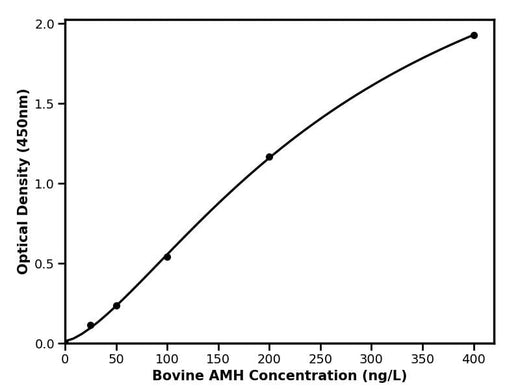
Bovine Anti Mullerian Hormone, AMH ELISA Kit
Know who made it. See the evidence. Buy through one marketplace.
Anti mullerian hormone (AMH) is a member of the TGF beta superfamily. It is secreted as a homodimeric 140kD disulphide linked precursor that is cleaved to release the mature 30kD homodimer. Originally classified as a foetal testicular hormone that inhibits Mullerian duct development, AMH is expressed post natally by immature Sertoli cells, and to a lesser degree by granulosa cells. AMH plays a role in testicular differentiation and in the regulation of ovarian follicle growth.
Fully tested in-house by ABMIUM, or supported by an advanced validation report from a partner reviewed by ABMIUM. Highest confidence. Non-conformities fully supported under the ABMIUM Product Promise.
Quality verified. Independent collaborator or expected-performance data available. Product meets ABMIUM quality standards.
Expected to work based on structural and biochemical data. Not yet directly tested by ABMIUM or a collaborator. No non-conformity support for this combination.
Not recommended for this application or species/sample combination. This may indicate either evidence of unsuitability or that the combination has not been tested and therefore cannot currently be recommended.
Evidence status by application and model.
| Evidence | Serum | Plasma | Urine | Ascites | Cerebrospinal fluid | Tissue | Cell culture supernatants | Tissue homogenates |
|---|---|---|---|---|---|---|---|---|
| Compatibility |
This product is manufactured by BT LAB and sold through ABMIUM without relabelling.
ABMIUM supports global orders. Availability, shipping requirements and applicable import arrangements are confirmed before fulfilment where required.
Yes. Send your target, sample, application and experimental conditions through ABMIUM MATCH or technical support.
Unless the listing expressly states otherwise, ABMIUM products are supplied for research use only and are not for diagnostic or therapeutic use.
AMH (anti-Mullerian hormone; anti-Muellerian hormone) is a secreted TGF-beta-superfamily ligand also known as Mullerian-inhibiting substance (MIS). It signals through AMHR2 and downstream SMAD pathways in reproductive development and gonadal biology.
Biological function: AMH is synthesized as a preproprotein and proteolytically processed into an active ligand complex. It binds the type-II receptor AMHR2, which recruits type-I receptors including ACVR1 and BMPR1A to activate SMAD signalling. During male fetal development this pathway drives Mullerian duct regression; AMH also contributes to Leydig-cell and ovarian follicle biology.