

Low bind tubes are microcentrifuge tubes engineered with a hydrophilic surface treatment that stops proteins and nucleic acids sticking to the plastic, and they earn their place whenever a sample is precious, dilute, or destined for a sensitive downstream assay. Use them for low‑yield protein work, proteomics, nucleic acid extraction, and single‑cell or trace‑level assays. Before buying, verify the material grade and purity claims, the centrifugation rating, and the cap seal, because vendor marketing on these three points varies more than most researchers assume.
TL;DR:
- Genuine low-bind tubes use a surface modification that survives autoclaving and repeated centrifugation, offering significant recovery improvements over standard polypropylene.
- Verifiable material quality, lot certification, and a reliable centrifugation rating are essential, as many vendor claims lack independent proof.
- Pre-wetting, limiting transfers, and aliquoting samples reduce adsorption and preserve protein or nucleic acid recovery during handling and storage.
- Choose small packs for high-value, low-yield samples to mitigate contamination risks, or bulk for routine, high-throughput workflows.
- Running a simple recovery test with known standards before large orders can identify performance gaps not shown in datasheets.
Table of Contents
- What are low bind tubes and how do they differ from standard tubes?
- What specifications should you check before buying low bind tubes?
- How do you choose the right low bind tube for your experiment?
- How should you handle and store low bind tubes to preserve recovery?
- ABMIUM’s perspective: verified sourcing and independent validation for critical workflows
- Selected primary literature and standards
- Why vendor claims deserve more scepticism than they get
- Get verified reagents and validation support from ABMIUM
- Sources
- FAQ
What are low bind tubes and how do they differ from standard tubes?
Standard polypropylene tubes already outperform glass or lower‑grade plastics on non‑specific binding, but they still let a measurable fraction of protein or nucleic acid stick to the inner wall. That loss is invisible until you’re staring at a failed qPCR curve or a Western blot with a faint band that should be strong. Engineered low‑bind surfaces reduce this adsorption through hydrophilic polymer technologies built into the polymer itself, not sprayed on as a coating that can wear off or leach during a freeze thaw cycle.
The manufacturing approach matters more than the marketing copy suggests. A genuine low retention tube uses a polymer blend or surface modification applied during moulding, which is why the effect survives autoclaving and repeated centrifugation, unlike a surface coating that degrades with use.
The recovery gap this closes is not trivial. Application notes and comparative reviews report substantial improvements in nucleic acid and protein recovery when switching to low‑retention tubes, particularly for dilute samples used in NGS library preparation and proteomics workflows. Situations where the difference becomes material include:
- Quantifying a single‑cell or FACS‑sorted RNA extract where every nanogram counts
- Storing a dilute antibody or enzyme standard for repeated freeze thaw use
- Running serial dilutions for a calibration curve where wall adsorption skews the low end
- Handling trace‑level environmental or forensic DNA samples
What specifications should you check before buying low bind tubes?
Vendor claims on low bind tubes are not uniformly verifiable, so treat the following as a checklist rather than a marketing summary.
- Material grade and purity. Look for explicit statements of medical‑grade polypropylene, PCR clean status, and RNase/DNase free certification rather than a generic “certified” label with no method disclosed.
- Centrifugation rating. Confirm the RCF (×g) limit the tube is rated to, and check the temperature range covers both your freezer storage (down to minus 80°C) and any autoclave step you plan to run.
- Cap style and seal performance. Snap caps, screw caps, and hinged caps differ in leak resistance and evaporation control during long‑term minus 20°C or minus 80°C storage; a poor seal defeats the point of a low‑bind surface if the sample dries out.
- Lot testing and certificates of analysis. Reputable manufacturers apply lot testing and PCR‑clean certification as standard manufacturing controls, and you should be able to request the certificate for the specific lot you’re buying, not a generic product datasheet.
- Pack size and pricing. Smaller packs cost more per tube but reduce the risk of contamination across an open box sitting on a bench for months; bulk packs make sense only for high‑throughput, low‑risk applications.
None of these specifications are exotic. What separates a genuinely low‑bind tube from a rebadged standard one is whether the vendor will actually produce the paperwork behind claim number four.
How do you choose the right low bind tube for your experiment?
The right tube depends on what you’re protecting. For nucleic acid work, prioritise RNase/DNase‑free certification and a cap that seals reliably through repeated freeze thaw cycles, since degradation risk usually outweighs marginal adsorption differences once concentration is above a few nanograms per microlitre. For protein and enzyme assays, the hydrophilic surface matters more, because proteins denature and stick via hydrophobic interactions that nucleic acids don’t share, and recovery gains here depend heavily on the specific protein and buffer composition in use.
Cost versus performance trade-offs come down to how you buy, not just what you buy:
- Buy small packs for irregular, high‑value samples where contamination risk from a half‑used box outweighs the per‑unit saving
- Buy bulk only for routine, high‑throughput protocols where consistency across a validated batch matters more than flexibility
- Treat a missing certificate of analysis or vague “low bind” claim with no stated mechanism as a red flag, not a minor omission
- Ask specifically whether the low‑bind property is a bulk polymer property or a surface coating, since coatings degrade with repeated use
Pro Tip: Run a simple recovery check before committing to a bulk order: serially dilute a known protein or nucleic acid standard, store it under your actual protocol conditions for the same duration you’d use in a real experiment, then quantify recovery against a fresh standard. Methodology papers recommend exactly this kind of short pilot test precisely because it catches gaps that vendor datasheets don’t show.
How should you handle and store low bind tubes to preserve recovery?
Buying the right tube solves only part of the adsorption problem. Technique accounts for a meaningful share of sample loss, and it costs nothing to fix.
- Pre‑wet tips and tubes before transfer. Pipetting a low‑concentration sample into a dry low‑bind tube still allows some adsorption during the first contact; pre‑wetting with buffer reduces this.
- Minimise surface contact during transfer. Pair low‑bind tubes with low‑binding pipette tips, and avoid unnecessary transfers between vessels, since each transfer is another adsorption opportunity.
- Manage freeze thaw cycles deliberately. Aliquot samples into single‑use volumes where possible rather than repeatedly freezing and thawing the same stock, particularly for proteins sensitive to repeated denaturation.
- Choose single‑use tubes for sterility‑critical work. Autoclaving is possible with most polypropylene low‑bind tubes within their stated temperature range, but repeated autoclave cycles can degrade surface properties over time, so single‑use is preferable for the most sensitive assays.
- Run a basic in‑house recovery check periodically. Include a known‑concentration control alongside your experimental samples and quantify it against a fresh reference, rather than assuming a previously validated tube batch performs identically to a new one.
ABMIUM’s perspective: verified sourcing and independent validation for critical workflows
Choosing the right tube is only half the equation. The reagents, antibodies, and standards you run through that tube carry the same provenance risk, and ABMIUM built its catalogue around addressing exactly that gap. Its approach centres on:
- Verified sourcing that traces reagent provenance before it reaches your bench
- Pre‑purchase validation so you’re not discovering performance gaps mid‑experiment
- Independent validation services for labs that need reproducibility confirmed beyond a manufacturer’s own datasheet
- Scientific support that helps compare product options rather than relying on marketing claims alone
For low‑yield assays, where a tube’s adsorption properties can mean the difference between a usable result and a failed run, the same scrutiny applied to a low‑bind tube’s certificate of analysis should apply to the antibody or protein marker you use to confirm recovery. A calibrated protein marker run alongside your low‑bind tube trial gives you a verifiable reference point rather than a guess.
Selected primary literature and standards
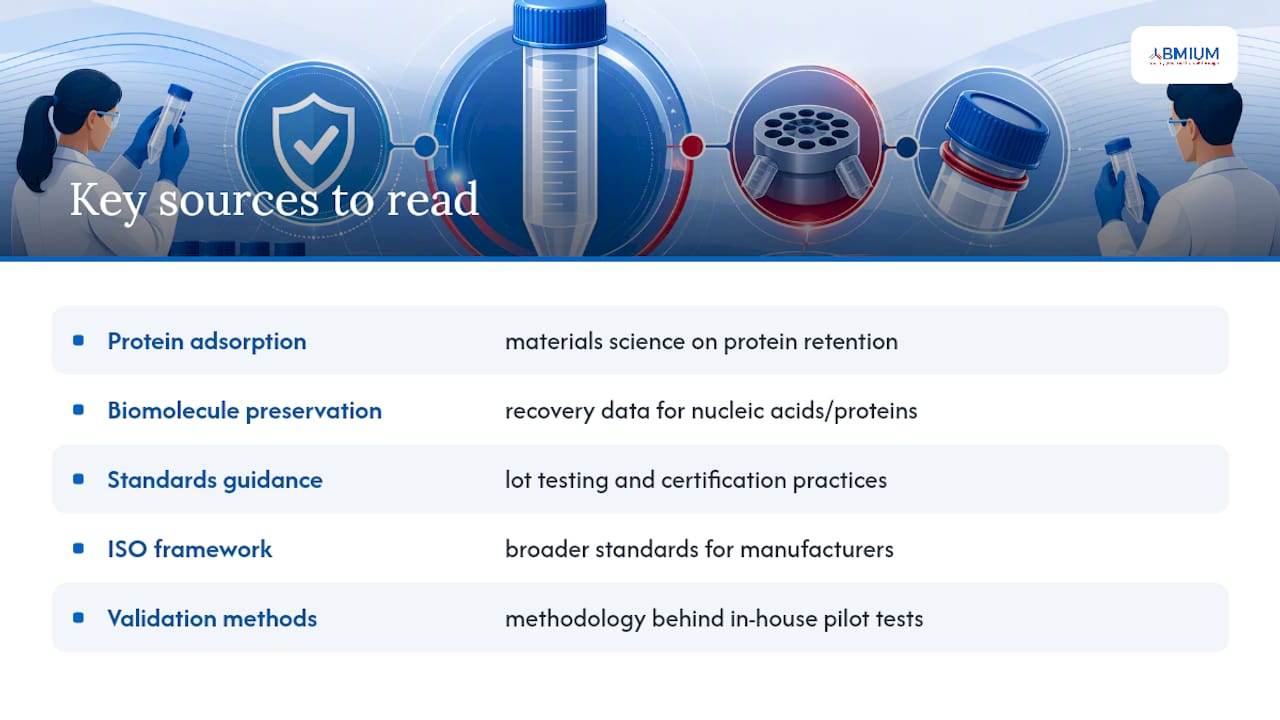
The guidance above draws on a small set of sources worth reading directly if you want to verify a specific claim rather than take it on trust. The PMC review on protein adsorption to surfaces covers the material science behind why standard polypropylene still retains protein and how hydrophilic modifications reduce it. The review on preservation of biomolecules supplies the recovery data behind claims about nucleic acid and protein performance gains. Standards guidance on laboratory consumables explains the lot testing and certification practices worth asking vendors about, and ISO provides the broader standards framework consumable manufacturers work against. The methodology paper on validation checks is the source behind the in‑house pilot test recommended above.
Why vendor claims deserve more scepticism than they get
The conventional advice on low bind tubes treats the label as a guarantee rather than a starting point, and that’s the biggest gap between what the marketing promises and what actually protects your sample. A tube stamped “low bind” without a disclosed mechanism, without lot certification, and without a stated centrifugation rating is a claim, not a specification.
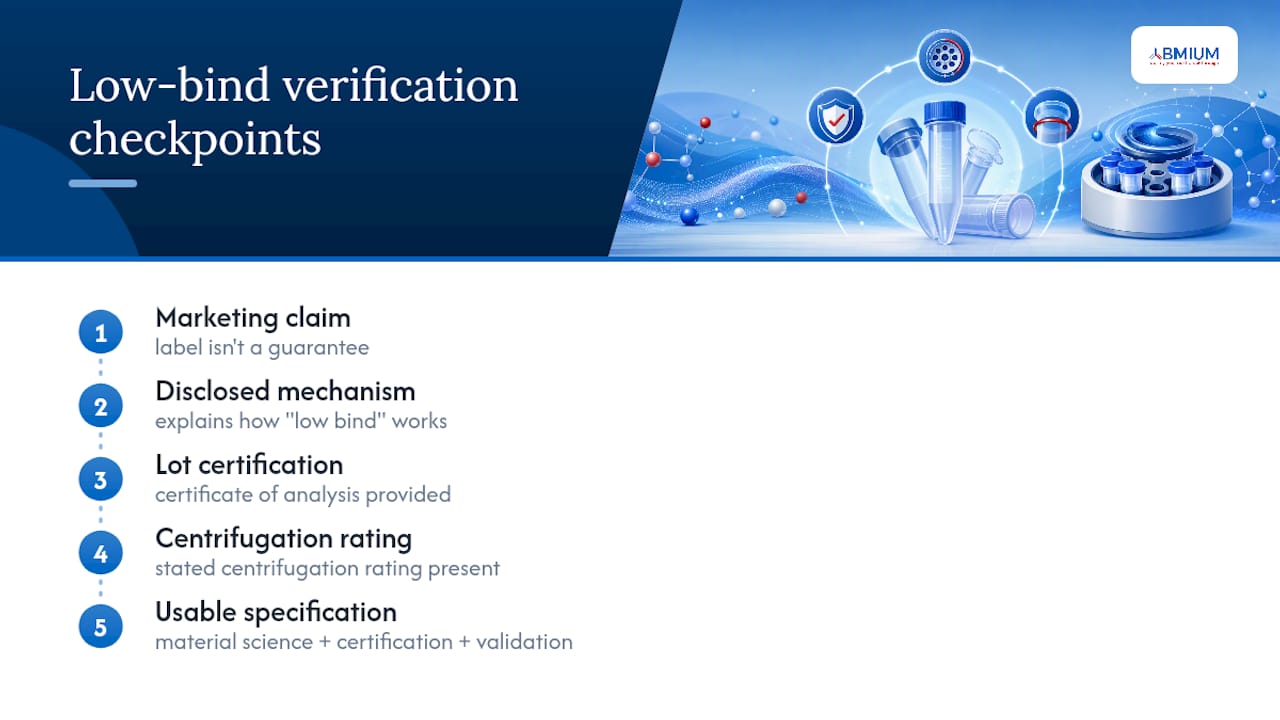
What the evidence actually supports is a hierarchy: material science first, verifiable certification second, and in‑house validation third. Skip the third step and you’re trusting a datasheet written by the same company selling you the product. That’s not a criticism of every manufacturer, but it is a reason to run the cheap pilot test described above before committing to a bulk order, particularly for proteomics or trace nucleic acid work where the cost of a failed run dwarfs the cost of a validation batch.
If there’s one habit worth adopting from this whole guide, it’s asking for the certificate of analysis before asking about the price. Everything else, the cap style, the pack size, the per‑unit cost, matters less than whether the manufacturer can actually prove the claim on the box.
— Veron
Get verified reagents and validation support from ABMIUM
Abmium is the resource to turn to once your low‑bind tube choice is sorted and you need the reagents running through it to carry the same level of scrutiny. Rather than gambling on a manufacturer’s unverified performance claims, Abmium reviews antibody and reagent provenance before you buy, and offers independent validation services for labs that need reproducibility confirmed rather than assumed.

That matters most in the exact workflows this guide has covered: low‑yield protein assays, proteomics, and nucleic acid work where a single unreliable reagent can undo the benefit of an otherwise well‑chosen tube. The catalogue includes primary and secondary antibodies, ELISA kits, and calibrated protein markers you can run as recovery controls alongside your low‑bind tube trials. If you’re setting up a validation batch or sourcing reagents for a sensitive low‑yield protocol, browse the Abmium catalogue and request pre‑purchase validation on the specific reagent you’re considering before it reaches your bench.
Sources
- Protein adsorption to surfaces and its effects on biosensors and solid‑phase assays — PMC3290000
- Review on best practices for preservation of biomolecules — PMC10246705
- Standards and best practice for laboratory consumables — PMC7768044
- Methodology papers recommending validation checks — DOI:10.3389/fnins.2020.602235
FAQ
What is a low binding tube?
A low binding tube, also called a low retention tube, is a microcentrifuge tube manufactured with a hydrophilic polymer surface that reduces protein and nucleic acid adsorption compared with standard polypropylene tubes.
When should you use a LoBind tube?
Use a low‑bind tube for low‑yield protein or nucleic acid work, proteomics, NGS library preparation, and any assay where sample concentration is low enough that wall adsorption would meaningfully affect recovery.
What is another name for a microcentrifuge tube?
Microcentrifuge tubes are also called Eppendorf tubes (after a common manufacturer), snap‑cap tubes, or safe‑lock tubes, depending on the cap style; low bind versions are sometimes marketed as low retention tubes or low protein binding tubes.
Are polypropylene tubes low protein binding?
Standard polypropylene tubes bind less protein than glass or lower‑grade plastics, but they still retain a measurable amount; engineered low‑bind tubes use hydrophilic surface modifications to reduce that retention further, which is the distinction that separates a true low‑bind tube from a standard one.
Can you autoclave low bind tubes?
Most low bind tubes tolerate autoclaving within their stated temperature range, but repeated autoclave cycles can degrade the surface treatment over time, so single‑use tubes are preferable for the most sensitive, low‑yield applications.