

For drug discovery or high precision research where standard kits fall short, commissioning a specialist custom assay development service is the fastest route to a validated, reproducible assay. The provider handles design, optimisation, and validation, then hands over full documentation so the assay runs reliably in your lab. Custom assay development services are a practical starting point if you need a supplier to contact directly.
TL;DR:
- Custom assay development can typically deliver validation data, SOPs, reagent provenance, and acceptance criteria, ensuring reliable reproducibility in your lab.
- The development timeline ranges from a few weeks for simple biochemical assays to several months for complex cell-based or automation-ready formats, depending on complexity.
- Validation metrics such as Z’ factor above 0.4, CV below 10%, and appropriate LOD/LOQ are essential for assay robustness and screening readiness.
- Choosing a provider requires verifying experience with your assay type, documented validation, reagent sourcing reliability, and clear IP and data ownership terms.
- Costs depend heavily on assay complexity, validation standards, reagent development, and project timelines, with phased quotes facilitating scope negotiation.
Table of Contents
- What custom assay development services actually deliver
- How long does assay development take, from consultation to handover?
- Which assay format and detection method fits your question?
- What validation metrics and documentation should you require?
- How do you choose a custom assay development provider?
- How ABMIUM supports reproducible custom assay projects
- What does custom assay development typically cost?
- Author perspective: when a custom service speeds discovery
- Request a feasibility assessment with ABMIUM
- Sources
- FAQ
What custom assay development services actually deliver
A commissioned assay project should end with more than a working protocol. Expect a defined package: the assay protocol itself, standard operating procedures (SOPs), raw and processed validation data, documented reagent provenance, recommended controls, and clear acceptance criteria for every batch you run afterwards. Without those documents, you own a black box rather than a reproducible method.
Custom assay development covers a wide range of scientific problems, not just novel assay creation from scratch. Providers regularly modify or convert existing formats, such as tuning an ELISA’s sensitivity range or adapting a catalogue assay for a new sample matrix, rather than building something entirely new each time, as Revvity’s assay development services illustrate. Assays themselves fall into two broad families: biochemical assays for hit finding and binding studies, and cell based assays for evaluating toxicity, safety, and physiological efficacy, a distinction that shapes almost every downstream design choice, according to Technology Networks.
Typical use cases where commissioning a specialist makes sense include:
- Hit confirmation assays following a primary screen, where false positives need ruling out quickly.
- Target engagement or potency assays supporting lead optimisation decisions.
- Biomarker quantification across clinical or preclinical sample sets.
- Converting an existing ELISA to a new sample type or throughput format.
- Cell based phenotypic assays where readouts depend on intact biology rather than isolated protein.
The decision to outsource usually comes down to three practical pressures: internal timelines that cannot absorb months of trial and error, a scale of testing that exceeds in house capacity, and a reproducibility bar set by regulatory submission or multi site studies that demands documented validation from day one.
How long does assay development take, from consultation to handover?
Assay development follows a fairly consistent staged workflow, whether the target is a simple enzymatic readout or a complex cell based screen. Providers typically use a structured, iterative process built around consultation, feasibility testing, optimisation, and validation, with customers expected to supply clear goals and reference material early on, as described by The Rockefeller University’s guidance on developing a robust assay.
- Consultation. You define the target, the biological question, and the acceptance criteria the finished assay must meet.
- Feasibility assessment. The provider tests whether the proposed format and detection method can generate signal above background using your reference material.
- Reagent screening and titration. Candidate antibodies, substrates, or detection reagents are screened and titrated to find working concentrations.
- Optimisation. Conditions are refined to reduce variability, often the longest phase, since robustness testing and reducing noise typically consume more time than the original design concept, per the NIH Assay Guidance Manual.
- Pilot validation. A small scale run checks the assay against real samples before committing to full validation.
- Full validation and handover. Z’ factor, coefficient of variation, and other performance metrics are formally recorded, and you receive the complete documentation package.
Timelines vary sharply with complexity. A straightforward biochemical assay using established detection chemistry can often be feasibility tested and optimised within a few weeks. A complex cell based or high throughput screening ready assay, particularly one requiring automation compatibility, more commonly takes several months from consultation to handover. The single biggest lever you control over lead time is how quickly you can supply target definition, reference standards, and acceptance criteria at the outset. Vague or incomplete input at the consultation stage is the most common cause of schedule slippage later.
Which assay format and detection method fits your question?
Choosing between biochemical, cell based, and molecular formats depends on what you actually need to measure. A biochemical assay isolates a specific molecular interaction, useful for binding studies and early hit finding where speed and simplicity matter. A cell based assay preserves cellular context, essential when you need to capture toxicity, signalling, or physiological efficacy that an isolated protein cannot reveal. Molecular assays, such as qPCR based readouts, suit quantification of nucleic acid targets or gene expression changes tied to a biological endpoint.
Detection technology follows from that choice:
- Luminescence offers high sensitivity and low background, well suited to enzyme activity and reporter gene assays.
- Fluorescence and TR-FRET work well for binding and displacement assays, though autofluorescent compounds can interfere.
- ELISA remains the standard for quantifying soluble analytes in complex matrices like serum or plasma.
- qPCR is the default for nucleic acid quantification and remains highly reproducible when primers and controls are well validated.
- Mass spectrometry offers unmatched specificity for small molecule or peptide quantification but demands more sample preparation and specialised instrumentation.
Practical constraints often decide the final format faster than scientific preference does. Sample volume limits, chemical or matrix interference, required throughput, and whether the assay eventually needs automation compatibility all narrow the options. Design choices around plate format and detection method should mirror the conditions of the final screening environment from the earliest feasibility stage, since retrofitting an assay for automation after the fact is one of the more expensive mistakes in the field, a point The Rockefeller University makes explicitly. Fundamentals of assay design guidance from News-Medical reinforces that specificity, sensitivity, dynamic range, and reproducibility need consideration across the whole workflow, from sample collection through to final data analysis, not just at the detection step.
What validation metrics and documentation should you require?
Fit for purpose validation rests on a handful of measurable criteria rather than a general impression that the assay “works”. The Z’ factor is the standard measure of assay quality for screening, calculated from the separation between positive and negative control signals relative to their variability.
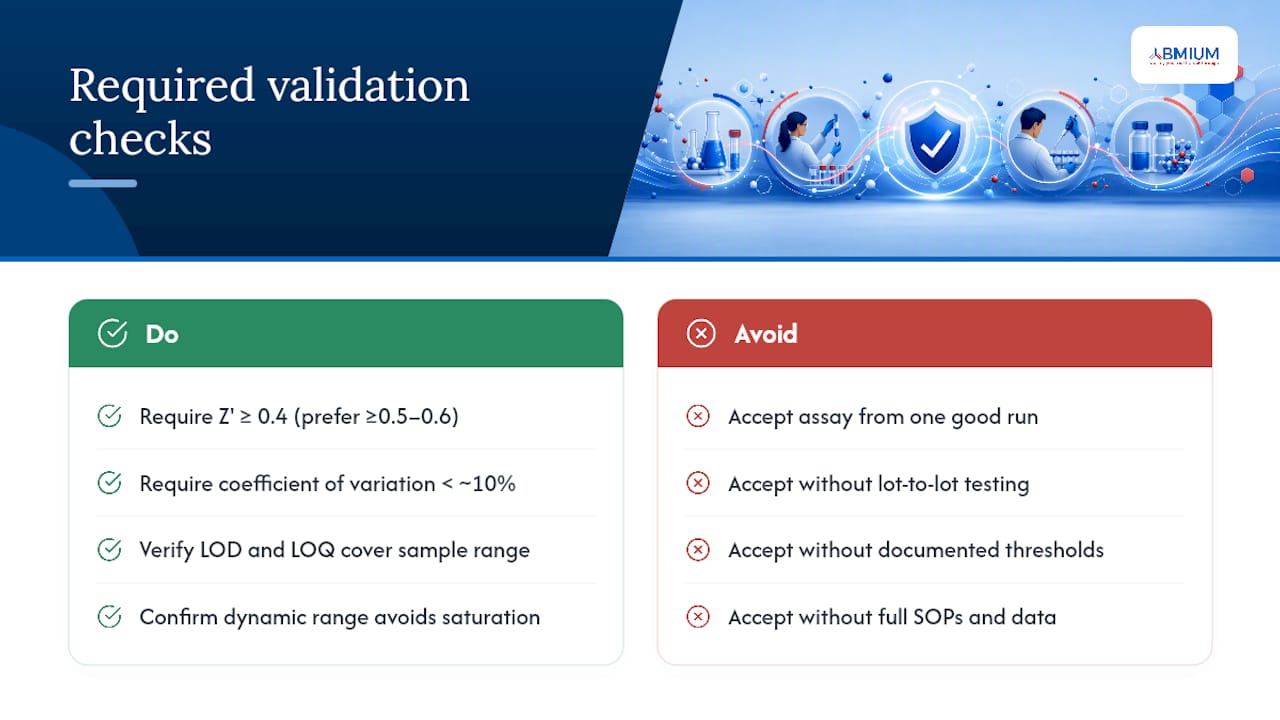
Benchmark to know: a Z’ factor above 0.4, with some labs preferring above 0.5 to 0.6, alongside a coefficient of variation below roughly 10%, is commonly cited as the threshold for a screening ready assay.
Alongside Z’, check limit of detection (LOD) and limit of quantification (LOQ) against the concentration range your samples actually occupy, and confirm the dynamic range covers your expected biological variation without saturating. Specificity, whether the assay reliably distinguishes your target from related molecules, matters just as much as sensitivity, particularly for antibody based formats.
Robustness checks separate a genuinely validated assay from one that merely performed well once. Controls, orthogonal confirmation assays, reagent titrations, and testing across multiple reagent lots all reveal whether performance holds under real world conditions, since liquid handling and environmental variation are among the most frequent sources of assay drift, as the NIH Assay Guidance Manual notes.
Before accepting handover, demand: full SOPs, raw and processed validation data, documented reagent provenance, and stated acceptance thresholds for every metric above.
How do you choose a custom assay development provider?
Evaluating a provider is less about their marketing claims and more about what they can actually document. Verify these points before signing anything:
- Platform fit: do they have direct experience with your specific assay format and detection technology, not just an adjacent one?
- Documented validation: will they share raw data and Z’ or CV figures, not just a summary report?
- Reagent sourcing and lot control: can they name reagent suppliers and commit to lot consistency across the project?
- Data ownership and IP terms: who owns the resulting protocol, data, and any novel reagents developed along the way?
On the feasibility call, ask direct technical questions: how do they handle assay drift across reagent lots, what orthogonal method would they use to confirm an unexpected result, and what happens if feasibility testing fails to hit agreed criteria. Vague answers to any of these are a warning sign.
Pro Tip: Ask a prospective provider to share one anonymised validation report from a previous project before you commit. A provider confident in their process will show you the raw data, not just the summary graph.
Red flags include reluctance to specify acceptance criteria upfront, no clear timeline for feasibility testing, and contracts that omit a defined handover package.
How ABMIUM supports reproducible custom assay projects
A leading approach to custom assay development rests on the principle that provenance and validation come before the sale. Some providers offer verified antibody sourcing, pre purchase validation, and independent reagent validation services, which matters directly for assay work because reagent lot inconsistency is one of the more common, and least visible, causes of failed longitudinal studies.
Catalogue items that support custom assay projects include validated primary antibodies such as the Anti-SA Antibody 15E6, and detection components such as the Polymer-HRP anti-mouse/rabbit IHC detection system, each with documented provenance rather than a generic specification sheet. Practical benefits of this approach include:
- Fewer wasted reagent purchases from unclear or unverifiable sourcing.
- Reduced mid project variance when reagent lots are locked down early.
- Independent validation data available before you commit budget to a full study.
What does custom assay development typically cost?
Pricing for custom assay development rarely follows a single fixed rate, because the variables that drive cost, complexity, format, and validation depth differ enormously between projects. Most providers price around three components: feasibility assessment, optimisation and validation work, and final documentation and handover. A simple biochemical assay with an established detection method sits at the lower end of most fee structures, since feasibility and optimisation typically move quickly. A cell based or high throughput screening ready assay costs substantially more, reflecting the additional optimisation cycles, robustness testing, and automation compatibility work involved.
Several factors push cost up regardless of assay type. Novel reagent development, rather than sourcing an existing validated reagent, adds both time and expense. Requiring full validation to a regulatory grade standard, with documented Z’, CV, and reproducibility data across multiple reagent lots, costs more than a research grade validation aimed at internal use only. Tight timelines that compress feasibility and optimisation into fewer weeks often carry a premium, since providers may need to run parallel workstreams rather than sequential ones.
Ask any provider for a cost breakdown by phase rather than a single lump figure. This lets you see where your budget is actually going, and it makes it easier to negotiate scope, for example, descoping full regulatory validation to a lighter research grade package if your project does not need it yet. Be wary of quotes that bundle feasibility, optimisation, and validation into one number with no phase level detail. That structure makes it hard to know what happens, financially, if feasibility testing reveals the original approach will not work.
Author perspective: when a custom service speeds discovery
Commissioning a specialist pays off fastest when internal timelines cannot absorb repeated optimisation cycles, or when a study’s reproducibility bar demands documented validation from the outset. Done well, it shortens the path from target hypothesis to a screening ready, defensible assay.
— Veron
Request a feasibility assessment with ABMIUM
Certain suppliers give researchers a practical route to a validated, reproducible assay without the guesswork of sourcing reagents from unverified suppliers mid project. Custom antibody and assay development work can sit alongside pre purchase validation and independent reagent validation services, so provenance and performance data exist before committing to a full study.

Browse the ABMIUM catalogue to see examples of validated reagents already documented for provenance, including products such as the Anti-Human CD135 Antibody BV10(BV10A4), which illustrates the level of documentation you should expect from any reagent feeding into a custom assay. If your project needs a bespoke design, optimisation, and validation package, contact ABMIUM to request a feasibility call and get a phased cost breakdown before committing budget.
Sources
- Assay Development: Best Practices in Drug Discovery | Technology Networks
- Developing a Robust Assay | The Rockefeller University
- Assay guidance manual | NCBI Bookshelf (NIH)
- Fundamentals of assay design and development | News‑Medical
FAQ
What does assay development mean?
Assay development is the process of designing, optimising, and validating a test that measures a specific biological or biochemical target, so the result is reproducible across runs and, where needed, across laboratories.
What does an assay actually measure?
An assay measures the presence, amount, or activity of a specific analyte, such as a protein, small molecule, or nucleic acid, and is central to assessing efficacy, toxicity, and target engagement in drug discovery.
What are the different types of assays?
Assays are broadly grouped into biochemical assays, used for hit finding and binding studies, and cell based assays, used to evaluate toxicity, safety, and physiological efficacy; molecular assays such as qPCR add a further category for nucleic acid quantification.
How much does custom assay development cost?
Costs vary by assay complexity and validation depth, with pricing typically broken into feasibility, optimisation and validation, and handover phases rather than a single flat fee.
Who should I contact for custom assay development?
Some providers offer custom antibody and assay development alongside independent reagent validation, which can be a practical first point of contact for researchers needing a tailored, validated assay.