

The safest route to replace a Bio-Rad product is a consultative specialist supplier that pairs validated catalogue reagents with scientist-led sourcing, such as ABMIUM’s ABMIUM MATCH™ service. Validation evidence and format compatibility matter more than brand loyalty when swapping suppliers. Before ordering anything, work through the supplier checklist below to confirm the replacement will actually perform in your protocol.
TL;DR:
- Validation evidence, including independent testing and batch-specific data, is crucial for confirming the performance of any Bio-Rad alternative.
- Compatibility with existing protocols, instruments, and reagent formats must be verified before switching to avoid assay failures.
- Prioritize supplier transparency, including clear provenance, lead times, and availability, to prevent disruptions during procurement.
- Running side-by-side pilot tests with defined acceptance criteria helps ensure reliable validation before full implementation.
- Specialist suppliers like ABMIUM provide scientist-led sourcing, custom development, and validation services that reduce the risk of unproven replacements.
Table of Contents
- What is the best way to find Bio-Rad alternatives?
- How do you choose an alternative supplier or product?
- What types of Bio-Rad substitutes exist?
- What is the checklist for replacing a discontinued Bio-Rad product?
- Why ABMIUM is a practical Bio-Rad equivalent supplier
- How do you run a controlled supplier switch?
- The trade-off procurement teams underestimate
- Sourcing your replacement reagents through ABMIUM
- Where to verify this guidance
- Sources
- FAQ
What is the best way to find Bio-Rad alternatives?
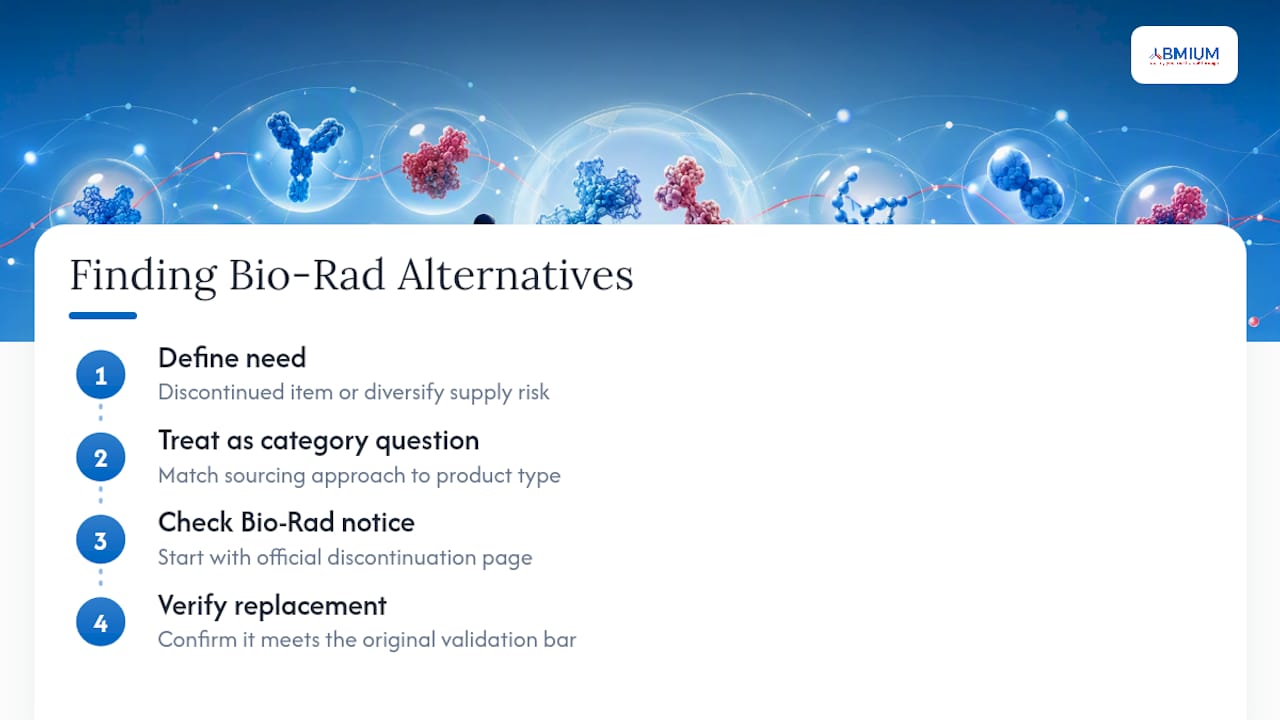
Researchers searching for Bio-Rad alternatives are usually solving one of two problems: a product has been discontinued, or procurement wants to diversify supply risk. Either way, the answer is not “pick a bigger competitor” but “pick a supplier that can prove the replacement works in your hands.”
Bio-Rad itself sits among a crowded field of diversified life-science suppliers. Owler’s competitor analysis places Thermo Fisher Scientific, BD and Roche among its closest rivals, reflecting a market where large, full-line vendors compete alongside dozens of specialist manufacturers. That breadth is exactly why “alternatives” should be treated as a category question, not a single-brand swap. A qPCR master mix substitute, a discontinued electrophoresis cassette, and a monoclonal antibody clone each demand a different sourcing approach.
Bio-Rad publishes official discontinuation pages that recommend direct replacements and advise contacting the local sales office for regional availability. That page is the correct first stop for any discontinued catalogue number. From there, the real work is verifying that whatever replacement you choose, whether from Bio-Rad’s own suggested list or a third party, meets the same validation bar the original product cleared. That verification step is where most switching projects either succeed quietly or fail expensively.
How do you choose an alternative supplier or product?
Choosing a replacement supplier is a compatibility exercise first and a price negotiation second. Get the technical fit wrong and no discount recovers the cost of repeated failed runs.
Compatibility with current protocols and instrument formats. Confirm buffer volumes, cassette dimensions, plate formats and detection chemistry match your existing workflow before you buy anything. A gel electrophoresis consumable that is a millimetre out on tray size, or an ELISA kit built around a different capture antibody pair, can quietly derail an entire assay.
Validation evidence. Ask for a Certificate of Analysis, batch-specific data, and ideally independent validation showing protocol comparability against the product you are replacing. Procurement teams that prioritise sample-prep and preanalytical fit tend to see fewer downstream assay failures, because these early-stage reagents determine whether everything after them behaves predictably.
Technical support. A supplier that offers application notes, troubleshooting guidance and access to a scientist for protocol questions reduces the time your team spends debugging a switch. This matters most for antibody replacements, where clone-specific behaviour can differ even between products marketed for the same target.
Supply continuity. Ask about current stock levels, typical lead times, regional distribution, and what happens if the replacement itself gets discontinued in eighteen months. A supplier with a published discontinuation policy is telling you something useful about how they treat customers long after the sale.
Commercial terms. Institutional pricing, warranty coverage, return policy on unused reagent, and whether small trial samples are available before a full order. Sample availability, in particular, separates suppliers confident in their product from those hoping you will not check.
Red flags worth watching for when vetting a new vendor:
- No named manufacturer or unclear product provenance on the listing
- Reluctance to provide a Certificate of Analysis or batch data on request
- No technical contact beyond a generic sales inbox
- Vague or absent lead time commitments for reorders
- Pricing that seems too good to be true relative to catalogue norms, often a sign of unverified sourcing
Pro Tip: When replacing an instrument consumable like an electrophoresis cassette, request a physical test unit before committing to a full order. Confirming tray size, buffer volume and cassette fit on the bench takes an afternoon and avoids a wasted batch order.
What types of Bio-Rad substitutes exist?
Bio-Rad product alternatives fall into five broad supplier categories, and matching the right category to the right need is the single most useful thing procurement can do before requesting quotes.
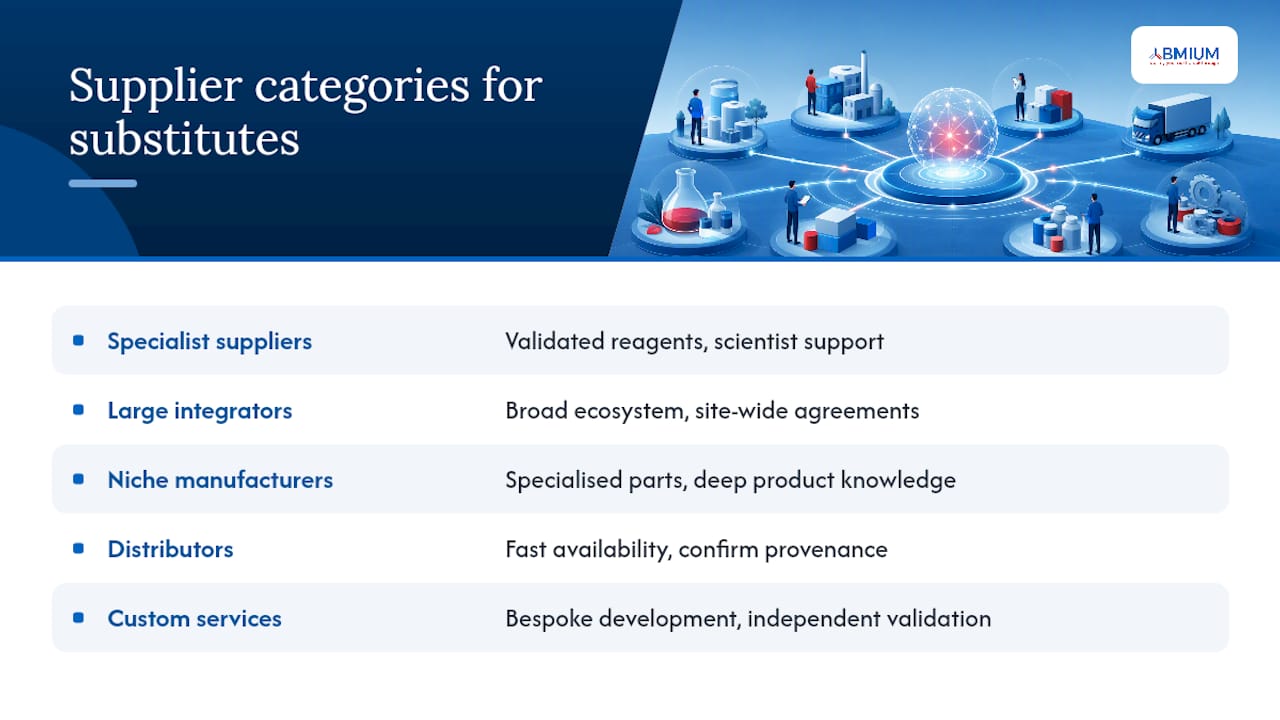
Specialist consultative suppliers and catalogues. These vendors focus on validated reagents, transparent provenance, and scientist support rather than moving volume across thousands of SKUs. They suit antibody, ELISA kit and recombinant protein replacements where getting the biology right matters more than getting the fastest delivery. Meridian Consensus’s market mapping notes that specialist firms compete alongside large integrated suppliers precisely because depth in a narrow application area is often what researchers actually need.
Large integrated suppliers. Vendors like the diversified life-science companies named in competitor analyses of Bio-Rad make sense when a lab is buying an entire instrument ecosystem, consolidating service contracts, or negotiating a site-wide agreement that spans consumables, instruments and software. The trade-off is that breadth rarely comes with the same depth of scientist-led technical support on any single niche product line.
Niche manufacturers. For highly specialised assays or instrumentation-compatible parts, a manufacturer that makes only that category of product tends to know its failure modes better than a generalist. This is the category to check first for unusual antibody clones, custom conjugates, or consumables tied to a specific legacy instrument.
Distributors and marketplaces. Useful when speed and availability are the priority, particularly for consumables with short lead-time requirements. The catch is provenance: a marketplace listing does not always disclose the original manufacturer clearly, so confirm the source before assuming equivalence. Industry observers note that researchers increasingly favour specialised manufacturers for depth even when large distributors are the obvious default, precisely because provenance gaps on marketplace listings can be hard to trace after the fact.
Custom and validation service providers. When a discontinued item has no direct catalogue equivalent, a bespoke development or independent validation service becomes the only realistic route. This applies to custom antibodies, custom ELISA formats, and cases where a lab needs independent confirmation that a proposed substitute performs equivalently before committing budget to a full switch.
Matching the category to the use case saves procurement cycles. A single antibody clone replacement rarely needs a full-line vendor negotiation, and a multi-instrument service contract rarely needs a boutique specialist. Knowing which lever to pull first is what separates a smooth switch from a stalled one.
What is the checklist for replacing a discontinued Bio-Rad product?
A discontinuation notice does not have to mean a scramble. Working through a fixed sequence keeps the switch controlled and documented.
- Consult the manufacturer’s official replacement guidance first. Bio-Rad’s discontinuation pages list recommended substitutes and regional contacts, and this remains the most reliable starting point because the manufacturer’s own support channel knows the product’s formulation history better than any third party.
- Capture every relevant part number. Record the exact catalogue number, lot number, and any application-specific variant before searching for equivalents, since a small formulation difference between variants can matter more than the headline product name suggests.
- Contact vendor technical support directly. Ask specifically whether the proposed replacement has been validated against the discontinued product’s own performance data, not just against a generic specification sheet.
- Run a side-by-side technical validation. Test the candidate replacement against your existing reference standard or, where possible, against remaining stock of the original product. Set acceptance criteria in advance (signal range, background, reproducibility across replicates) rather than judging results after the fact.
- Request samples before a full purchase. Most credible suppliers will provide a trial quantity. If a vendor refuses a sample for a reagent that costs more than a token amount, treat that as a signal worth investigating.
- Confirm lead times and set trial purchase terms. Negotiate a smaller initial order with terms that let you scale up once validation passes, rather than committing to bulk pricing before the science is confirmed.
- Secure full documentation. File the Certificate of Analysis, batch records, protocol comparability data, and any service agreement terms alongside your validation results, so the next person who needs this product has a paper trail rather than institutional memory.
Pro Tip: Keep a running log of acceptance criteria and results for every substitution your lab makes. Over a few years this becomes an internal reference that shortens future validation cycles considerably, because you stop re-deriving the same pass/fail thresholds from scratch.
Why ABMIUM is a practical Bio-Rad equivalent supplier
ABMIUM’s catalogue covers the categories most commonly affected by a Bio-Rad discontinuation or supply switch: primary antibodies, ELISA kits, recombinant proteins, PCR and qPCR kits, FISH probes, and laboratory consumables. Every product is filterable by target, application, species, host and clonality, which matters when a like-for-like clone swap is the whole point of the exercise.
A distinctive approach in some scientific reagent suppliers’ models is a scientist-led sourcing service built specifically to address validation challenges. Customers can submit experimental requirements and receive help to compare suitable products and supporting evidence. That structure directly answers the question procurement teams ask most often when facing a Bio-Rad substitute search: which of several candidate products will actually behave the same way in this specific assay.
For cases with no clean catalogue equivalent, ABMIUM runs custom antibody, protein and ELISA development, alongside custom PCR and qPCR assay development and multiplex assay development. Independent product validation, native mass spectrometry and spatial validation services may be available through specialist collaborators, providing confirmation beyond a supplier’s internal testing before a substitute is accepted into a regulated or long-running protocol.
Evidence forms supplied alongside products include validation data, defined product specifications, and calibrated reference materials such as the Calibrated Color Prestained Protein Marker (10 to 250 kDa), an example of the kind of specification transparency that lets a lab check a replacement’s identity before it ever reaches the bench.
What this adds up to for a Bio-Rad switch:
- Catalogue depth across the core reagent categories most affected by discontinuations
- A sourcing service designed around validation risk, not just product search
- Custom development for items with no direct catalogue match
- Independent validation options through specialist collaborators for higher-stakes substitutions
Manufacturer visibility is built into every listing rather than left implicit, which is precisely the provenance gap that marketplace and distributor routes can leave open.
How do you run a controlled supplier switch?
A supplier switch that skips project structure tends to surface its problems at the worst possible moment, mid-experiment, rather than during planning.
- Assign clear roles before ordering anything. Procurement owns vendor terms and lead times; a technical lead owns the validation protocol and acceptance criteria; QA or QC owns documentation and sign-off. In clinical or accredited settings, this separation is often required, not optional.
- Design the pilot before you buy the pilot materials. Fix your sample size, the specific performance metrics you will measure, and the pass or fail thresholds in advance. Reviewing results against criteria set after the fact almost always introduces bias, even unintentionally.
- Run the pilot against a known reference. Where original stock remains, run the candidate replacement side by side with it. Where it does not, use a certified reference standard or a well-characterised control instead.
- Record everything for regulatory and audit purposes. Clinical and accredited labs typically need the Certificate of Analysis, batch records, and comparability data filed as part of a formal change control record, not just kept informally by whoever ran the test.
- Set a timeline with a built-in delay option. Give the pilot a fixed window, but agree in advance that a genuine ambiguity in the results is grounds to extend testing or run a second batch, rather than pushing a full switch through on a deadline.
- Keep a fallback plan live until the pilot passes. Retaining a small buffer of the original product, or a second candidate supplier in parallel, avoids a hard stop if the first replacement underperforms.
Dual sourcing during this window costs a little more upfront. It is a far smaller cost than an assay that fails three months into a study because the pilot was rushed to hit an arbitrary deadline.
The trade-off procurement teams underestimate
Most guidance on replacing an incumbent supplier treats the decision as a straight trade between price and convenience. That framing misses the actual trade-off, which sits between specialist validation depth and integrated convenience. A large full-line vendor can genuinely simplify a multi-instrument service agreement. It rarely matches a specialist’s depth of evidence on a single antibody clone or assay, because that depth is not what the large vendor’s business model is built to deliver at scale.
The instinct to chase the lowest unit price on a replacement reagent is understandable and usually wrong. A cheaper substitute that fails validation, or passes weakly and causes irreproducible results six months later, costs far more in repeated experiments than the saving ever returned. Reproducibility should outrank unit price on any procurement scorecard for a reagent switch, full stop.
Where the evidence genuinely is ambiguous, run a pilot rather than committing outright, and consider holding dual sourcing until a full batch of results confirms the new supplier performs. Consult a scientist-led sourcing service if your team wants expert help comparing candidates rather than working through the comparison alone.
— Veron
Sourcing your replacement reagents through ABMIUM
Some specialist suppliers are built to address switching problems like replacing a product from a major supplier without losing validation evidence that made the original trustworthy. Where a large integrated vendor offers broad product lines, some suppliers combine a transparent, provenance-led catalogue with scientist-led sourcing services to provide comparisons of suitable candidates and the evidence behind them before budgeting.

Start with the collections most relevant to your current switch: primary antibodies, ELISA kits, or recombinant proteins for catalogue-based replacements. If your discontinued item has no clean equivalent, the custom development and validation services page covers custom antibody, protein and ELISA development, plus independent validation routes through specialist collaborators. Pricing for custom work and validation services is available on request rather than published, so the practical next step is to submit your requirements through ABMIUM MATCH™ and get a scientist-led comparison back, request a sample of a candidate product, or start a quote for institutional pricing on your regular order volume.
Where to verify this guidance
The recommendations in this article draw on manufacturer guidance and independent market mapping, all publicly checkable.
- Discontinued products and alternatives, Bio-Rad’s own page listing recommended replacements and regional sales contacts
- Discontinuation recommendations, Bio-Rad’s US guidance on identifying validated substitutes
- Bio-Rad competitors, Owler’s competitor mapping covering Thermo Fisher Scientific, BD and Roche
- Bio-Rad market share, competitors and market positions, Meridian Consensus’s mapping of overlapping suppliers including Cytiva, Thermo Fisher and Merck KGaA
Sources
- Bio-Rad competitors (Owler)
- Discontinued products and alternatives — Bio‑Rad
- Bio‑Rad market share, competitors & market positions — Meridian Consensus
FAQ
Who are Bio-Rad’s main competitors?
Owler’s competitor analysis lists Thermo Fisher Scientific, BD and Roche among Bio-Rad’s closest large competitors. Meridian Consensus adds Cytiva, Merck KGaA and Sartorius to the wider competitive map, alongside specialist suppliers such as ABMIUM that compete on validation depth rather than scale.
Is Bio-Rad still in business?
Yes, Bio-Rad continues to operate and sell across its life-science and clinical diagnostics divisions. The company also maintains active discontinuation and replacement pages for products it retires, which is the first place to check when a specific catalogue number stops shipping.
What is the parent company of Bio-Rad?
Bio-Rad Laboratories operates as an independent, publicly traded company rather than a subsidiary of a larger parent. It is not owned by another life-science conglomerate, which distinguishes its ownership structure from several of the diversified competitors named in market mapping.
Are there genuine alternatives to Bio-Rad for validated reagents?
Yes. Specialist suppliers such as ABMIUM offer catalogue antibodies, ELISA kits and recombinant proteins with transparent provenance, alongside scientist-led sourcing through ABMIUM MATCH™ to help confirm a replacement fits your protocol before purchase. Large integrated vendors and niche manufacturers offer alternative routes depending on whether you need breadth or narrow technical depth.
How long does it typically take to validate a replacement reagent?
Validation timelines vary by product type and the acceptance criteria a lab sets, so no single figure applies across antibodies, kits and consumables. Running a side-by-side pilot with a defined sample size and clear pass or fail thresholds, as outlined in the checklist above, is the most reliable way to keep the timeline predictable.