

The most reliable route for institutional buyers is a specialist reagent and distributor supplier with visible product provenance and validation support, rather than a straight swap to another full-service conglomerate. ABMIUM fits that category directly, offering verified antibodies, ELISA kits, and scientist-led sourcing designed to cut the risk of failed experiments. That combination of validation evidence and procurement ease matters more than brand size when reproducibility is the goal.
TL;DR:
- Selecting a reagent and distributor specialist ensures validated products with traceable provenance, reducing experiment failure risk compared to generalist suppliers.
- Reagent specialists often provide validation data, batch metadata, and scientist-led sourcing that improve reproducibility and overall experimental success.
- Transitioning suppliers typically takes two to three months, involving audit, parallel validation, negotiating terms, and staged purchasing to maintain reproducibility.
- Costs should be evaluated across total ownership, considering validation, support, lead times, and staff time; cheaper validated reagents often save money long-term.
- Open-source hardware projects can lower costs but require engineering capacity; otherwise, validated commercial solutions may be more cost-effective over the device lifecycle.
Table of Contents
- Which Thermo Fisher alternatives suit your lab?
- How do these supplier categories compare on cost and support?
- What should a procurement checklist include?
- How does ABMIUM reduce procurement risk?
- What does switching actually cost?
- How long does switching suppliers actually take?
- Why the branded shortlist approach gets this wrong
- Get started with a reagent specialist you can verify
- Sources
- FAQ
Which Thermo Fisher alternatives suit your lab?
Choosing among Thermo Fisher competitors starts with matching the supplier category to the actual problem you’re solving, not the size of the vendor’s catalogue. Procurement teams often default to another large conglomerate out of habit, when a narrower specialist would serve the science better and cost less.
Five categories cover almost every realistic substitution:
- Full-service conglomerates: broad instrument and consumables ranges with global logistics. Best when you want a single vendor handling everything from pipette tips to mass spectrometers, and you can accept less negotiating leverage per product line.
- Specialised instrument vendors: firms focused on chromatography, mass spectrometry, or sequencing platforms. Best when instrumentation depth and application-specific engineering support outweigh the convenience of one supplier for everything.
- Reagent and distributor specialists: catalogue-based suppliers offering validated antibodies, kits, and reagents with institutional pricing. Best for labs prioritising reproducible results and traceable provenance over sheer product breadth. There are specialist reagent and distributor suppliers that combine a verified catalogue with scientist-led sourcing services that help researchers compare suitable reagents against their exact experimental requirements.
- Contracted service and bioprocess providers: end-to-end manufacturing, GMP production, and clinical-scale services. Best for teams scaling from bench work to regulated production runs.
- Open-source and frugal-hardware projects: community-built tools such as OpenCell’s low-cost DNA extraction device, openELISPOT’s readers, and the Poseidon syringe pump and microscope system. Best for prototyping, teaching labs, and in-house custom builds where budget constraints outweigh the need for vendor support.
The category you pick should follow your actual failure mode. If experiments keep failing because of unclear reagent provenance, a distributor with validation data is the solution. If your bottleneck is instrument uptime, a specialised vendor with faster field service solves a different problem entirely.
How do these supplier categories compare on cost and support?
Institutional buyers weighing lab equipment alternatives need to judge suppliers against dimensions that actually predict procurement outcomes, not just headline pricing.
- Product range and specialism: conglomerates and full catalogues win on breadth; specialists and reagent distributors win on depth within their niche.
- Service and technical support: field engineer coverage and response times vary enormously. A specialised vendor with a smaller footprint can still outperform a conglomerate on turnaround, because their support teams work fewer, more focused product lines.
- Institutional pricing and contract options: framework agreements, tiered discounts, and bulk terms differ by category. Distributor specialists often negotiate more flexibly than large conglomerates locked into standardised list pricing.
- Validation, provenance and reproducibility support: this is where reagent specialists tend to separate from generalist suppliers, since batch-level metadata and validation datasets are core to their offer rather than an add-on.
- Supply resilience and lead times: local stocking and distribution network depth determine whether a stockout costs you a day or a month.
The frugal-hardware trade-off: open-source builds can undercut commercial pricing dramatically. OpenCell’s DNA extraction device is designed to run at a low cost, openELISPOT targets a full reader build under £500, and the Poseidon system offers automated imaging and dispensing at a relatively low cost. Reconfigurable LEGO-based lab tools have matched commercial equipment in validation testing, while offering genuine reuse and repair advantages over sealed proprietary units.
The catch with frugal hardware is hidden cost, not sticker price. These builds shift expense from procurement budget to internal engineering time, and someone on your team needs the technical capability to assemble and maintain the device. For labs without that capacity, a validated commercial reagent or instrument, even at a higher unit cost, often works out cheaper across the total lifecycle.
What should a procurement checklist include?
Before signing with any Thermo Fisher substitute, run the vendor through a fixed checklist rather than relying on a sales conversation alone.
- Confirm workflow compatibility. Check that reagents, consumables, or instruments integrate with your existing protocols and equipment without requiring a parallel validation exercise.
- Demand validation evidence upfront. Ask for lot-specific data, not generic datasheets. A credible supplier should provide this before you commit budget.
- Verify provenance documentation. Request clear manufacturing origin and chain-of-custody information for every reagent or kit under consideration.
- Test the institutional pricing structure. Ask directly about framework agreements, volume discounts, and whether pricing scales with multi-year commitments.
- Check service SLAs and spare-parts availability. For instruments, confirm response-time guarantees and whether parts are stocked regionally or shipped from overseas.
- Ask about lot-to-lot quality assurance. A supplier who cannot explain their QA process between batches is asking you to gamble on reproducibility.
Watch for red flags: vendors who cannot produce validation data on request, opaque supply chains with unclear manufacturing origin, no institutional pricing tier for repeat buyers, or warranty terms that dodge specifics on turnaround.
Pro Tip: Pilot a new supplier on a low-stakes reagent order before switching a whole workflow. A small trial order exposes lead times, batch consistency, and support responsiveness with minimal disruption if something goes wrong.
How does ABMIUM reduce procurement risk?
Some specialized suppliers are built around buyer concerns that dominate serious vendor checklists: provenance, validation, and institutional terms, not just catalogue size. Verified catalogues can let researchers filter antibodies, ELISA kits, and recombinant proteins by target, application, species, host, and clonality, with validation evidence visible before purchase.
Scientist-led sourcing services can extend that further, allowing researchers to submit experimental requirements and get help comparing suitable products and supporting evidence, rather than guessing from a datasheet alone. Custom antibody and protein development, independent validation, and collaborations covering native mass spectrometry and spatial validation are often offered by specialist providers.
This structure maps directly onto what reduces experimental risk in institutional labs: verified provenance and independent validation. Specialist distributors that pair catalogue sales with consultative scientific support consistently reduce the chance of failed or irreproducible experiments, because researchers get batch metadata and supporting evidence at the point of decision, not after a failed run.
- Verified catalogue with filterable validation evidence
- Scientist-led reagent comparison services
- Custom antibody, protein, and ELISA development
- Independent validation and spatial/mass-spectrometry collaborations
- Institutional pricing for academic, biotech, and pharmaceutical buyers
What does switching actually cost?
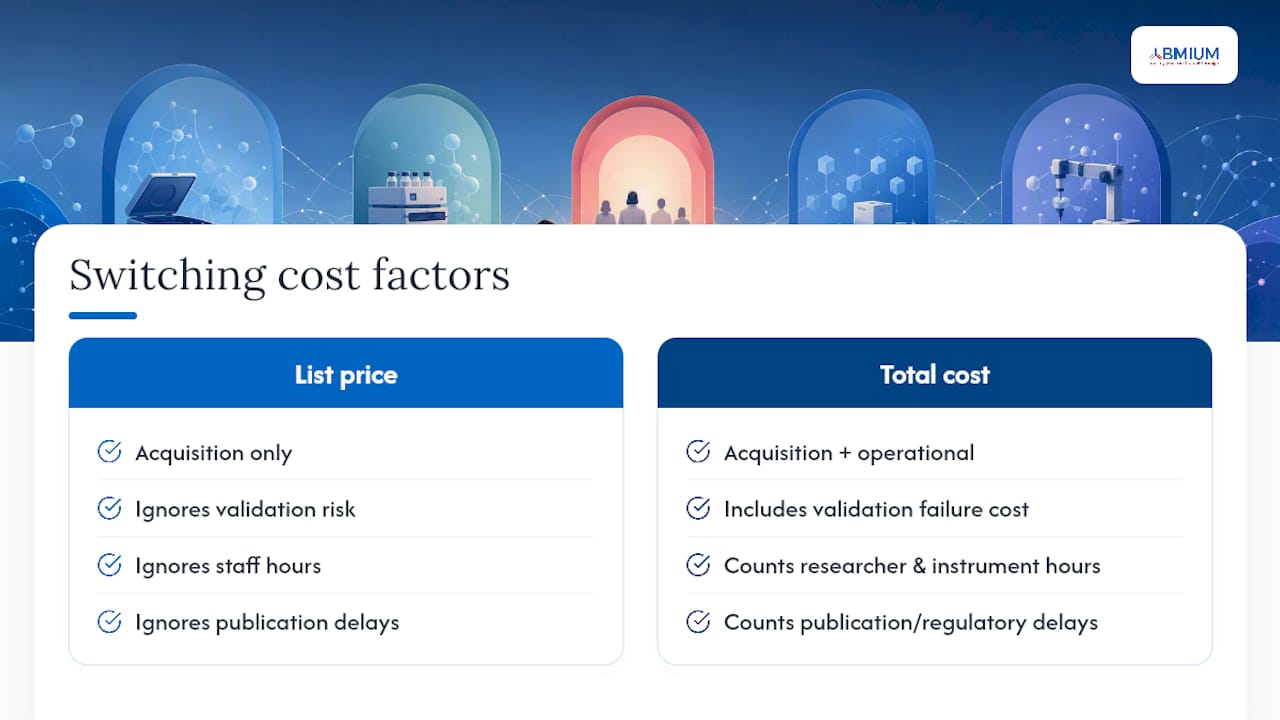
Total cost of ownership rarely matches the number on a quote. A cheaper reagent that fails validation and forces a repeat experiment costs more than a slightly pricier one that works first time, once you count researcher hours, instrument time, and delayed publication or regulatory timelines.
Institutional pricing structures also shift the real cost. Framework agreements and bulk-purchase terms can bring per-unit reagent costs down substantially for high-volume labs, but only if the supplier offers genuine contract flexibility rather than a fixed list price dressed up as a “discount”. Ask any prospective supplier whether their institutional terms scale with order volume or simply apply a flat percentage regardless of commitment.
Open-source and modular equipment changes the cost equation differently. Avoiding vendor-locked service contracts and proprietary consumables lowers long-term operational spend, but that saving only materialises if your team can absorb the assembly and maintenance workload internally. For a lab without spare engineering capacity, that “saving” often reappears as delayed experiments.
The realistic comparison, then, is not list price versus list price. It’s total cost across acquisition, validation failure risk, service response time, and staff hours spent on troubleshooting or rebuilding. Reagent specialists with strong provenance data tend to win this comparison for routine experimental work, while conglomerates and instrument specialists still make sense for capital equipment with long service lifespans.
How long does switching suppliers actually take?
Moving away from an incumbent supplier rarely happens overnight, and rushing it increases the chance of a validation gap slipping through unnoticed.
A realistic transition runs in four stages. First, audit your current reagent and consumables list against what the new supplier’s catalogue actually covers, typically one to two weeks for a mid-sized lab. Second, run parallel validation on critical reagents, ordering from both the incumbent and the candidate supplier to compare performance directly rather than trusting datasheets alone. This stage often takes four to six weeks, since it needs to cover enough experimental repeats to be meaningful.
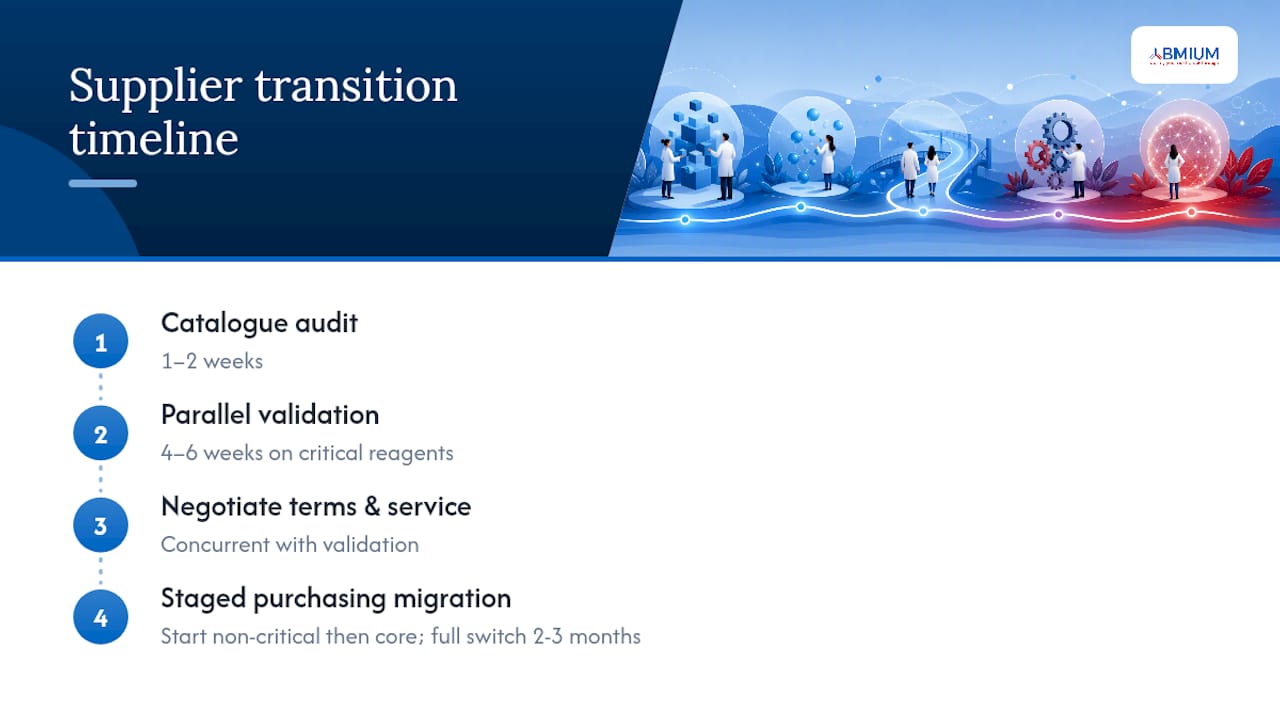
Third, negotiate institutional terms and confirm service arrangements before fully committing volume, which can run concurrently with validation. Fourth, migrate purchasing in stages, starting with non-critical consumables and moving to core reagents only once validation confirms equivalent or better performance.
For a lab with a moderate catalogue, expect the full transition to take roughly two to three months from first audit to full switch-over. Instrument replacements take considerably longer, given installation, calibration, and staff training requirements. Rushing any of these stages to save time is usually where reproducibility problems creep in later.
Why the branded shortlist approach gets this wrong
Most guides to Thermo Fisher competitors default to naming rival conglomerates, as if switching were simply a matter of picking a different logo on the same kind of catalogue. That framing misses the actual decision buyers face, which is a category choice, not a brand choice. A lab doesn’t need “another Thermo Fisher”. It needs the right kind of supplier for the specific failure it’s trying to avoid, whether that’s unclear provenance, poor institutional terms, or slow instrument service.
The conventional advice also underweights validation evidence, treating it as a nice-to-have rather than the thing that actually determines whether an experiment works. Open-source hardware gets dismissed too quickly in most comparisons, when projects like openELISPOT and Poseidon genuinely solve real problems for teaching labs and prototyping, provided the team has the engineering capacity to support them.
Prioritise provenance and validation evidence before price. A lower quote with weak documentation is rarely the cheaper option once repeat experiments are factored in.
— Veron
Get started with a reagent specialist you can verify
Some specialist suppliers offer an alternative to a broad, generalist catalogue for labs that need reproducible results, not just a lower quote. Unlike large conglomerates that provide a datasheet and move on, scientist-led sourcing services put expert guidance behind every recommendation, comparing suitable reagents and supporting evidence against actual experimental requirements before purchase.

Two ways to start today. Browse the ABMIUM catalogue directly if you know what you need, filtering by target, application, species, host, and clonality. Or, if you’re unsure which reagent fits a specific experiment, submit your requirements through ABMIUM MATCH and get scientist-led comparison support before you commit budget. For a concrete example of the provenance and validation detail available on a live product page, look at the Anti-Mouse CD3e Antibody [500A2] listing, or the Polymer-HRP IHC Detection System for a sense of how batch and application data are presented. Institutional buyers can often request contract pricing directly through the catalogue for repeat or high-volume orders.
Sources
Readers building a procurement dossier or exploring frugal-hardware options may find these useful: the PLOS ONE study on LEGO-based reconfigurable lab equipment, the OpenCell low-cost DNA extraction device, and the openELISPOT project for open-source reader builds. For structuring a literature review around your validation dossier, PaperSynapse supports systematic review workflows.
FAQ
Is Thermo Fisher laying off staff?
Thermo Fisher has announced workforce reductions as part of broader cost-management measures in recent years, a pattern common across large life-science conglomerates adjusting to shifting research funding. Specific current figures are best checked against the company’s own investor communications rather than secondary reporting.
How is Thermo Fisher performing financially?
Thermo Fisher remains one of the largest life-science and diagnostics companies globally, with revenue spread across instruments, reagents, and contracted services. Financial performance fluctuates with research funding cycles and diagnostics demand, so current figures should be checked against the company’s own quarterly filings.
What companies has Thermo Fisher acquired?
Thermo Fisher has grown substantially through acquisition over the past two decades, absorbing instrument makers, reagent producers, and clinical service providers to build its current breadth. The exact list of acquisitions changes regularly, so current details are best confirmed through the company’s official announcements.
What happened to Thermo Fisher Scientific?
Thermo Fisher Scientific resulted from a merger and has continued expanding through acquisitions since. It remains an active, publicly traded company rather than one that has ceased operating or been broken up.
Is ABMIUM a good Thermo Fisher alternative for reagents?
ABMIUM suits labs specifically looking for verified provenance, validation evidence, and institutional pricing on antibodies, ELISA kits, and recombinant proteins, rather than broad instrument coverage. Current pricing is listed directly on the ABMIUM catalogue.