

Prioritise suppliers that publish sequence and provenance data alongside application-specific validation evidence over those ranked highly on citation counts alone. For routine targets, catalogue filtering by species, clonality and validation type will usually get you there. For difficult targets, therapeutic leads, or anything publication-critical, a scientist-led sourcing route can reduce the risk of buying a reagent that fails in your specific application.
TL;DR:
- Prioritize suppliers that publish detailed validation and provenance data, especially for difficult or publication-critical targets, rather than relying solely on citation counts.
- Validation evidence such as knockout validation, orthogonal comparison, and recombinant sequence availability provides stronger assurance of specificity and reproducibility.
- When sourcing, define your specific application, species, and clonality needs, request validation images, and consider pilot experiments before full purchase.
- Custom or specialist antibody providers are necessary for novel epitopes, therapeutic leads, or challenging membrane proteins, with verification of their technical capabilities.
- Cost-effectiveness depends on validation quality and validation status, as cheaper reagents with weak validation often incur higher downstream costs.
Table of Contents
- Which antibody suppliers dominate the citation data?
- Why validation and provenance matter when choosing antibodies
- Practical evaluation checklist you can use before ordering
- When to choose a custom or specialist provider
- How ABMIUM helps researchers meet the validation standard
- Comparing pricing models across antibody suppliers
- What good customer service looks like from an antibody supplier
- Supply chain reliability and delivery times
- Ethical sourcing and sustainability in antibody production
- Large suppliers versus specialised suppliers: who does what best
- Author perspective: balancing citation prestige with experimental fit
- Practical next steps: sourcing validated antibodies through ABMIUM
- Sources
- FAQ
Which antibody suppliers dominate the citation data?
Citation datasets give a useful, if partial, picture of the market. CiteAb’s most-cited analysis found that in 2023, Cell Signaling Technology held 35 of the top 100 most-cited antibodies, with Abcam holding 19. Thermo Fisher Scientific also features prominently across recent top-100 lists.
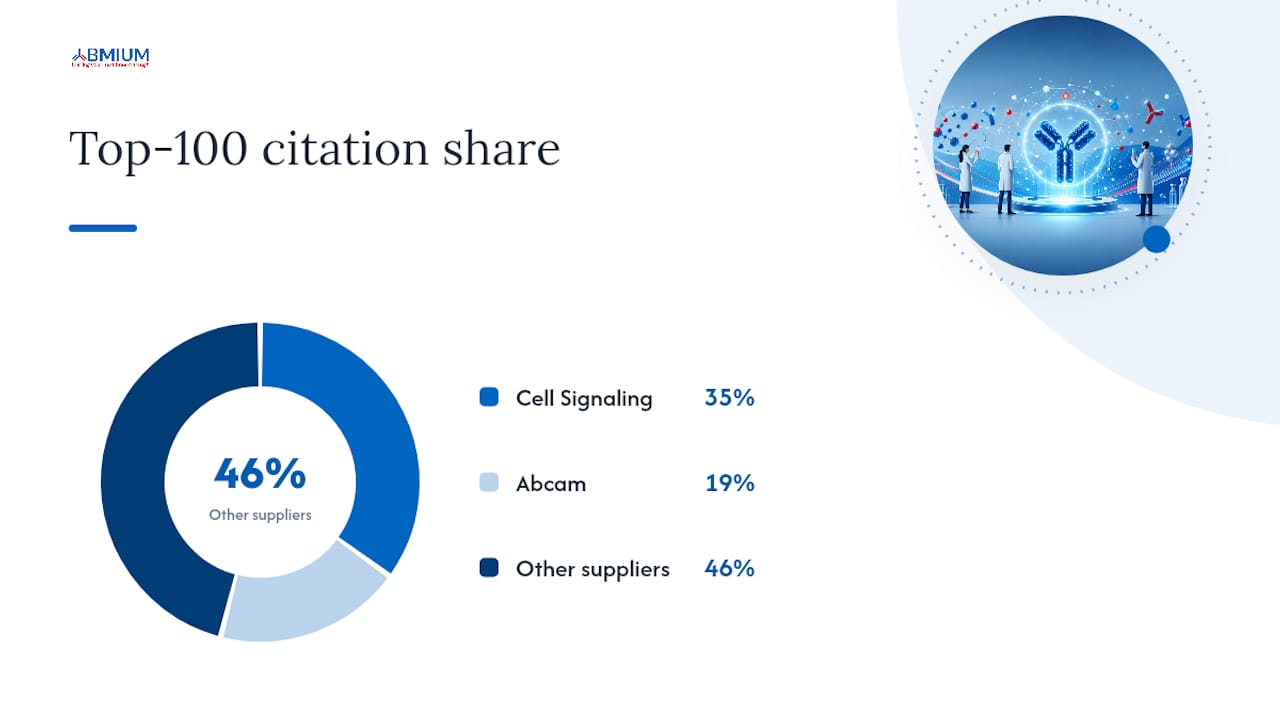
That concentration tells you which reagents get used often, not which reagent suits your experiment. A monoclonal cited thousands of times in cancer cell line studies may perform poorly in a primary neuron culture your lab is running. Citation volume reflects historical adoption, publication bias towards established fields, and, in some cases, simple availability rather than independent proof of specificity for your target and species.
Three limitations are worth holding in mind when you scan a citation list:
- Coverage bias favours antibodies against well-studied targets in mainstream fields, leaving newer or niche targets under-represented regardless of quality.
- A high citation count can persist for years after a reagent’s original validation, even where newer batches show lot-to-lot drift.
- CiteAb’s Top 100 dataset increasingly highlights recombinant, sequence-defined antibodies, a signal of where the market is heading rather than a guarantee any single listed product fits your assay.
Pro Tip: Treat a citation list as a shortlist generator, not a final answer. Cross-check any candidate against its own validation data before you order.
Why validation and provenance matter when choosing antibodies
A citation count tells you an antibody has been used. It does not tell you whether it was used correctly, or whether the batch you receive matches the one described in the paper you just read. Provenance and validation evidence close that gap.
Three types of evidence carry real weight:
- Knockout or knockdown validation, where the target is genetically removed and the signal disappears, is the strongest available proof of specificity.
- Orthogonal validation, comparing results against an independent method (mass spectrometry, an alternative antibody clone, or RNA expression data) builds confidence when a knockout model is not practical.
- Recombinant sequence availability means the antibody’s variable region is defined and reproducible from batch to batch, a feature increasingly common among top-cited recombinant antibodies.
Application-specific evidence matters just as much as specificity data. An antibody validated for Western blot does not automatically work for immunohistochemistry or flow cytometry, because fixation, epitope accessibility and background noise behave differently in each format. Batch and lot documentation lets you trace exactly which manufacturing run produced the vial in your freezer, which matters when a result unexpectedly fails to reproduce six months later.
Missing validation is rarely dramatic. It usually shows up as a faint, inconsistent band on a Western blot, or immunohistochemistry staining that looks plausible until a knockout tissue control reveals the same pattern with no target present at all. That is the failure mode validation evidence is built to prevent.
Practical evaluation checklist you can use before ordering
Work through these steps in order, rather than jumping straight to price:
- Define your application precisely. Western blot, IHC, flow cytometry and ELISA place different demands on an antibody, so decide this before you search.
- Check species and clonality against your model. A monoclonal validated in human tissue will not necessarily cross-react cleanly with mouse or rat samples.
- Request validation images and protocols. Ask for the actual blot, staining image or flow histogram, not just a summary claim of “validated”.
- Check for a sequence or recombinant claim. Sequence-defined reagents are traceable and reproducible in a way polyclonal, serum-derived antibodies rarely are.
- Confirm lot availability and lead times. For long studies, ask whether the supplier can hold or replicate a lot so you are not forced to revalidate mid-project.
- Ask about sample or small-pilot options. A trial-size aliquot lets you test performance before committing to a full order.
- Confirm technical support and datasheet depth. A thin datasheet with no dilution guidance or positive control is a warning sign, not a minor gap.
How you weight price against validation depends on the stage of the work. Exploratory, hypothesis-generating experiments can tolerate a cheaper, less thoroughly validated reagent, since a false lead gets caught downstream. Publication-grade work cannot: reviewers and readers increasingly expect knockout or orthogonal validation data, catalogue and lot numbers, and a clear species and clonality statement in the methods section. Treat those four items as the minimum documentation you should be able to produce for any antibody named in a manuscript.
When to choose a custom or specialist provider
Standard catalogue searching breaks down in a handful of predictable situations. Novel epitopes with no existing commercial antibody, therapeutic antibody leads destined for further development, and difficult membrane proteins that resist standard immunisation approaches all tend to need a bespoke route rather than an off-the-shelf purchase.
Before commissioning custom work, verify the provider’s actual capabilities rather than taking a marketing claim at face value:
- Recombinant expression systems suited to your target class, particularly for membrane proteins or low-abundance targets.
- In-house or partnered sequencing, so the final antibody is sequence-defined rather than a black box.
- Access to native mass spectrometry for structural and binding confirmation, and spatial validation partners where tissue-context data matters.
- A realistic, staged project timeline rather than a single vague delivery date.
Analyst guidance on custom antibody providers points to sequencing, recombinant manufacture and native mass spectrometry as the clearest differentiators between providers capable of genuinely novel work and those simply reselling standard immunisation services. Staged milestones, a small pilot batch before full-scale production, and independent validation of the pilot are the three practical levers that keep custom development risk manageable.
How ABMIUM helps researchers meet the validation standard
ABMIUM structures its catalogue around exactly the criteria the checklist above demands. Researchers can filter by target, application, species, host and clonality, and view product-level validation evidence directly against each listing rather than hunting through a separate datasheet.
For anything that does not fit a straightforward catalogue search, ABMIUM MATCH offers scientist-led sourcing: you submit your experimental requirements and receive help comparing suitable products and the evidence behind them, rather than working through a generic search filter alone. Where no existing reagent fits, ABMIUM’s custom services extend to bespoke antibody and protein development, independent product validation, native mass spectrometry, and spatial validation through specialist collaborators.
A practical workflow looks like this:
- Search the catalogue by target, species and application to build a shortlist.
- Compare the validation evidence attached to each candidate, not just the price or brand.
- Where nothing fits cleanly, contact ABMIUM MATCH for scientist-led comparison and sourcing support.
- Run a pilot order or validation pass before committing to a full-scale purchase.
Pro Tip: Ask for the exact validation image tied to the lot number you would actually receive, not a generic figure pulled from the product’s original launch data.
Comparing pricing models across antibody suppliers
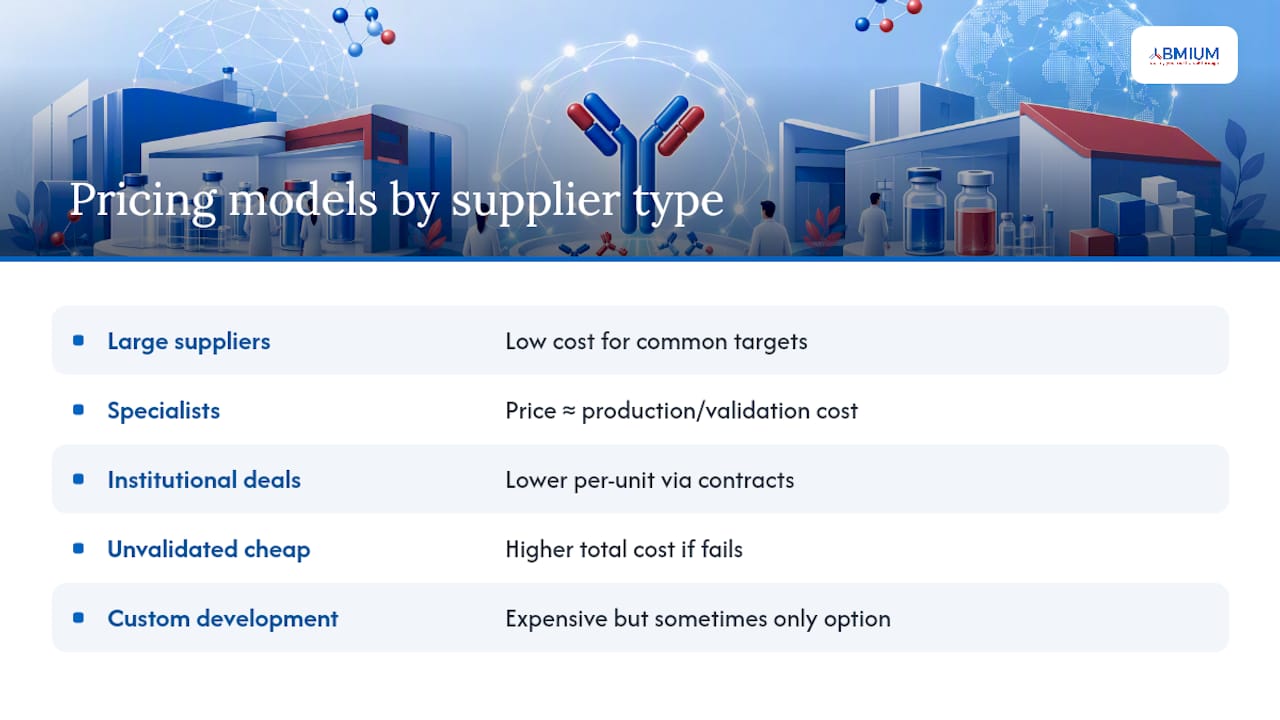
Antibody pricing rarely follows a single logic, which makes price-only comparisons misleading. Large integrated suppliers typically price around economies of scale: high-volume manufacturing keeps unit costs down for common targets, but that advantage narrows sharply for niche or difficult reagents, where the same supplier may charge a premium simply because internal demand is low.
Specialist and agile suppliers often price closer to their actual production and validation cost per product, which can make a niche or custom antibody more competitively priced than an equivalent from a large catalogue vendor, even though the sticker price per vial looks similar. Institutional and bulk agreements shift the calculation again: a lab ordering across multiple projects can often negotiate contract pricing that a single-purchase academic order never sees.
The more useful comparison is cost-effectiveness rather than raw price. A cheaper antibody that fails validation, or that requires a second confirmatory purchase after a failed experiment, costs more in wasted reagent, researcher time and delayed publication than a slightly pricier, better-documented alternative. Custom development sits at the far end of this spectrum: expensive relative to a catalogue purchase, but often the only cost-effective route when no validated commercial reagent exists for a target at all. Weighing price against the documentation and validation evidence a supplier actually provides, rather than against list price alone, is the comparison that matters for reproducible work.
What good customer service looks like from an antibody supplier
Technical support quality varies more between antibody suppliers than most researchers expect, and it becomes obvious exactly when you need it least: mid-experiment, with a reagent behaving unexpectedly.
A supplier worth using should be able to answer specific technical questions, such as recommended dilution ranges for your exact application, known cross-reactivity issues, and troubleshooting advice when a result looks inconsistent with published validation data. Datasheet depth is a reasonable proxy for this before you even make contact: a thorough datasheet with positive and negative controls, recommended protocols and lot-specific data usually signals a support team that can go further when asked directly.
Response speed matters, but so does whether the response comes from someone who understands the science rather than a generic order-status system. Guarantee and replacement policies are the other practical marker: a supplier confident in its validation data will typically offer to replace or refund a reagent that fails to perform as described, which shifts risk away from your budget and back onto the manufacturer. Ask about this before ordering rather than after a failed experiment, since policies that sound generous in marketing copy sometimes carry conditions that only surface at the claims stage.
Supply chain reliability and delivery times
Delivery reliability affects experimental planning more than most procurement checklists acknowledge. A delayed antibody shipment can push back an entire experimental timeline, particularly where cell culture, animal work, or time-sensitive clinical samples are involved and cannot simply wait for a reagent to arrive.
Large integrated suppliers generally offer more predictable stock levels for common, high-volume reagents, since production runs at scale and multiple regional warehouses reduce the chance of a single point of failure. Specialist suppliers can be less predictable for widely used targets but often move faster on lower-volume or niche items precisely because they are not managing the same scale of inventory.
Lot availability is the detail worth checking before you commit to a long study rather than after. Ask directly whether a supplier can hold a specific lot for the duration of your project, or whether they can manufacture a matching replacement lot if your original stock runs out mid-study. A supplier that cannot answer this clearly is one where a mid-project batch change, and the revalidation work that follows, becomes a real risk rather than a remote one. Building in a buffer order, particularly for a reagent central to a publication-grade study, is a simple way to protect a timeline against a delayed shipment or an unexpected stock-out.
Ethical sourcing and sustainability in antibody production
Antibody production has shifted meaningfully towards recombinant, sequence-defined manufacturing, and that shift carries an ethical dimension alongside the reproducibility benefits already discussed. Traditional polyclonal antibody production relies on immunising live animals, typically rabbits or goats, and harvesting serum, a process that raises welfare considerations that recombinant technology avoids almost entirely.
Recombinant antibodies are produced in cell culture systems once the antibody’s genetic sequence is known, removing the need for repeated animal immunisation for each new production run. That production shift, already visible in CiteAb’s data on recombinant antibody prominence, reflects both a reproducibility argument and a welfare one moving in the same direction.
Sustainability considerations extend to packaging, cold-chain shipping efficiency, and manufacturer transparency about where and how a reagent is actually produced. A supplier willing to disclose manufacturing location and process detail is generally easier to hold accountable on both ethical and quality grounds than one that treats provenance as commercially sensitive information. Ask about animal welfare standards and recombinant production options directly when evaluating a supplier, particularly for polyclonal reagents where the traditional production method remains more common.
Large suppliers versus specialised suppliers: who does what best
The antibody market splits fairly cleanly into two functional roles, and understanding which one you actually need saves time. Large, integrated suppliers such as those dominating the citation datasets typically offer breadth: extensive catalogues, established manufacturing infrastructure, and strong support for common targets across mainstream research fields.
Specialist suppliers occupy a different niche. Analyst commentary on supplier fit notes that academic and small-scale labs often prefer specialist suppliers specifically for transparent validation practices and the agility to handle unusual requests that a larger organisation’s standard workflow cannot easily accommodate. A specialist is more likely to discuss your exact experimental context directly rather than routing you through a generic sales process.
Neither role is inherently superior. High-throughput screening or a large multi-site trial benefits from a large supplier’s manufacturing scale and consistent stock. A single difficult target, a custom development project, or a lab that wants direct scientific input into product selection tends to fare better with a specialist, or with a hybrid service that combines catalogue breadth with the consultative depth specialist suppliers are known for.
Author perspective: balancing citation prestige with experimental fit
Citation prestige rewards adoption, not accuracy. The antibodies you should trust most are the ones with a defined sequence and an application image that matches your exact use case, not the ones with the longest reference list. Stage your validation: run a pilot before committing a full study to any reagent, especially where the target is difficult or the stakes are a publication you cannot afford to retract.
— Veron
Practical next steps: sourcing validated antibodies through ABMIUM
ABMIUM is the direct alternative to hunting through scattered catalogue listings and unverifiable citation rankings: every product is filterable by validation evidence, and where nothing fits, a scientist compares options with you directly rather than leaving you to guess.

If your target is well-characterised and common, start by browsing ABMIUM’s primary antibody collection and filtering by species, clonality and available validation data. If your work involves a difficult target, a therapeutic lead, or a species combination that standard searching cannot resolve cleanly, contact ABMIUM MATCH directly: you submit your experimental requirements and receive scientist-led comparison of suitable products, along with the supporting documentation you need for publication-grade work. Where no existing product fits at all, ABMIUM’s custom antibody and assay development service covers bespoke antibodies, proteins, ELISA development and independent validation, including native mass spectrometry and spatial validation through specialist collaborators. Expect a documented, staged process rather than a single opaque quote, whichever route you take.
FAQ
Which companies are the top antibody companies?
Citation datasets consistently place Cell Signaling Technology, Thermo Fisher Scientific and Abcam among the most-cited suppliers, with Cell Signaling Technology alone holding 35 of the top 100 most-cited antibodies in 2023. Specialist suppliers and platforms such as ABMIUM occupy a different role, focused on validation transparency and scientist-led sourcing rather than raw citation volume.
Is Abcam a reliable antibody supplier?
Abcam holds a strong position in citation rankings, appearing in 19 of the top 100 most-cited antibodies in a recent analysis. Reliability for your specific experiment still depends on checking the individual product’s validation evidence, species reactivity and application data rather than relying on the supplier’s overall citation standing.
Where can I buy antibodies?
Antibodies are available through large integrated catalogue suppliers, specialist providers focused on particular target classes, and consultative platforms such as ABMIUM that combine a searchable catalogue with scientist-led sourcing support. For difficult targets or publication-grade work, a platform offering validation evidence alongside the product listing, such as ABMIUM’s primary antibody collection, reduces the risk of an unvalidated purchase.
What’s the best antibody for my experiment?
There is no single best antibody independent of application: the right choice depends on your target, species, clonality requirement and assay format. The most reliable approach is to shortlist candidates with knockout, orthogonal or recombinant sequence validation matched to your exact application, then confirm fit with a small pilot order before scaling up.