

ElabscienceABMIUM Verified™
Anti-Human MTOR Antibody [4B9]
SKU: ABM853-1Primary Antibodies
- Target
- MTOR
- Host
- Rabbit
- Clonality
- Monoclonal
- Reactivity
- Human
- Applications
- WB
From£89.60£112.00
Save 20%
Available to orderABMIUM target intelligence
mechanistic target of rapamycin kinase
Mechanistic target of rapamycin kinase (MTOR), commonly called mTOR, is a serine/threonine protein kinase and core component of mTOR signalling complexes. This ABMIUM record connects NCBI Gene 2475 and UniProtKB P42345 to catalogue-backed research products.
Read full target overview


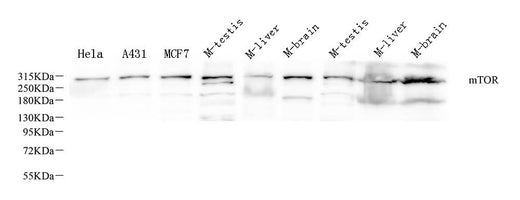




Research context & evidence
Target information is kept separate from product-level validation so you can review the biology and the reagent evidence independently.
Mechanistic target of rapamycin kinase (mTOR/MTOR) is the catalytic kinase of mTORC1 and mTORC2. These complexes integrate nutrient, energy and growth-factor signals to regulate processes including protein synthesis, cell growth, metabolism, survival and cytoskeletal organisation.
MTOR is widely studied in nutrient sensing, growth-factor signalling, metabolism, protein synthesis, autophagy and mTORC1/mTORC2 pathway biology. Review the linked ABMIUM research products and confirm species, sample type, assay format, application and product-level validation.
Names used across publications, databases and supplier catalogues.