

For reproducible research, commission sequence-defined custom antibodies, either recombinant formats or thoroughly validated monoclonals, rather than relying on unverified off-the-shelf reagents. Some providers offer a direct, checkable route: request sequence data, application-specific validation files and lot traceability from the outset. Expect trade-offs in time, cost and validation workload, but these are recoverable through fewer failed experiments downstream.
TL;DR:
- Sequence-defined recombinant antibodies are recommended for better reproducibility, with turnaround times as short as a few weeks for phage display and longer for hybridoma methods.
- Validation should be application-specific, including data from Western blot, immunohistochemistry, or flow cytometry, alongside lot consistency and sequence confirmation.
- Production scale impacts timelines and yields, with bioreactors offering gram-scale quantities in weeks to months, while small-scale cultures take days to weeks.
- The antigen design must closely mimic native structures, especially for membrane proteins like GPCRs or ion channels, to avoid low-affinity leads.
- Ownership and IP rights of antibody sequences should be clarified in writing before starting the project to prevent disputes, especially for therapeutic or patent-sensitive applications.
Table of Contents
- What are the stages of custom antibody development?
- Which discovery platform suits your target?
- How does production scale affect yield and timeline?
- Purification, concentration and conjugation choices
- What validation data should you demand from a provider?
- What should you ask before commissioning custom antibody work?
- ABMIUM’s offering: verified reagents and custom development
- Monoclonal, polyclonal or recombinant: which format fits?
- Why do custom antibody projects fail, and how do you fix it?
- Who owns the antibody sequence and IP?
- What regulatory and ethical rules apply to antibody development?
- When should you build in-house versus outsource?
- Getting started with ABMIUM for your next project
- Sources
- FAQ
What are the stages of custom antibody development?
Every custom antibody development project moves through the same broad pipeline, though the time spent at each stage depends heavily on the discovery platform and target complexity. Understanding what to expect, and what a provider should deliver, at each step lets you budget realistically and spot delays before they become expensive.
- Antigen design. The provider selects immunogen format (peptide, recombinant protein, whole cell) based on epitope accessibility and downstream application. Deliverable: a design rationale document and, where relevant, a synthesised or expressed antigen batch.
- Discovery. Animal immunisation, phage panning, or single B cell sorting generates candidate binders. Deliverable: a lead list with binding data (titres, clone counts, or panning enrichment).
- Screening. Candidates are ranked by affinity, specificity and cross-reactivity against related targets. Deliverable: ELISA or surface plasmon resonance screening data comparing clones.
- Production. Selected clones are scaled in cell culture. Deliverable: a defined yield and a production batch record.
- Purification. Antibody is separated from culture media and host contaminants. Deliverable: purity metrics, typically by SDS-PAGE or size-exclusion chromatography.
- Validation. The purified antibody is tested in the intended application. Deliverable: application-specific data (Western blot, immunohistochemistry, flow cytometry) with positive and negative controls.
- Delivery. Final reagent ships with a certificate of analysis and, ideally, sequence information.
Hybridoma-based projects commonly run three to six months from antigen to validated reagent, while recombinant and phage-derived routes can compress discovery to a few weeks. Cost drivers are the antigen complexity (a membrane protein costs more to present correctly than a soluble peptide), the number of screening rounds needed to hit specificity targets, and how many application tests the validation stage covers.
Which discovery platform suits your target?
Hybridoma technology remains the workhorse for standard protein and peptide targets. Mice or rabbits are immunised, spleen cells are fused with myeloma cells, and surviving hybrid clones are screened for antibody secretion. It is well understood, produces stable monoclonal lines, and works reliably for straightforward soluble antigens. It is slower than newer methods and involves animal immunisation, which raises ethical review requirements.
Phage display bypasses animal immunisation entirely. Antibody fragment libraries displayed on bacteriophage are panned against immobilised antigen, with binders enriched over successive rounds. This suits difficult targets, including toxins and highly conserved proteins where animals mount weak immune responses, and it hands you sequence data from the start, which is a genuine advantage for reproducibility as antibody engineering approaches increasingly favour design-by-sequence workflows.
Single B cell methods sort antigen-specific B cells directly from immunised or convalescent donors, then clone the paired heavy and light chain sequences. This captures natural affinity maturation and works well for targets where the native pairing of chains matters, such as many membrane receptors.
Recombinant and de novo design methods, including computational antibody design and synthetic library approaches, are the newest tools. They suit projects where speed and full sequence control outweigh the value of natural immune diversity.
- Hybridoma: reliable, moderate speed, involves live animals, weaker on membrane and post-translationally modified targets.
- Phage display: fast, sequence-defined, no animal immunisation required, strong for difficult epitopes.
- Single B cell: captures native affinity, good for receptors, requires donor or immunised animal material.
- Recombinant/de novo: fastest turnaround, full sequence control from day one, benefits from engineered formats like scFv and nanobodies.
Pro Tip: If your target is a GPCR or ion channel, ask upfront how the provider will present the membrane protein during immunisation or panning. A poorly folded antigen is the single most common cause of low-affinity leads against membrane targets.
How does production scale affect yield and timeline?
Production scale in custom antibody development splits roughly into three tiers: small-scale (milligram quantities from flask or roller-bottle culture), medium-scale (tens to hundreds of milligrams from bioreactor or hollow-fibre systems), and large-scale (gram quantities from fed-batch bioreactors, typically reserved for therapeutic or long-term commercial supply).
Fed-batch bioreactor processes, the standard for industrial-scale monoclonal antibody manufacture, report cell densities of 8 to 12 million cells per millilitre, with yield scaling accordingly as the process is optimised. Hollow-fibre bioreactors occupy a useful middle ground for research quantities, capable of producing 500 milligrams or more of monoclonal antibody in a compact, continuous-perfusion format, though the setup cost is higher than a simple flask culture.
- Small-scale flask or CELLine culture: milligrams, low setup cost, days to a few weeks.
- Hollow-fibre or mini-PERM systems: hundreds of milligrams, moderate setup cost, several weeks.
- Fed-batch bioreactor: gram-scale, highest setup cost, weeks to months depending on cell line adaptation.
Fast fact: hybridoma cell lines often need adaptation to serum-free media before scale-up, and that adaptation step can add weeks to a timeline when it fails on the first attempt.
In vitro systems are increasingly preferred over ascites production for both consistency and ethical reasons. Ascites yields vary with the health and immune status of individual animals, whereas bioreactor and hollow-fibre systems give batch-to-batch consistency that supports reproducible science, and this shift also aligns with growing restrictions on ascites-based production across UK and European research settings.
Purification, concentration and conjugation choices
Protein A or Protein G affinity chromatography is the default purification route for IgG antibodies, offering high specificity for the Fc region and good recovery. Antigen affinity purification, where the target antigen itself is immobilised as the capture ligand, gives higher specificity but costs more and takes longer to set up. Ion exchange or size-exclusion polishing steps often follow either route to strip out host immunoglobulin contamination, a particular risk with ascites-derived or serum-supplemented culture material.
Concentration and buffer exchange steps carry a real risk of denaturation, especially with repeated freeze-thaw cycles or aggressive centrifugal concentration. Ask your provider what stabilising buffer they use and whether the antibody is tested for aggregation after concentration, not just before.
- Fluorophore conjugates (FITC, phycoerythrin, Alexa Fluor dyes) suit flow cytometry and immunofluorescence.
- HRP or alkaline phosphatase conjugates suit ELISA and Western blot detection.
- Oligo tags suit multiplexed or barcoded single-cell applications.
- Biotin remains a flexible, low-cost option compatible with streptavidin-based detection systems.
Storage recommendations should specify concentration, buffer composition, and whether the antibody tolerates repeated freeze-thaw or requires single-use aliquoting. A validation file that omits storage guidance is an incomplete one.
What validation data should you demand from a provider?
Application-specific validation is where most custom antibody projects succeed or fail quietly. An antibody that binds well in ELISA can perform poorly in immunohistochemistry, where fixation and epitope masking change the presentation of the target entirely. Demand data in the application you actually intend to use, not a generic binding assay.
- Western blot. Confirms molecular weight specificity and checks for nonspecific bands under denaturing conditions.
- ELISA. Establishes titre, sensitivity and cross-reactivity against related antigens.
- Immunohistochemistry. Tests performance on fixed tissue, where epitope accessibility often differs sharply from solution-based assays.
- Flow cytometry. Confirms surface or intracellular staining specificity on live or fixed cells, essential for membrane targets.
Ask specifically for sequence data or confirmation of recombinant identity when long-term reproducibility matters. Lot-to-lot testing against a reference standard, alongside negative controls (knockout cell lines or isotype controls) and an orthogonal validation method, gives far stronger assurance than a single positive result. A structured workflow for interpreting cross-reactivity in immunoassays is worth reviewing before you sign off on any validation package. Independent third-party validation, where a lab unconnected to the manufacturer repeats the key application tests, remains the strongest evidence a reagent will perform as claimed, because it removes the manufacturer’s own incentive to report a favourable result.
What should you ask before commissioning custom antibody work?
Choosing between providers, or between building in-house and outsourcing, comes down to four questions: does the platform fit your target type, will you receive sequence-defined output, what deliverables are guaranteed, and what support exists if the first round underperforms.
- Will the antibody be validated in my specific application, or only in a generic binding assay?
- Do I own the sequence, and can I request it as a deliverable rather than a paid extra?
- What happens if the lead clones fail to meet specificity criteria: is there a go/no-go checkpoint before I pay for scale-up?
- What is the realistic lead time, including any hybridoma adaptation or re-screening rounds?
- Is lot-to-lot consistency data available for catalogue reagents I might use instead of commissioning new work?
Red flags include vague turnaround promises with no defined milestones, refusal to share sequence data under any terms, and validation limited to a single application when you need three.
Pro Tip: Treat the first screening report as a checkpoint, not a formality. If cross-reactivity against a related family member shows up early, it is far cheaper to redesign the antigen than to discover the problem after full-scale production.
ABMIUM’s offering: verified reagents and custom development
Some providers approach custom antibody development the way reproducibility-focused researchers actually work: with provenance, validation, and sequence transparency treated as standard, not optional extras. Some catalogues carry documented sourcing information, so you know how the antibody was generated before you commit budget to it.
- Offerings may include sourcing with provenance documentation, pre-purchase validation data to assess fit, independent validation services, and custom antibody and assay development with sequence data supplied where available.
Catalogue examples such as the anti-human CD19 antibody and anti-human CD276 antibody illustrate the level of characterisation applied across the range. Engaging a custom development provider for a project typically starts with a scientific consultation covering target sequence, intended application and sample constraints, followed by a written development plan before any production work begins.
Monoclonal, polyclonal or recombinant: which format fits?
Polyclonal antibodies, raised in rabbits, goats or sheep, contain a mixture of antibodies recognising multiple epitopes on the target. They are cheap and fast to produce and tolerate minor denaturation of the antigen well, which makes them useful for detecting proteins across species or after harsh fixation. Their weakness is batch variability: no two immunised animals produce identical antisera, so lot-to-lot consistency is inherently limited.
Monoclonal antibodies, derived from a single hybridoma clone, recognise one epitope with high specificity and, once the clone is established, offer excellent batch consistency. The trade-off is a longer development timeline and the risk that a single-epitope antibody loses signal entirely if that epitope is masked or mutated.
Recombinant antibodies solve the consistency problem at its root: because the sequence is known and expressed from stable genetic constructs, every batch is chemically identical. This is why sequence-defined recombinant antibodies are increasingly the preferred option for long-term reagent supply, despite higher upfront engineering costs. Recombinant formats also allow deliberate re-engineering, humanisation, affinity maturation or fragment formats like scFv and VHH, which fixed hybridoma clones cannot easily offer.
For most research applications requiring reproducibility across years and multiple lots, recombinant or thoroughly sequenced monoclonal formats represent the more defensible long-term choice.
Why do custom antibody projects fail, and how do you fix it?
Low affinity is the most common failure mode, and it usually traces back to antigen design rather than the discovery platform itself. A peptide immunogen too short to fold into its native conformation, or a recombinant protein expressed without proper glycosylation, generates antibodies that bind the immunogen perfectly and the native target poorly. The fix is upstream: present the antigen in a format as close to its native structure as the application demands, even when that costs more at the design stage.
Cross-reactivity against related family members is the second major issue, particularly for target families with high sequence homology, such as many kinase or cell-surface receptor families. Screening against a panel of related antigens early, rather than only the intended target, catches this before scale-up rather than after.
Poor epitope accessibility in the final application causes a third category of failure: an antibody validated by ELISA against purified protein may fail completely in immunohistochemistry if the epitope sits in a region masked by fixation or protein-protein interactions in situ. This is why application-specific validation, not generic binding data, is the standard to insist on.
Batch-to-batch drift affects hybridoma lines that are not carefully banked and monitored, since spontaneous mutation or chromosome loss can shift antibody output over successive passages. Sequencing the productive clone early and freezing a well-characterised master cell bank mitigates this risk substantially.
Who owns the antibody sequence and IP?
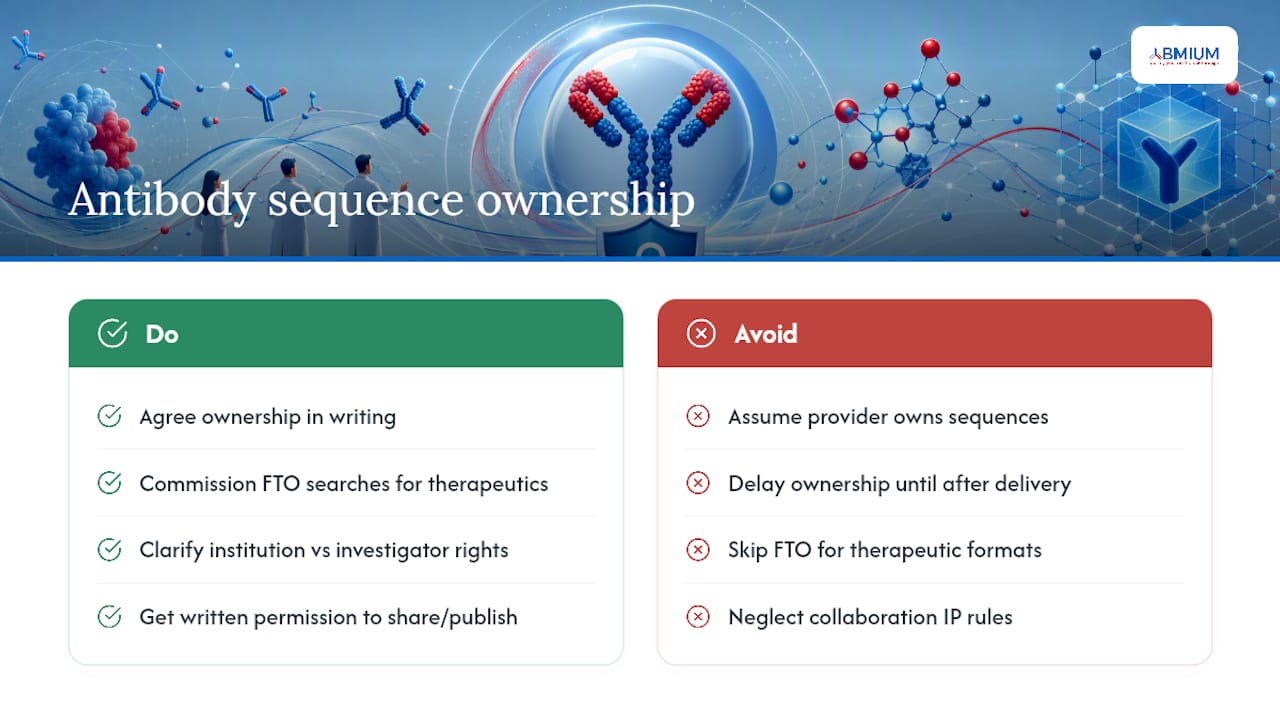
Intellectual property terms in custom antibody development vary considerably between providers, and this is one area where assumptions cause expensive disputes later. Some providers retain rights to the sequence and lead clones by default, licensing use back to the client for a defined purpose. Others transfer full ownership, including sequence data, as a matter of course once the project is paid for.
Establish ownership terms in writing before work begins, not after delivery. If your project may lead to a publication, a patent filing, or a therapeutic development programme, sequence ownership and freedom to operate matter far more than they do for a one-off research tool.
Freedom-to-operate searches are worth commissioning separately when a target antigen or antibody format overlaps with an active patent landscape, particularly for therapeutic antibody formats such as humanised IgG or bispecific constructs, where the patent thickets around framework regions and conjugation chemistries are dense. Academic collaborations commissioning custom work through a core facility should also clarify, in advance, whether the institution or the individual investigator holds rights to any resulting sequence, since this affects later licensing to industry partners.
For research-only reagents with no downstream commercial intent, the practical stakes are lower, but it remains good practice to secure written confirmation that you can share the sequence with collaborators and publish methodological details without separate permission.
What regulatory and ethical rules apply to antibody development?
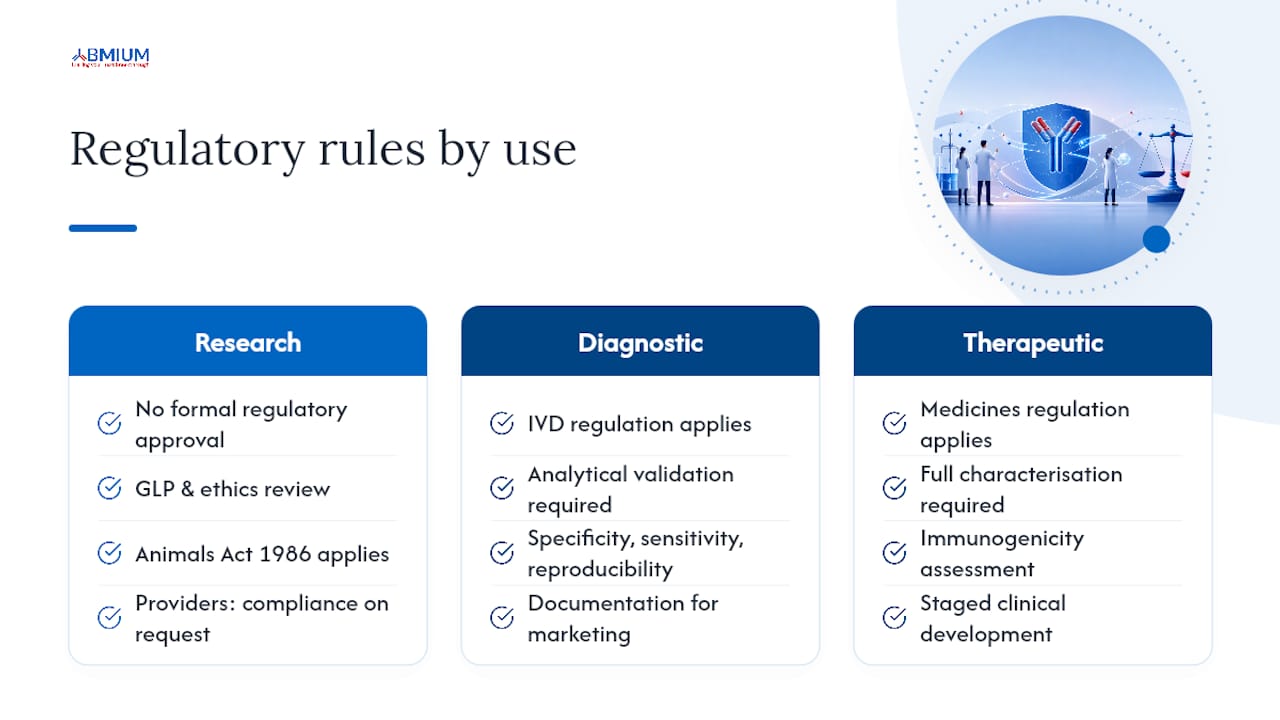
Regulatory expectations for custom antibody development scale sharply with intended use. A reagent destined purely for research use carries no formal regulatory approval requirement in the UK, though good laboratory practice and institutional ethics review still apply wherever animal immunisation is involved. The Animals (Scientific Procedures) Act 1986 governs any UK-based immunisation work, and providers using animal-based discovery platforms should be able to demonstrate compliance and named authority approvals on request.
Diagnostic antibodies intended for clinical use fall under in vitro diagnostic medical device regulation, which requires documented analytical validation, including specificity, sensitivity and reproducibility data, before the reagent can be marketed for patient testing. Therapeutic antibody candidates face a substantially higher bar again: full characterisation, immunogenicity assessment, and staged clinical development under medicines regulatory frameworks, a process that operates on an entirely different timeline and evidence standard from research-grade reagent development.
Ethically, the shift toward in vitro and recombinant discovery platforms reduces reliance on animal immunisation and ascites production, and institutional ethics committees increasingly expect justification when an animal-based route is chosen over an available non-animal alternative. Documenting why a particular platform was selected, and what steps were taken to minimise animal use where it remains necessary, is now a standard expectation in ethics submissions across UK research institutions.
When should you build in-house versus outsource?
Building recombinant expression capability in-house makes financial sense when a lab runs many antibody projects a year and already has the cell culture and molecular biology infrastructure to support it. For occasional projects, outsourcing to a specialist avoids the sunk cost of equipment and expertise that sits idle between projects.
A cost-effective middle path exists when you already hold a hybridoma line: sequencing the hybridoma runs roughly $500 to $1,500, against $5,000 to $12,000 to sequence a purified monoclonal antibody from scratch, making it worth doing before the original clone is lost to passage drift or contamination. The most resilient workflow pairs an institutional core facility for early discovery with an external specialist for scale-up, purification and application validation, keeping control of sequence and IP in-house while outsourcing the capital-intensive stages.
— Veron
Getting started with ABMIUM for your next project
Compared with commissioning a full custom programme from scratch, Some providers offer a starting point with a catalogue of already-characterised reagents to check against your target before committing to a bespoke build, alongside direct custom development and independent validation routes when nothing existing fits.

Before reaching out, prepare three things: the target sequence or accession number, the intended application (Western blot, flow cytometry, immunohistochemistry, or another), and any sample constraints, such as species, fixation method or expected concentration range. This lets providers scope a realistic timeline and validation plan early in the conversation rather than after several rounds of back-and-forth.
ABMIUM’s services cover custom antibody and assay development, independent validation for reagents you already hold, and a growing catalogue of verified primary and secondary antibodies, including options like the anti-rat IgG secondary antibody and anti-human CD45 antibody. If your target already exists in the catalogue, that is usually the faster and cheaper route. If it does not, visit the ABMIUM catalogue to start a custom development enquiry and get a project scope back with a defined timeline.
Sources
- Antibody engineering and design-by-sequence (PMC5649246)
- Generation and diversification of recombinant monoclonal antibodies (eLife)
- Monoclonal antibody production methods (NCBI Bookshelf)
FAQ
How long does custom antibody development typically take?
Recombinant and phage-derived projects can complete discovery in a few weeks, while hybridoma-based projects commonly take three to six months from antigen to validated reagent.
Is a recombinant or monoclonal antibody better for reproducibility?
Recombinant antibodies offer the strongest long-term reproducibility because every batch expresses from the same defined sequence, though a well-sequenced and banked monoclonal clone can approach the same consistency.
What validation data should I request from ABMIUM or any provider?
Ask for data in your specific intended application, such as Western blot, ELISA, immunohistochemistry or flow cytometry, along with lot-to-lot consistency data and sequence information where reproducibility matters.
Does outsourcing cost more than building in-house?
It depends on project frequency: occasional projects are usually cheaper outsourced, while labs running many projects a year often save money building recombinant expression capability internally.
Who owns the antibody sequence after a custom project?
Ownership terms vary by provider and should be agreed in writing before work begins, particularly if the antibody may later support a publication, patent or licensing agreement.