

Antibody conjugation methods fall into three practical classes: random chemistries (lysine/NHS, cysteine/maleimide), site-specific approaches (glycan remodelling, enzymatic tags, engineered residues), and affinity-based noncovalent labelling. Choose random chemistry for speed and low cost, site-specific methods when positional control or diagnostic-grade consistency matters, and always confirm the result with DAR, aggregation, and binding-activity checks before trusting the conjugate.
TL;DR:
- Random conjugation methods are faster and cheaper but produce heterogeneous antibody populations with variable label positions and numbers, which can affect consistency.
- Site-specific approaches, such as glycan remodelling or engineered residues, provide more uniform DAR and better reproducibility, especially important for diagnostic and clinical applications.
- Cysteine conjugation offers better control than lysine chemistry but requires careful reduction, pH, and fresh reagents to prevent aggregation and ensure efficiency.
- Analytical validation including DAR measurement, aggregation checks, and binding activity testing is essential before releasing a conjugate for use, regardless of the chemistry used.
- Moving from small-scale to large-scale production demands tighter process controls and thorough characterization to maintain batch consistency and meet regulatory standards.
Table of Contents
- What are the main categories of antibody conjugation methods?
- Lysine and cysteine chemistry: the workhorse methods
- Site-selective conjugation: glycan, enzymatic, and engineered approaches
- Building a reliable conjugation workflow and QC checklist
- Which method fits your application?
- Troubleshooting common conjugation failures
- How ABMIUM supports reproducible conjugation projects
- How conjugation changes pharmacokinetics and in vivo behaviour
- Scaling antibody conjugation from bench to production
- What actually separates a good conjugation from a failed one
- Source validated antibodies and custom conjugation support
- Sources
- FAQ
What are the main categories of antibody conjugation methods?
Every conjugation strategy sits on a spectrum between speed and homogeneity. Random chemistries attach a label wherever a reactive amino acid happens to be accessible on the antibody surface. Site-specific methods force attachment to one defined location, usually away from the antigen-binding site. The choice between them shapes everything downstream: assay sensitivity, batch-to-batch consistency, and how much analytical work you will need to do before you trust the reagent.
Random conjugation typically targets lysine residues (via NHS esters) or cysteine thiols (via maleimides), exploiting chemistry that has been standard in antibody labelling for decades. It is fast, requires no antibody engineering, and works with almost any purified IgG. The trade-off is heterogeneity. A typical NHS-based reaction produces a distribution of antibodies carrying different numbers of labels attached at different lysines, some of which may sit near the complementarity-determining regions and interfere with binding.
Site-specific conjugation installs the label at one predictable position, using glycan remodelling at the Fc, enzymatic tags such as transglutaminase or sortase, or engineered cysteines and non-canonical amino acids introduced during recombinant expression. These methods produce a defined degree of labelling (DAR) with far less lot-to-lot variability, which matters most when you need reproducible signal intensity across many samples, such as a diagnostic immunoassay or a companion multiplex panel.
Affinity and noncovalent methods, including biotin/streptavidin bridging and Protein A/G capture, avoid chemical modification of the antibody altogether. They are reversible, gentle on binding activity, and useful for pilot experiments, but they are rarely suitable for permanent labelling needed in a validated assay.
Payload chemistry narrows the choice further. Small-molecule fluorophores and biotin tolerate random lysine chemistry reasonably well. Cytotoxic payloads for antibody-drug conjugates, oligonucleotide probes, and enzymes with sensitive active sites usually push researchers towards cysteine or site-specific chemistry, because uncontrolled loading on these larger, more reactive payloads increases the risk of aggregation and loss of function.
For diagnostic-grade reagents, developability considerations enter early. A conjugate destined for a regulated assay needs a manufacturing process that can be locked down and repeated, which is exactly what homogeneous, site-specific conjugation supports. A research-only conjugate used once in a pilot experiment has far more tolerance for batch variation.
Key trade-offs to weigh before committing to a method:
- Positional control: site-specific methods place the label away from the CDRs; random methods do not guarantee this.
- Homogeneity: engineered and enzymatic approaches typically yield a narrow DAR distribution; NHS chemistry yields a broad one.
- Process burden: random chemistry needs no antibody engineering; site-specific methods often require recombinant expression, extra purification, and additional analytics.
- Cost and turnaround: lysine and cysteine chemistries are cheaper and faster for a single small-batch experiment.
- Regulatory tolerance: diagnostic and clinical-grade reagents benefit from the reproducibility that site-specific chemistry provides.
Lysine and cysteine chemistry: the workhorse methods
Lysine conjugation via NHS (N-hydroxysuccinimide) esters remains the most widely used chemical labelling method because nearly every IgG carries 80 to 100 accessible lysine residues on its surface. The NHS ester reacts with the primary amine of the lysine side chain to form a stable amide bond, releasing NHS as a by-product. Reaction conditions are simple: a mildly alkaline buffer (pH 8.0 to 8.5), room temperature, and a defined molar excess of reagent to antibody. The downside is exactly what makes it convenient: the reaction is largely indiscriminate, so different antibody molecules end up carrying different numbers of labels at different positions.
Cysteine conjugation offers more control. Native IgG has interchain disulfide bonds holding the heavy and light chains together, and these can be selectively reduced with a mild reducing agent (commonly TCEP or DTT) to expose free thiols. Those thiols then react with maleimides, haloacetamides, or pyridyl disulfides to form the conjugate. Because there are fewer accessible thiols than lysines, and because they cluster at defined disulfide positions, cysteine chemistry produces a more constrained, though still not perfectly uniform, labelling pattern. Incomplete reduction control, however, can still generate mixed DARs and drive aggregation.
Disulfide re-bridging chemistries, including bis-sulfone and ThioBridge-type linkers, go a step further by reconnecting the two cysteine thiols left after reduction with a single bridging linker rather than two separate ones. This restores some of the structural stability lost during reduction and produces a narrower DAR distribution than standard maleimide chemistry, at the cost of a more complex reagent and reaction setup.
A practical sequence for a cysteine-based conjugation:
- Confirm antibody purity and concentration, then buffer-exchange into a reduction-compatible buffer free of competing thiols.
- Reduce interchain disulfides with a controlled molar excess of TCEP, monitoring reduction extent where possible.
- Remove excess reducing agent before adding the maleimide-linker reagent, since residual reductant will quench the maleimide.
- React at the specified molar ratio, pH, and temperature for the recommended time window.
- Quench unreacted maleimide with a small-molecule thiol, then purify by desalting or size-exclusion chromatography.
Maleimide hydrolysis is a known failure point: maleimides can hydrolyse to an unreactive ring-opened form in aqueous buffer over time, particularly at higher pH or temperature, which lowers effective coupling efficiency if the reagent sits too long before use. Next-generation maleimides with improved hydrolytic stability address this, but freshly prepared stock and prompt use remain the more reliable fix in most labs.
Heterogeneity tolerance depends entirely on the downstream assay. A flow cytometry panel using a fluorophore-conjugated antibody at saturating concentration will often tolerate a broad DAR distribution without any visible effect on signal. A quantitative immunoassay depending on a fixed signal-to-antibody ratio, or an antibody-drug conjugate where loading directly affects potency and toxicity, cannot. Higher or uneven loading has been linked to faster clearance and greater toxicity risk in ADC development, and a lower, more uniform DAR frequently outperforms a higher but heterogeneous one for stability and exposure.
Pro Tip: Run a small pilot matrix of three or four reagent-to-antibody ratios before committing to a full-scale reaction. Overconjugation causes more binding loss and aggregation than most researchers expect, and a quick titration saves far more material than it costs.
Site-selective conjugation: glycan, enzymatic, and engineered approaches
When positional control matters more than speed, three families of site-specific chemistry dominate current practice: glycan-directed labelling, enzymatic tag methods, and engineered-residue approaches. Each trades additional process complexity for a tighter, more predictable conjugate.
Glycan remodelling exploits the conserved N-linked glycan on the Fc region of IgG (at Asn297). A typical workflow enzymatically trims the native glycan down to a minimal core structure, then installs a chemical handle, such as an azide or aldehyde, onto the remaining sugar using a glycosyltransferase or oxidation step. That handle then reacts with a complementary click-chemistry partner carrying the payload. Because the glycan sits far from the CDRs, this route reliably avoids the antigen-binding site. It works on native, unmodified antibodies, so no recombinant engineering is required, but it does depend on a homogeneous starting glycoform and adds enzymatic steps that need their own quality control.
Enzymatic and tag-based methods use a specific enzyme to attach the payload at a defined recognition sequence. Microbial transglutaminase recognises a glutamine within a short peptide tag (sometimes engineered into the antibody, sometimes exploiting a native glutamine) and forms an isopeptide bond with a primary amine on the payload. Sortase A recognises an LPXTG motif and performs a transpeptidation reaction. SNAP-tag and similar self-labelling protein tags react covalently and rapidly with benzylguanine-linked payloads. Some of these need an engineered tag fused to the antibody sequence; others, particularly newer transglutaminase-based chemistries, can act on select native antibody residues without any sequence modification, which is a meaningful advantage when engineering the antibody is not practical. Recent work confirms that enzyme- or affinity-mediated approaches can modify native antibodies directly, giving site-specificity without the expression changes that engineered tags require.
Engineered cysteines and non-canonical amino acids give the highest positional precision available. THIOMAB-style engineering introduces a single reactive cysteine at a defined, surface-exposed, non-CDR position during antibody expression; non-canonical amino acid incorporation goes further, introducing a bio-orthogonal functional group (such as an azide or alkyne-bearing residue) at a genetically encoded position for click-chemistry conjugation. Both approaches deliver essentially uniform DAR and near-total positional control. Both also require recombinant expression of the antibody, meaning they are unavailable for off-the-shelf antibodies purchased from a catalogue, and they demand extra chemistry, manufacturing, and controls (CMC) work to characterise the engineered cell line and confirm the modification did not introduce new liabilities.
Affinity-based and noncovalent conjugation, using biotin/streptavidin bridging or Protein A/G capture, sits apart from the covalent methods above. These approaches attach a payload through a strong but non-covalent interaction rather than a chemical bond, which makes them fast to set up and gentle on the antibody, at the cost of being reversible under some assay conditions. They suit pilot screening, secondary detection layers in multiplex panels, and situations where permanent modification is unnecessary or undesirable.
A key mechanistic insight ties all site-specific strategies together: modifying a residue too close to the CDRs risks reducing affinity regardless of how precise the chemistry is, which is exactly why Fc glycan, Fc-affinity, and engineered-tag strategies are designed to keep the attachment point away from the antigen-binding surface.
Trade-offs worth weighing before selecting a site-specific route:
- Process burden: glycan and native chemoenzymatic methods need no antibody engineering; engineered residues do.
- DAR uniformity: engineered cysteines and non-canonical amino acids give the narrowest distribution; enzymatic tags are close behind.
- Turnaround: chemoenzymatic methods on catalogue antibodies are faster than routes requiring new recombinant expression.
- Analytical burden: every site-specific method adds characterisation steps beyond what random chemistry requires.
- Suitability for off-the-shelf reagents: only glycan and native enzymatic methods work directly on antibodies you did not engineer yourself.
Site-specific approaches consistently produce more homogeneous conjugates and are the right choice when positional control or long-term developability outweighs the extra expression, purification, and analytical work they demand. The decision should start from the product attributes you actually need, not from a default preference for whichever chemistry is newest.
Building a reliable conjugation workflow and QC checklist
A conjugation reaction that looks clean by protein concentration alone can still be a functional failure. The workflow below reflects the sequence most labs use to avoid that trap.
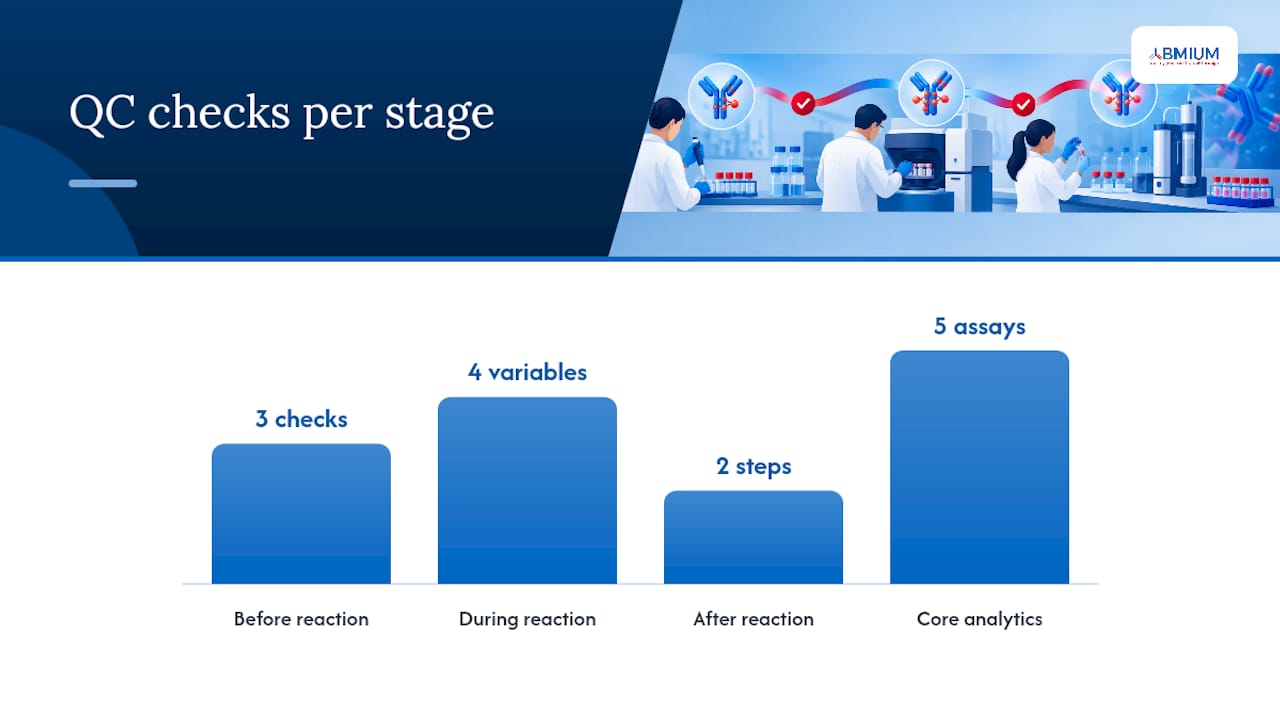
Before the reaction begins, confirm three things about the antibody: concentration (by A280 or a validated protein assay), buffer composition, and purity. Buffer composition deserves particular attention, because carrier proteins such as BSA, competing free amines, sodium azide, and residual reducing agents are among the most common hidden causes of failed labelling, quietly consuming reagent before it ever reaches the antibody. Dialysis, desalting columns, or ultrafiltration remove these additives when the antibody tolerates the handling, and this single buffer exchange step resolves more failed reactions than any adjustment to reagent ratio.
During the reaction, four variables need explicit control: stoichiometry (molar ratio of reagent to antibody), pH, temperature, and reaction time. Small deviations in any of these shift the DAR distribution, sometimes substantially. After the reaction, unreacted reagent must be quenched, and the conjugate purified away from free label and any newly formed aggregates, typically by desalting, size-exclusion chromatography (SEC), or affinity purification depending on the payload.
Core analytics follow a consistent pattern across labelling chemistries:
- Remove free, unconjugated label completely, since residual free dye or payload inflates apparent signal and confounds every downstream measurement.
- Run SEC to check for aggregation and high-molecular-weight species, which uneven charge distribution or hydrophobic payloads tend to promote.
- Measure the degree of labelling (DAR) using UV absorbance ratios for chromophoric labels, or intact mass spectrometry and peptide mapping for a more precise readout.
- Confirm retained antigen binding activity with an ELISA, SPR, or flow cytometry assay run alongside the unconjugated parent antibody as a comparator.
- Test stability under realistic storage and handling conditions, including at least one freeze-thaw cycle, before releasing the conjugate for use.
This sequence mirrors the practical workflow described in the antibody conjugation and formulation literature: define the application and label first, confirm concentration and purity, remove reactive additives, exchange buffer, run a controlled coupling reaction, then quench, purify, and measure DAR, purity, aggregation, and binding before calling the conjugate ready. The same source recommends including free payload, intact mass or peptide mapping, and post-storage stability testing in the standard analytical package.
DNA and oligonucleotide conjugates need a modified analytical approach, because nucleic acids behave differently under standard chromatography and mass spectrometry conditions. Combining orthogonal methods such as SEC-MS, ion-exchange chromatography coupled to mass spectrometry (IEC-MS), and SEC-MALS gives a more reliable picture than any single technique alone, since the charge and ionisation behaviour of oligo conjugates can distort results from methods validated on protein-only conjugates. Hydrophobic payloads carry their own risk profile, driving aggregation even at moderate DAR, so a stabilising excipient or a lower loading target is often the safer starting point.
Pro Tip: Keep an unconjugated aliquot of every antibody lot you label. Running it side by side in your binding assay is the fastest way to tell whether a drop in signal comes from the conjugation chemistry or from the antibody lot itself.
Which method fits your application?
Matching a conjugation method to an experiment comes down to five practical axes: how much positional control you need, how much heterogeneity your assay can absorb, the chemistry of your payload, the sensitivity your detection system demands, and the analytics you actually have access to. Working through these in order, before touching a reagent, saves more time than any single chemistry decision.
A flow cytometry panel labelling a catalogue antibody with a standard fluorophore is usually well served by lysine or cysteine chemistry. Saturating antibody concentrations and gated positive/negative populations tolerate a broad DAR distribution without materially affecting the result.
A multiplexed immunoassay, where signal from several channels must stay proportionate and reproducible across plates, benefits from site-specific or at least tightly controlled cysteine chemistry. Batch-to-batch DAR drift here directly threatens quantitative accuracy.
Immuno-PCR, which relies on extremely low background and a defined oligo-to-antibody ratio to achieve its sensitivity advantage, almost always needs site-specific or carefully controlled cysteine conjugation, since a heterogeneous oligo attachment undermines the amplification step that gives the assay its power.
Early-stage antibody-drug conjugate chemistry work typically starts with cysteine or lysine conjugation for rapid screening across candidate linkers and payloads, then migrates to site-specific chemistry (engineered cysteine, glycan, or enzymatic tag) once a lead candidate needs a defined, reproducible DAR for further development.
Quick reference for common scenarios:
- Pilot screening or single-use research experiment: lysine (NHS) chemistry, fastest and cheapest.
- Routine flow cytometry or immunofluorescence: cysteine/maleimide chemistry, good balance of control and speed.
- Quantitative or multiplex diagnostic assay: site-specific chemistry (glycan, enzymatic tag) for reproducibility.
- Immuno-PCR or oligo conjugate work: site-specific chemistry paired with orthogonal analytics.
- ADC lead optimisation: cysteine re-bridging or engineered-residue chemistry once a candidate is selected.
Outsourcing becomes the sensible choice once a project needs recombinant antibody engineering, non-canonical amino acid incorporation, or analytical capability the lab does not routinely run, such as native mass spectrometry or spatial validation. Building that capability in-house for a single project rarely pays for itself; a specialist collaboration usually reaches a validated conjugate faster and with fewer surprises.
Troubleshooting common conjugation failures
Most conjugation problems trace back to one of three root causes, and each has a defined diagnostic path.
High aggregation after conjugation usually points to overlabelling or a hydrophobic payload disrupting the antibody’s surface properties. The corrective sequence is straightforward:
- Reduce the reagent-to-antibody molar ratio in a repeat reaction and compare SEC profiles side by side.
- Change the reaction or storage buffer, since ionic strength and pH both influence aggregation propensity.
- Add a stabilising excipient (a low concentration of a compatible surfactant or sugar) if the payload itself is hydrophobic.
- Re-run SEC after each change to confirm the aggregate peak has genuinely shrunk, not just shifted.
Loss of binding activity signals that the label landed too close to the antigen-binding site. Confirm this with a competitive ELISA or SPR assay comparing conjugate to unconjugated parent antibody. If binding loss correlates with labelling extent, the conjugation site is the likely culprit, and switching to an Fc-directed glycan or enzymatic tag strategy that keeps the label away from the CDRs is the most direct fix.
Low labelling efficiency often comes down to buffer chemistry or reagent quality: competing amines or residual reducing agent in the buffer, degraded or improperly stored reagent, or a reagent-to-antibody ratio set too conservatively. Checking buffer composition first, then reagent freshness, then stoichiometry, resolves most cases without needing to change chemistry entirely. Extending reaction time or switching to a more reactive linker chemistry are reasonable next steps if buffer and reagent are confirmed clean.
After any correction, re-run the full validation panel, SEC for aggregation, the binding assay, and DAR measurement, rather than trusting a single improved metric in isolation. A conjugate that now shows the right DAR but has not been re-tested for binding activity is not yet validated.
Pro Tip: Discard a batch rather than re-optimise it when more than one QC metric fails simultaneously (for example, high aggregation plus reduced binding). Chasing a single parameter on a compromised batch usually costs more bench time than starting a fresh, smaller-scale reaction.
How ABMIUM supports reproducible conjugation projects
Reliable conjugation starts before the reaction, with the antibody itself. ABMIUM MATCH gives researchers scientist-led help comparing suitable primary antibodies and their supporting validation evidence, which reduces the risk of discovering, after a full conjugation and QC cycle, that the starting antibody was never fit for the intended application.
For projects that need more than an off-the-shelf reagent, ABMIUM’s custom antibody and ELISA development services cover bespoke antibody generation, protein production, and assay design where a catalogue product will not do. Independent product validation, together with access to native mass spectrometry and spatial validation through specialist collaborators, gives researchers a route to confirm a conjugate’s identity, homogeneity, and binding activity beyond what an in-house lab can typically run.
Engaging is straightforward: submit your experimental requirements through the scientist-led sourcing service and request a quote for custom conjugation, development, or validation work through the custom product page. The goal throughout is traceability, knowing exactly what antibody, what chemistry, and what evidence stands behind a conjugate before it goes into a critical experiment.
How conjugation changes pharmacokinetics and in vivo behaviour
Conjugation does not just change what an antibody can detect; it changes how the antibody behaves once it leaves the test tube. Attaching a payload can alter circulating half-life, tissue distribution, and clearance rate, and the direction of that change depends heavily on the payload’s chemistry and how much of it is attached.
Hydrophobic payloads tend to increase nonspecific uptake by the liver and other clearance organs, shortening circulating half-life compared with the unmodified antibody. Charge changes introduced by the label, particularly with highly charged fluorophores or nucleic acid payloads, can shift renal clearance and alter how the conjugate distributes across tissue compartments. None of this is unique to therapeutic antibody-drug conjugates. A heavily labelled imaging or diagnostic antibody used in an in vivo model can show meaningfully different biodistribution from its parent antibody, which matters for anyone using conjugated antibodies in animal-based validation work rather than purely in vitro assays.
DAR itself is a major driver of this effect. Higher or heterogeneous loading has been shown to increase clearance and toxicity in antibody-drug conjugate development, and a lower, more uniform DAR frequently performs better for both stability and systemic exposure than a higher but inconsistent one. This is a direct consequence of aggregation-prone, unevenly loaded conjugates being recognised and cleared faster by the body’s own protein quality-control systems.
For research and diagnostic applications that stay in vitro, these effects rarely matter. For anyone running conjugated antibodies through an animal model, whether for imaging, pharmacokinetic characterisation, or early efficacy work, the same conservative DAR strategy that improves in vitro stability tends to improve in vivo behaviour too.
Scaling antibody conjugation from bench to production
Moving a conjugation protocol from a microgram-scale bench reaction to a gram-scale or production run exposes problems that never appear at small volume. Mixing efficiency, heat transfer, and reaction homogeneity all behave differently at larger scale, and a reaction that gave a clean, narrow DAR distribution in a microcentrifuge tube can drift wider once scaled into a bioreactor-format vessel.
Process controls that matter most at scale include tighter control of addition rate (adding reagent too quickly locally overshoots the target ratio before it has time to mix), more rigorous temperature control throughout the vessel rather than just at a single monitored point, and in-process sampling at multiple stages rather than relying solely on an end-point measurement. Purification also changes character at scale: desalting columns that work well for milligram quantities are usually replaced by tangential flow filtration or preparative chromatography for larger batches, and each of those techniques needs its own qualification against the DAR and aggregation specifications set at bench scale.
For clinical-grade or diagnostic-grade production, the analytical package established during method development becomes the basis for a locked-down release specification: DAR range, aggregation limit, free-label limit, and a defined binding-activity threshold, each with a validated assay method behind it. Site-specific chemistries generally scale more predictably than random lysine or cysteine labelling, precisely because their narrower starting DAR distribution leaves less room for scale-related drift to push a batch out of specification. Teams planning to scale should treat the analytical characterisation work built during bench development, not the reaction conditions alone, as the real deliverable to carry forward.
What actually separates a good conjugation from a failed one
The gap between a technically successful reaction and a genuinely useful conjugate is where most published protocols fall short. Reaction yield and DAR are the numbers everyone reports, yet they say nothing about whether the antibody still binds its target the way it did before conjugation. That gap is where I would put the most weight when judging any new conjugation method, not on how elegant the chemistry looks on paper.
Three rules of thumb hold up consistently across chemistries. First, always run a small pilot matrix of ratios before scaling a reaction, because overconjugation causes more damage than underconjugation and a titration is cheap insurance. Second, prioritise the binding assay over the DAR measurement when the two conflict; a beautifully uniform conjugate that has lost affinity is not a success. Third, outsource the moment a project needs recombinant engineering or analytics your lab does not run routinely, rather than building that capability for a single experiment.
Reproducibility is not a bureaucratic afterthought here. Every hour spent on buffer exchange and QC upfront is an hour saved chasing a failed downstream experiment months later.
— Veron
Source validated antibodies and custom conjugation support
This service provides a clearer starting point than a standard catalogue purchase: verified manufacturer provenance and structured validation evidence before committing an antibody to a conjugation project, rather than discovering problems after the reaction is already run.

Start with the primary antibodies collection to source starting material with clearer provenance for lysine or cysteine labelling. If your project needs a defined DAR, a bespoke binding profile, or an antibody format that does not exist off the shelf, the custom antibody and development services page covers custom antibody generation, protein production, ELISA development, and PCR/qPCR assay work, each scoped around your experimental requirements rather than a fixed catalogue item. Researchers validating a finished conjugate can also draw on ELISA kits to confirm retained binding activity against a known standard.
The most direct next step is to submit your experimental requirements through a scientist-led sourcing service and request a quote for custom conjugation support or independent validation work suited to your specific application.
Sources
For deeper mechanistic and comparative detail beyond this guide, the antibody conjugation and formulation review covers reduction and maleimide chemistry risks, the Antibody Therapeutics review of ADC conjugation technologies compares site-specific platforms, and the practical conjugation workflow paper sets out the stepwise protocol and analytical package referenced throughout this article.
- Antibody conjugation and formulation - PMC
- Antibody-drug conjugate review (JNCI)
- Antibodies 101: conjugation (Addgene blog)
FAQ
What is the difference between random and site-specific conjugation?
Random conjugation attaches a label at multiple accessible lysine or cysteine positions across the antibody, producing a mixed DAR distribution. Site-specific conjugation places the label at one defined position, usually away from the antigen-binding site, giving a narrower, more reproducible DAR at the cost of extra process complexity.
How do I choose the best DAR for my antibody conjugate?
There is no universal ideal DAR; it depends on payload and application. Evidence from antibody-drug conjugate development shows a lower, uniform DAR often outperforms a higher but heterogeneous one for stability and reduced aggregation, so a conservative starting ratio, confirmed by a pilot titration, is the safer default for most research and diagnostic reagents.
Why does a conjugate lose binding activity even when labelling looks successful?
Loss of binding usually means the label attached near or within the complementarity-determining regions, physically blocking antigen engagement. A chemically successful coupling can still be a functional failure, which is why every conjugate needs a binding assay run against the unconjugated parent antibody, not just a DAR measurement.
When should I outsource antibody conjugation rather than run it in-house?
Outsourcing makes sense once a project needs recombinant antibody engineering, non-canonical amino acid incorporation, or analytics such as native mass spectrometry that most labs do not run routinely. ABMIUM’s custom antibody and development services support projects at this level, and pricing is available on request through the site.
What is the minimum QC panel for a new antibody conjugate?
At minimum, confirm removal of free label, run size-exclusion chromatography for aggregation, measure DAR by UV ratio or mass spectrometry, and test binding activity against an unconjugated control. This sequence follows the practical conjugation and characterisation workflow used across current antibody labelling protocols.