Vimentin (phospho Ser83) Kaninchen-pAk von ELK Biotechnology
Know who made it. See the evidence. Buy through one marketplace.
Vimentin (phospho Ser83) rabbit pAb ist ein ELK Biotechnology Antikörper für Forschungsabläufe, die Vimentin betreffen.
Dieses Gen kodiert ein Mitglied der Intermediärfilamentfamilie. Intermediärfilamente bilden zusammen mit Mikrotubuli und Aktinmikrofilamenten das Zytoskelett. Das von diesem Gen kodierte Protein ist für die Aufrechterhaltung der Zellform, die Integrität des Zytoplasmas und die Stabilisierung von Zytoskelett-Interaktionen verantwortlich. Es ist auch an der Immunantwort beteiligt und steuert den Transport von aus Lipoproteinen niedriger Dichte (LDL) stammendem Cholesterin von einem Lysosom zum Veresterungsort. Es fungiert als Organisator einer Reihe kritischer Proteine, die an Anhaftung, Migration und Zellsignalisierung beteiligt sind. Mutationen in diesem Gen verursachen einen dominanten pulverförmigen Katarakt. [Bereitgestellt von RefSeq, Juni 2009]
| Spezifität | Der Phospho-Vimentin (S83) polyklonale Antikörper detektiert endogene Vimentin-Proteinspiegel nur, wenn diese an S83 phosphoryliert sind. |
|---|---|
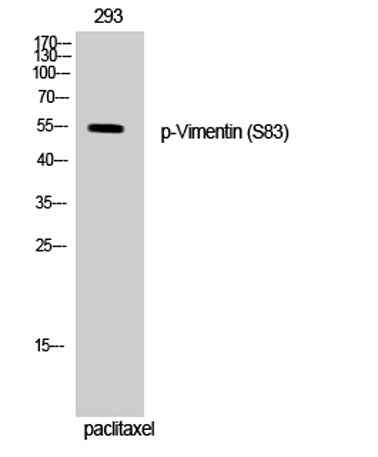
| Validierungsnachweis-Beschriftungen | Western-Blot-Analyse von 293-Zellen mit Phospho-Vimentin (S83) polyklonalem Antikörper | Immunhistochemische Analyse von paraffin-eingebettetem menschlichem Gehirn. Der Antikörper wurde 1:100 verdünnt (4° über Nacht). Für die Antigen-Retrieval wurde Tris-EDTA, pH 8,0 unter hohem Druck und hoher Temperatur verwendet. Die negative Kontrolle (rechts) wurde aus dem Antikörper gewonnen, der zuvor durch Immunogen-Peptid präabsorbiert wurde. | Immunhistochemische Analyse von paraffin-eingebettetem menschlichem Brustkarzinom unter Verwendung des Vimentin (Phospho-Ser83) Antikörpers. Das Bild rechts ist mit dem Phosphopeptid blockiert. | Western-Blot-Analyse von Lysaten aus 293-Zellen, die 24 Stunden lang mit Paclitaxel 1 uM behandelt wurden, unter Verwendung des Vimentin (Phospho-Ser83) Antikörpers. Die rechte Spur ist mit dem Phosphopeptid blockiert. |
Fully tested in-house by ABMIUM, or supported by an advanced validation report from a partner reviewed by ABMIUM. Highest confidence. Non-conformities fully supported under the ABMIUM Product Promise.
Quality verified. Independent collaborator or expected-performance data available. Product meets ABMIUM quality standards.
Expected to work based on structural and biochemical data. Not yet directly tested by ABMIUM or a collaborator. No non-conformity support for this combination.
Not recommended for this application or species/sample combination. This may indicate either evidence of unsuitability or that the combination has not been tested and therefore cannot currently be recommended.
Evidence status by application and model.
| Arten | WB | IHC | IF | ELISA | IP | FCM | ChIP |
|---|---|---|---|---|---|---|---|
| Mensch | |||||||
| Maus | |||||||
| Ratte |
This product is manufactured by ELK Biotechnology and sold through ABMIUM without relabelling.
ABMIUM supports global orders. Availability, shipping requirements and applicable import arrangements are confirmed before fulfilment where required.
Yes. Send your target, sample, application and experimental conditions through ABMIUM MATCH or technical support.
Unless the listing expressly states otherwise, ABMIUM products are supplied for research use only and are not for diagnostic or therapeutic use.
VIM identifies vimentin in Homo sapiens (Human). This target record connects NCBI Gene 7431, UniProtKB P08670 and related ABMIUM catalogue products.
Biological function: VIM (vimentin) is a class III intermediate-filament protein expressed especially in mesenchymal and other non-epithelial cells. It contributes to cytoskeletal organisation, cell shape and directional migration, including organisation at the leading edge of migrating cells.