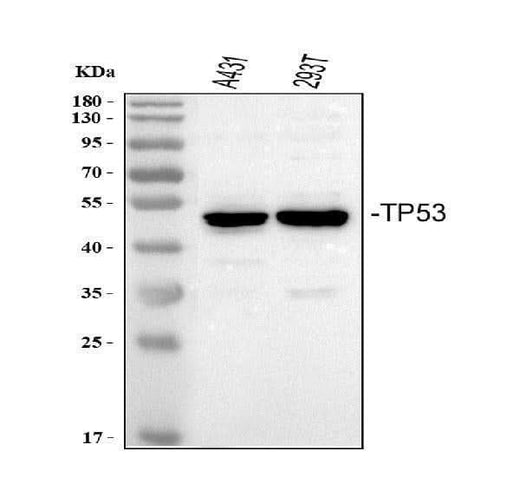
Primärer Antikörper geliefert von Boster Bio
Know who made it. See the evidence. Buy through one marketplace.
Das p53-Tumorantigen findet sich in erhöhten Mengen in einer Vielzahl von transformierten Zellen. Das Protein ist auch in vielen aktiv proliferierenden, nicht-transformierten Zellen nachweisbar, ist aber in ruhenden Zellen nicht nachweisbar oder nur in geringen Mengen vorhanden. Dieses Protein induziert Zellzyklusarrest oder Apoptose als Reaktion auf subletale bzw. schwere DNA-Schäden, durch differentielle Transkription von Zielgenen und durch transkriptionsunabhängige apoptotische Funktionen. Das p53-Protein enthält 393 Aminosäuren. Das menschliche p53-Tumorantigen ist an Band 17p13 lokalisiert. p53-Mutationen sind häufig bei Bauchspeicheldrüsenkrebs und fehlen bei chronischer Pankreatitis.
| Anbieter | Boster Bio |
|---|---|
| ABMIUM Evidenzstatus | ABMIUM Verified™ Kollaborateur-getestete Daten |
| Katalognummer | PB9008 |
| Produktkategorie | Primäre Antikörper |
| Reaktive Spezies | Mensch |
| Getestete Anwendungen | ELISA, Durchflusszytometrie, IF/ICC, IHC, IHC-P, WB |
| Verfügbare Konjugationen | Unkonjugiert, Biotin, Cy3, Fluoro488, Fluoro550, Fluoro594, FITC, HRP, APC, PE, Fluoro647 |
| Genname | TP53 |
| Proteinname | Zelluläres Tumorantigen p53 |
| Spezifität | Keine Kreuzreaktivität mit anderen Proteinen. |
| Immunogen | Aus E. coli stammendes rekombinantes humanes P53-Protein (Position: A74-D393). Humanes P53 teilt 83 % bzw. 85 % Aminosäuresequenzidentität mit Maus- und Ratten-P53. |
| Wirt | Kaninchen |
| Klonalität | Polyklonal |
| Isotyp | Kaninchen-IgG |
| Reinigung | Immunogen-affinitätsgereinigt. |
| Lagerung | Bei -20℃ für ein Jahr ab Erhalt lagern. Nach Rekonstitution bei 4℃ für einen Monat. Es kann auch aliquotiert und für sechs Monate bei -20℃ eingefroren gelagert werden. Wiederholte Einfrier-Auftau-Zyklen vermeiden. |
| UniProt | P04637 |
| NCBI Gen-ID | 7157 |
| Konjugation | Größe |
|---|---|
| Unkonjugiert | 100 μg/Vial |
| Biotin | 100 μg/Vial |
| Cy3 | 100 μg/Vial |
| Fluoro488 | 100 μg/Vial |
| Fluoro550 | 100 μg/Vial |
| Fluoro594 | 100 μg/Vial |
| FITC | 100 μg/Vial |
| HRP | 100 μg/Vial |
| APC | 100 μg/Vial |
| PE | 100 μg/Vial |
| Fluoro647 | 100 μg/Vial |
Fully tested in-house by ABMIUM, or supported by an advanced validation report from a partner reviewed by ABMIUM. Highest confidence. Non-conformities fully supported under the ABMIUM Product Promise.
Quality verified. Independent collaborator or expected-performance data available. Product meets ABMIUM quality standards.
Expected to work based on structural and biochemical data. Not yet directly tested by ABMIUM or a collaborator. No non-conformity support for this combination.
Not recommended for this application or species/sample combination. This may indicate either evidence of unsuitability or that the combination has not been tested and therefore cannot currently be recommended.
Evidence status by application and model.
| Arten | WB | IHC | IHC-P | IHC-F | IF/ICC | Durchflusszytometrie | ELISA | IP |
|---|---|---|---|---|---|---|---|---|
| Human |
This product is manufactured by Boster Bio and sold through ABMIUM without relabelling.
ABMIUM supports global orders. Availability, shipping requirements and applicable import arrangements are confirmed before fulfilment where required.
Yes. Send your target, sample, application and experimental conditions through ABMIUM MATCH or technical support.
Unless the listing expressly states otherwise, ABMIUM products are supplied for research use only and are not for diagnostic or therapeutic use.
TP53 identifies tumor protein p53 in Homo sapiens (Human). This target record connects NCBI Gene 7157, UniProtKB P04637 and related ABMIUM catalogue products.
Biological function: TP53 encodes p53, a multifunctional DNA-binding transcription factor that responds to cellular stress by regulating programmes including cell-cycle arrest, DNA repair and apoptosis. Its activity is controlled by extensive protein interactions and post-translational regulation.