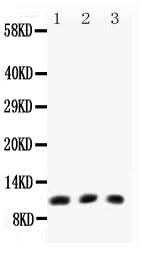
Primärantikörper geliefert von Boster Bio
Know who made it. See the evidence. Buy through one marketplace.
CCL11, auch bekannt als Eotaxin, ist ein potenter Induktor der Eosinophilen-Chemotaxis und gilt als selektiver Ligand des CC-Chemokinrezeptors 3 (CCR3), der auf Eosinophilen, Basophilen und Th2-Lymphozyten exprimiert wird. Das Gen kartiert auf Chromosom 17 und wird konstitutiv in hohen Mengen im Dünndarm und Kolon sowie in geringeren Mengen in verschiedenen anderen Geweben exprimiert. CCL11 ist ein kleines Zytokin, das zur CC-Chemokinfamilie gehört. Es wird angenommen, dass es an eosinophilen Entzündungskrankheiten wie atopischer Dermatitis, allergischer Rhinitis, Asthma und parasitären Infektionen beteiligt ist. Die Wirkungen von CCL11 werden durch seine Bindung an einen G-Protein-gekoppelten Rezeptor, einen Chemokinrezeptor, vermittelt.
| Lieferant | Boster Bio |
|---|---|
| ABMIUM Evidenzstatus | ABMIUM Verified™ Kollaborateur-getestete Daten |
| Katalognummer | PB9065 |
| Produktkategorie | Primärantikörper |
| Reaktive Spezies | Maus |
| Getestete Anwendungen | ELISA, Durchflusszytometrie, IHC, IHC-P, WB |
| Verfügbare Konjugationen | Unkonjugiert, Biotin, Cy3, Fluoro488, Fluoro550, Fluoro594, FITC, HRP, APC, PE, Fluoro647 |
| Genname | CCL11 |
| Proteinname | Eotaxin |
| Spezifität | Keine Kreuzreaktivität mit anderen Proteinen. |
| Immunogen | E.coli-abgeleitetes rekombinantes Maus-Eotaxin-Protein (Position: H24-P97). Maus-Eotaxin teilt 62 % und 97 % Aminosäuresequenzidentität mit menschlichem bzw. Ratten-Eotaxin. |
| Wirt | Kaninchen |
| Klonalität | Polyklonal |
| Isotyp | Kaninchen-IgG |
| Reinigung | Immunogen-affinitätsgereinigt. |
| Lagerung | Ein Jahr ab Erhalt bei -20℃ lagern. Nach der Rekonstitution einen Monat bei 4℃ lagern. Es kann auch in Aliquots aufgeteilt und sechs Monate bei -20℃ eingefroren gelagert werden. Wiederholtes Einfrieren und Auftauen vermeiden. |
| UniProt | P48298 |
| NCBI Gen-ID | 20292 |
| Konjugation | Größe |
|---|---|
| Unkonjugiert | 100 μg/Vial |
| Biotin | 100 μg/Vial |
| Cy3 | 100 μg/Vial |
| Fluoro488 | 100 μg/Vial |
| Fluoro550 | 100 μg/Vial |
| Fluoro594 | 100 μg/Vial |
| FITC | 100 μg/Vial |
| HRP | 100 μg/Vial |
| APC | 100 μg/Vial |
| PE | 100 μg/Vial |
| Fluoro647 | 100 μg/Vial |
Fully tested in-house by ABMIUM, or supported by an advanced validation report from a partner reviewed by ABMIUM. Highest confidence. Non-conformities fully supported under the ABMIUM Product Promise.
Quality verified. Independent collaborator or expected-performance data available. Product meets ABMIUM quality standards.
Expected to work based on structural and biochemical data. Not yet directly tested by ABMIUM or a collaborator. No non-conformity support for this combination.
Not recommended for this application or species/sample combination. This may indicate either evidence of unsuitability or that the combination has not been tested and therefore cannot currently be recommended.
Evidence status by application and model.
| Arten | WB | IHC | IHC-P | IHC-F | IF/ICC | Durchflusszytometrie | ELISA | IP |
|---|---|---|---|---|---|---|---|---|
| Mouse |
This product is manufactured by Boster Bio and sold through ABMIUM without relabelling.
ABMIUM supports global orders. Availability, shipping requirements and applicable import arrangements are confirmed before fulfilment where required.
Yes. Send your target, sample, application and experimental conditions through ABMIUM MATCH or technical support.
Unless the listing expressly states otherwise, ABMIUM products are supplied for research use only and are not for diagnostic or therapeutic use.
CCL11 identifies C-C motif chemokine ligand 11 in Homo sapiens (Human). This target record connects NCBI Gene 6356, UniProtKB P51671 and related ABMIUM catalogue products.