
ELISA Kit supplied by Boster Bio Read more ›

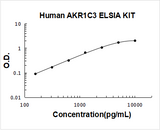
Human AKR1C3 ELISA Kit PicoKine® is a research-use ELISA kit from Boster Bio for measuring Aldo-keto reductase family 1 member C3 in Cell culture supernatant, serum and plasma (heparin, EDTA). samples from Human. Use the listed assay range, sample guidance and protocol documents to assess suitability for the intended study.
Human AKR1C3 ELISA Kit PicoKine® (96 Tests). Quantitate Human AKR1C3 in cell culture supernatants, serum and plasma (heparin, EDTA). Sensitivity: 10pg/ml. The brand Picokine indicates this is a premium quality ELISA kit. Each Picokine kit delivers precise quantification, high sensitivity, and excellent reproducibility. Only our most reliable and effective kits qualify as Picokine, guaranteeing top-tier results for your assays.Aldo-keto reductase family 1 member C3 (AKR1C3), also known as 17β-hydroxysteroid dehydrogenase type 5 (17β-HSD5, HSD17B5) is a key steroidogenic enzyme that in humans is encoded by the AKR1C3 gene. It is mapped to 10p15.1. This gene encodes a member of the aldo/keto reductase superfamily, which consists of more than 40 known enzymes and proteins. These enzymes catalyze the conversion of aldehydes and ketones to their corresponding alcohols by utilizing NADH and/or NADPH as cofactors. The enzymes display overlapping but distinct substrate specificity. This enzyme catalyzes the reduction of prostaglandin (PG) D2, PGH2 and phenanthrenequinone (PQ), and the oxidation of 9alpha,11beta-PGF2 to PGD2. It may play an important role in the pathogenesis of allergic diseases such as asthma, and may also have a role in controlling cell growth and/or differentiation. This gene shares high sequence identity with three other gene members and is clustered with those three genes at chromosome 10p15-p14. Three transcript variants encoding different isoforms have been found for this gene.
| Collaborator | Boster Bio |
| Partner model | EK1869 |
| Target | Aldo-keto reductase family 1 member C3 |
| Reactivity | Human |
| Applications | ELISA |
| Cross-reactivity | There is no detectable cross-reactivity with other relevant proteins. |
| Immunogen | Expression system for standard: E.coli; Immunogen sequence: M1-Y323 |
| Sample types | Cell culture supernatant,serum and plasma (heparin,EDTA). |
| Detection range | 156 pg/ml - 10,000 pg/ml |
| Sensitivity | <10 pg/ml |
| Purity | Natural and recombinant human AKR1C3 |
| Shelf life | Store at 4℃ for 6 months, at -20℃ for 12 months. Avoid multiple freeze-thaw cycles (Ships with gel ice, can store for up to 3 days in room temperature. Freeze upon receiving.) |
| Availability | Available |
Collaborator meets ABMIUM quality standards and overall product performance standards have been met.
For research applications. Not for diagnostic use.
No customer reviews yet.
