
NU3M rabbit pAb from ELK Biotechnology Read more ›

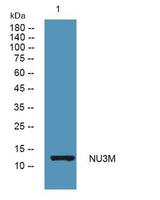
NU3M rabbit pAb is a research-use antibody from ELK Biotechnology for studying NU3M in WB, ELISA workflows with listed reactivity for Human, Rat, Mouse. Specifications and supporting documents below should be reviewed when planning the experiment.
catalytic activity:NADH + ubiquinone = NAD(+) + ubiquinol.,disease:Defects in MT-ND3 are a cause of complex I mitochondrial respiratory chain deficiency [MIM:252010]. Complex I (NADH-ubiquinone oxidoreductase), the largest complex of the mitochondrial respiratory chain, contains more than 40 subunits. It is embedded in the inner mitochondrial membrane and is partly protruding in the matrix. Complex I deficiency is the most common cause of mitochondrial disorders. It represents largely one-third of all cases of respiratory chain deficiency and is responsible for a variety of clinical symptoms, ranging from neurological disorders to cardiomyopathy, liver failure, and myopathy.,disease:Defects in MT-ND3 are a cause of Leigh syndrome (LS) [MIM:256000]. LS is a severe neurological disorder characterized by bilaterally symmetrical necrotic lesions in subcortical brain regions.,function:Core subunit of the mitochondrial membrane respiratory chain NADH dehydrogenase (Complex I) that is believed to belong to the minimal assembly required for catalysis. Complex I functions in the transfer of electrons from NADH to the respiratory chain. The immediate electron acceptor for the enzyme is believed to be ubiquinone.,similarity:Belongs to the complex I subunit 3 family.,
| Specificity | NU3M Polyclonal Antibody detects endogenous levels of protein. |
|---|---|
| Validation evidence captions | Western blot analysis of lysates from HCT116 cells, primary antibody was diluted at 1:1000, 4°over night |
| Collaborator | ELK Biotechnology |
| Partner model | ES9883 |
| Target | NU3M |
| Research areas | >>Oxidative phosphorylation, >>Metabolic pathways, >>Thermogenesis, >>Retrograde endocannabinoid signaling, >>Alzheimer disease, >>Parkinson disease, >>Amyotrophic lateral sclerosis, >>Huntington disease, >>Prion disease, >>Pathways of neurodegeneration - multiple diseases, >>Chemical carcinogenesis - reactive oxygen species, >>Diabetic cardiomyopathy |
| Reactivity | Human,Rat,Mouse |
| Applications | WB,ELISA |
| Conjugation | Unconjugated |
| Dilution range | WB 1:500-2000 ELISA 1:5000-20000 |
| Host | Rabbit |
| Clonality | Polyclonal |
| Isotype | IgG |
| Immunogen | Synthesized peptide derived from human protein . at AA range: 20-100 |
| Concentration | 1 mg/ml |
| Purification | The antibody was affinity-purified from rabbit antiserum by affinity-chromatography using epitope-specific immunogen. |
| Assay type | Antibody validation/application |
| Expression system | Blood,Bone fossil,Bones,Breast cancer,Distant normal tissue,Glioma, |
| Purity | The antibody was affinity-purified from rabbit antiserum by affinity-chromatography using epitope-specific immunogen. |
| Species | WB | IHC | IF | ELISA | IP | FCM | ChIP |
|---|---|---|---|---|---|---|---|
| Human | |||||||
| Rat | |||||||
| Mouse |
| Species | Dilution | Notes |
|---|---|---|
| Human | WB 1:500-2000 ELISA 1:5000-20000 | — |
| Rat | — | — |
| Mouse | — | — |
| Species | Dilution | Notes |
|---|
Collaborator meets ABMIUM quality standards and overall product performance standards have been met.
Quality management certification.
For research applications. Not for diagnostic use.
No customer reviews yet.
