
WNT4 rabbit pAb from ELK Biotechnology Read more ›

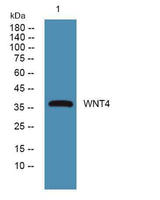
WNT4 rabbit pAb is a research-use antibody from ELK Biotechnology for studying WNT4 in WB, ELISA workflows with listed reactivity for Human, Mouse, Rat. Specifications and supporting documents below should be reviewed when planning the experiment.
The WNT gene family consists of structurally related genes which encode secreted signaling proteins. These proteins have been implicated in oncogenesis and in several developmental processes, including regulation of cell fate and patterning during embryogenesis. This gene is a member of the WNT gene family, and is the first signaling molecule shown to influence the sex-determination cascade. It encodes a protein which shows 98% amino acid identity to the Wnt4 protein of mouse and rat. This gene and a nuclear receptor known to antagonize the testis-determining factor play a concerted role in both the control of female development and the prevention of testes formation. This gene and another two family members, WNT2 and WNT7B, may be associated with abnormal proliferation in breast tissue. Mutations in this gene can result in Rokitansky-Kuster-Hauser syndrome and in SERKAL syndrome. [provided by RefSe
| Specificity | WNT4 Polyclonal Antibody detects endogenous levels of protein. |
|---|---|
| Validation evidence captions | Western blot analysis of lysates from Jarkat cells, primary antibody was diluted at 1:1000, 4°over night |
| Collaborator | ELK Biotechnology |
| Partner model | ES9231 |
| Target | WNT4 |
| Research areas | >>mTOR signaling pathway, >>Wnt signaling pathway, >>Axon guidance, >>Hippo signaling pathway, >>Signaling pathways regulating pluripotency of stem cells, >>Melanogenesis, >>Thyroid hormone signaling pathway, >>Cushing syndrome, >>Alzheimer disease, >>Pathways of neurodegeneration - multiple diseases, >>Human papillomavirus infection, >>Pathways in cancer, >>Proteoglycans in cancer, >>Basal cell carcinoma, >>Breast cancer, >>Hepatocellular carcinoma, >>Gastric cancer |
| Reactivity | Human,Mouse,Rat |
| Applications | WB,ELISA |
| Conjugation | Unconjugated |
| Dilution range | WB 1:500-2000 ELISA 1:5000-20000 |
| Host | Rabbit |
| Clonality | Polyclonal |
| Isotype | IgG |
| Immunogen | Synthesized peptide derived from human protein . at AA range: 190-270 |
| Concentration | 1 mg/ml |
| Purification | The antibody was affinity-purified from rabbit antiserum by affinity-chromatography using epitope-specific immunogen. |
| Assay type | Antibody validation/application |
| Expression system | Fetal tissues,Mammary gland,Placenta, |
| Purity | The antibody was affinity-purified from rabbit antiserum by affinity-chromatography using epitope-specific immunogen. |
| Species | WB | IHC | IF | ELISA | IP | FCM | ChIP |
|---|---|---|---|---|---|---|---|
| Human | |||||||
| Mouse | |||||||
| Rat |
| Species | Dilution | Notes |
|---|---|---|
| Human | WB 1:500-2000 ELISA 1:5000-20000 | — |
| Mouse | — | — |
| Rat | — | — |
| Species | Dilution | Notes |
|---|
Collaborator meets ABMIUM quality standards and overall product performance standards have been met.
Quality management certification.
For research applications. Not for diagnostic use.
No customer reviews yet.
