TBC1D4 rabbit pAb from ELK Biotechnology Read more ›

TBC1D4 rabbit pAb is a research-use antibody from ELK Biotechnology for studying TBC1D4 in IHC, IF, ELISA workflows with listed reactivity for Human, Mouse. Specifications and supporting documents below should be reviewed when planning the experiment.
This gene is a member of the Tre-2/BUB2/CDC16 domain family. The protein encoded by this gene is a Rab-GTPase-activating protein, and contains two phopshotyrosine-binding domains (PTB1 and PTB2), a calmodulin-binding domain (CBD), a Rab-GTPase domain, and multiple AKT phosphomotifs. This protein is thought to play an important role in glucose homeostasis by regulating the insulin-dependent trafficking of the glucose transporter 4 (GLUT4), important for removing glucose from the bloodstream into skeletal muscle and fat tissues. Reduced expression of this gene results in an increase in GLUT4 levels at the plasma membrane, suggesting that this protein is important in intracellular retention of GLUT4 under basal conditions. When exposed to insulin, this protein is phosphorylated, dissociates from GLUT4 vesicles, resulting in increased GLUT4 at the cell surface, and enhanced glucose transport. Ph
| Specificity | TBC1D4 Polyclonal Antibody detects endogenous levels of TBC1D4 protein. |
|---|---|
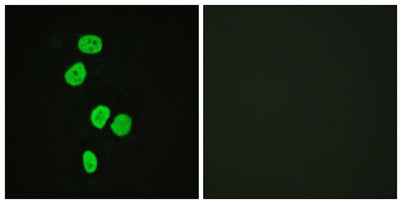
| Validation evidence captions | Immunofluorescence analysis of HeLa cells, using AS160 Antibody. The picture on the right is blocked with the synthesized peptide. | Immunohistochemical analysis of paraffin-embedded human tonsil. 1, Antibody was diluted at 1:200(4° overnight). 2, Tris-EDTA,pH9.0 was used for antigen retrieval. 3,Secondary antibody was diluted at 1:200(room temperature, 30min). |
| Collaborator | ELK Biotechnology |
| Partner model | ES8120 |
| Target | TBC1D4 |
| Research areas | >>Thyroid hormone signaling pathway, >>Insulin resistance, >>Diabetic cardiomyopathy |
| Reactivity | Human,Mouse |
| Applications | IHC,IF,ELISA |
| Conjugation | Unconjugated |
| Dilution range | Immunohistochemistry: 1/100 - 1/300. Immunofluorescence: 1/200 - 1/1000. ELISA: 1/10000. Not yet tested in other applications. |
| Host | Rabbit |
| Clonality | Polyclonal |
| Isotype | IgG |
| Immunogen | The antiserum was produced against synthesized peptide derived from human AS160. AA range:611-660 |
| Concentration | 1 mg/ml |
| Purification | The antibody was affinity-purified from rabbit antiserum by affinity-chromatography using epitope-specific immunogen. |
| Assay type | Antibody validation/application |
| Expression system | Widely expressed. Isoform 2 is the highest overexpressed in most tissues. Isoform 1 is highly expressed in skeletal muscle and heart, but was not detectable in the liver nor in adipose tissue. Isoform 2 is strongly expressed in adrenal and thyroid gland, and also in lung, kidney, colon, brain and adipose tissue. Isoform 2 is moderately expressed in skeletal muscle. Expressed in pancreatic Langerhans islets, including beta cells (at protein level). Expression is decreased by twofold in pancreatic islets in type 2 diabetes patients compared to control subjects. Up-regulated in T-cells from patients with atopic dermatitis. |
| Purity | The antibody was affinity-purified from rabbit antiserum by affinity-chromatography using epitope-specific immunogen. |
| Species | WB | IHC | IF | ELISA | IP | FCM | ChIP |
|---|---|---|---|---|---|---|---|
| Human | |||||||
| Mouse |
| Species | Dilution | Notes |
|---|---|---|
| Human | Immunohistochemistry: 1/100 - 1/300. Immunofluorescence: 1/200 - 1/1000. ELISA: 1/10000. Not yet tested in other applications. | — |
| Mouse | — | — |
| Species | Dilution | Notes |
|---|
| Species | Dilution | Notes |
|---|
Collaborator meets ABMIUM quality standards and overall product performance standards have been met.
Quality management certification.
For research applications. Not for diagnostic use.
No customer reviews yet.