
CD4 (phospho Ser433) rabbit pAb from ELK Biotechnology Read more ›

CD4 (phospho Ser433) rabbit pAb is a research-use antibody from ELK Biotechnology for studying CD4 in IHC, IF, ELISA workflows with listed reactivity for Human, Mouse. Specifications and supporting documents below should be reviewed when planning the experiment.
This gene encodes a membrane glycoprotein of T lymphocytes that interacts with major histocompatibility complex class II antigenes and is also a receptor for the human immunodeficiency virus. This gene is expressed not only in T lymphocytes, but also in B cells, macrophages, and granulocytes. It is also expressed in specific regions of the brain. The protein functions to initiate or augment the early phase of T-cell activation, and may function as an important mediator of indirect neuronal damage in infectious and immune-mediated diseases of the central nervous system. Multiple alternatively spliced transcript variants encoding different isoforms have been identified in this gene. [provided by RefSeq, Aug 2010],
| Specificity | Phospho-CD4 (S433) Polyclonal Antibody detects endogenous levels of CD4 protein only when phosphorylated at S433. |
|---|---|
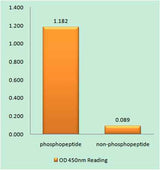
| Validation evidence captions | Enzyme-Linked Immunosorbent Assay (Phospho-ELISA) for Immunogen Phosphopeptide (Phospho-left) and Non-Phosphopeptide (Phospho-right), using CD4 (Phospho-Ser433) Antibody | Immunofluorescence analysis of HepG2 cells, using CD4 (Phospho-Ser433) Antibody. The picture on the right is blocked with the phospho peptide. | Immunohistochemistry analysis of paraffin-embedded human brain, using CD4 (Phospho-Ser433) Antibody. The picture on the right is blocked with the phospho peptide. |
| Collaborator | ELK Biotechnology |
| Partner model | ES7987 |
| Target | CD4 |
| Research areas | >>Viral life cycle - HIV-1, >>Cytokine-cytokine receptor interaction, >>Cell adhesion molecules, >>Antigen processing and presentation, >>Hematopoietic cell lineage, >>Th1 and Th2 cell differentiation, >>Th17 cell differentiation, >>T cell receptor signaling pathway, >>Yersinia infection, >>Human T-cell leukemia virus 1 infection, >>Human immunodeficiency virus 1 infection, >>PD-L1 expression and PD-1 checkpoint pathway in cancer, >>Primary immunodeficiency |
| Reactivity | Human,Mouse |
| Applications | IHC,IF,ELISA |
| Conjugation | Unconjugated |
| Dilution range | Immunohistochemistry: 1/100 - 1/300. Immunofluorescence: 1/200 - 1/1000. ELISA: 1/40000. Not yet tested in other applications. |
| Host | Rabbit |
| Clonality | Polyclonal |
| Isotype | IgG |
| Immunogen | The antiserum was produced against synthesized peptide derived from human CD4 around the phosphorylation site of Ser433. AA range:401-450 |
| Concentration | 1 mg/ml |
| Purification | The antibody was affinity-purified from rabbit antiserum by affinity-chromatography using epitope-specific immunogen. |
| Assay type | Antibody validation/application |
| Expression system | Highly expressed in T-helper cells. The presence of CD4 is a hallmark of T-helper cells which are specialized in the activation and growth of cytotoxic T-cells, regulation of B cells, or activation of phagocytes. CD4 is also present in other immune cells such as macrophages, dendritic cells or NK cells. |
| Purity | The antibody was affinity-purified from rabbit antiserum by affinity-chromatography using epitope-specific immunogen. |
| Species | WB | IHC | IF | ELISA | IP | FCM | ChIP |
|---|---|---|---|---|---|---|---|
| Human | |||||||
| Mouse |
| Species | Dilution | Notes |
|---|---|---|
| Human | Immunohistochemistry: 1/100 - 1/300. Immunofluorescence: 1/200 - 1/1000. ELISA: 1/40000. Not yet tested in other applications. | — |
| Mouse | — | — |
| Species | Dilution | Notes |
|---|
| Species | Dilution | Notes |
|---|
Collaborator meets ABMIUM quality standards and overall product performance standards have been met.
Quality management certification.
For research applications. Not for diagnostic use.
No customer reviews yet.
