
VDR (phospho Ser208) rabbit pAb from ELK Biotechnology Read more ›

VDR (phospho Ser208) rabbit pAb is a research-use antibody from ELK Biotechnology for studying Vitamin D Receptor in WB, IF, ELISA workflows with listed reactivity for Human, Rat, Mouse. Specifications and supporting documents below should be reviewed when planning the experiment.
This gene encodes the nuclear hormone receptor for vitamin D3. This receptor also functions as a receptor for the secondary bile acid lithocholic acid. The receptor belongs to the family of trans-acting transcriptional regulatory factors and shows sequence similarity to the steroid and thyroid hormone receptors. Downstream targets of this nuclear hormone receptor are principally involved in mineral metabolism though the receptor regulates a variety of other metabolic pathways, such as those involved in the immune response and cancer. Mutations in this gene are associated with type II vitamin D-resistant rickets. A single nucleotide polymorphism in the initiation codon results in an alternate translation start site three codons downstream. Alternative splicing results in multiple transcript variants encoding different proteins. [provided by RefSeq, Feb 2011],
| Specificity | Phospho-VDR (S208) Polyclonal Antibody detects endogenous levels of VDR protein only when phosphorylated at S208. |
|---|---|
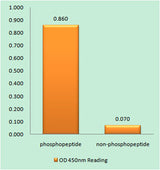
| Validation evidence captions | Enzyme-Linked Immunosorbent Assay (Phospho-ELISA) for Immunogen Phosphopeptide (Phospho-left) and Non-Phosphopeptide (Phospho-right), using Vitamin D Receptor (Phospho-Ser208) Antibody | Immunofluorescence analysis of A549 cells, using Vitamin D Receptor (Phospho-Ser208) Antibody. The picture on the right is blocked with the phospho peptide. | Western blot analysis of lysates from HT29 cells treated with heat shock, using Vitamin D Receptor (Phospho-Ser208) Antibody. The lane on the right is blocked with the phospho peptide. |
| Collaborator | ELK Biotechnology |
| Partner model | ES7494 |
| Target | Vitamin D Receptor |
| Research areas | >>Parathyroid hormone synthesis, secretion and action, >>Endocrine and other factor-regulated calcium reabsorption, >>Mineral absorption, >>Tuberculosis, >>Chemical carcinogenesis - receptor activation |
| Reactivity | Human,Rat,Mouse |
| Applications | WB,IF,ELISA |
| Conjugation | Unconjugated |
| Dilution range | Western Blot: 1/500 - 1/2000. Immunofluorescence: 1/200 - 1/1000. ELISA: 1/10000. Not yet tested in other applications. |
| Host | Rabbit |
| Clonality | Polyclonal |
| Isotype | IgG |
| Immunogen | The antiserum was produced against synthesized peptide derived from human Vitamin D Receptor around the phosphorylation site of Ser208. AA range:181-230 |
| Concentration | 1 mg/ml |
| Purification | The antibody was affinity-purified from rabbit antiserum by affinity-chromatography using epitope-specific immunogen. |
| Assay type | Antibody validation/application |
| Expression system | Lens epithelium,Peripheral blood,Placenta,Rectum, |
| Purity | The antibody was affinity-purified from rabbit antiserum by affinity-chromatography using epitope-specific immunogen. |
| Species | WB | IHC | IF | ELISA | IP | FCM | ChIP |
|---|---|---|---|---|---|---|---|
| Human | |||||||
| Rat | |||||||
| Mouse |
| Species | Dilution | Notes |
|---|---|---|
| Human | Western Blot: 1/500 - 1/2000. Immunofluorescence: 1/200 - 1/1000. ELISA: 1/10000. Not yet tested in other applications. | — |
| Rat | — | — |
| Mouse | — | — |
| Species | Dilution | Notes |
|---|
| Species | Dilution | Notes |
|---|
Collaborator meets ABMIUM quality standards and overall product performance standards have been met.
Quality management certification.
For research applications. Not for diagnostic use.
No customer reviews yet.
