
SGK1 (phospho Ser78) rabbit pAb from ELK Biotechnology Read more ›

SGK1 (phospho Ser78) rabbit pAb is a research-use antibody from ELK Biotechnology for studying SGK1 in WB, IHC, ELISA workflows with listed reactivity for Human, Mouse, Rat. Specifications and supporting documents below should be reviewed when planning the experiment.
This gene encodes a serine/threonine protein kinase that plays an important role in cellular stress response. This kinase activates certain potassium, sodium, and chloride channels, suggesting an involvement in the regulation of processes such as cell survival, neuronal excitability, and renal sodium excretion. High levels of expression of this gene may contribute to conditions such as hypertension and diabetic nephropathy. Several alternatively spliced transcript variants encoding different isoforms have been noted for this gene. [provided by RefSeq, Jan 2009],
| Specificity | Phospho-SGK1 (S78) Polyclonal Antibody detects endogenous levels of SGK1 protein only when phosphorylated at S78. |
|---|---|
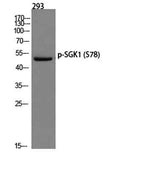
| Validation evidence captions | Western blot analysis of 293 using p-SGK1 (S78) antibody. Antibody was diluted at 1:2000 | Enzyme-Linked Immunosorbent Assay (Phospho-ELISA) for Immunogen Phosphopeptide (Phospho-left) and Non-Phosphopeptide (Phospho-right), using SGK (Phospho-Ser78) Antibody | Western blot analysis of lysates from 293 cells treated with UV 15', using SGK (Phospho-Ser78) Antibody. The lane on the right is blocked with the phospho peptide. | Immunohistochemical analysis of paraffin-embedded human tonsil. 1, Antibody was diluted at 1:200(4° overnight). 2, Tris-EDTA,pH9.0 was used for antigen retrieval. 3,Secondary antibody was diluted at 1:200(room temperature, 45min). |
| Collaborator | ELK Biotechnology |
| Partner model | ES7180 |
| Target | SGK1 |
| Research areas | >>FoxO signaling pathway, >>mTOR signaling pathway, >>PI3K-Akt signaling pathway, >>Aldosterone-regulated sodium reabsorption |
| Reactivity | Human,Mouse,Rat |
| Applications | WB,IHC,ELISA |
| Conjugation | Unconjugated |
| Dilution range | WB 1:500-2000;IHC-p 1:50-300; ELISA 2000-20000 |
| Host | Rabbit |
| Clonality | Polyclonal |
| Isotype | IgG |
| Immunogen | The antiserum was produced against synthesized peptide derived from human SGK around the phosphorylation site of Ser78. AA range:41-90 |
| Concentration | 1 mg/ml |
| Purification | The antibody was affinity-purified from rabbit antiserum by affinity-chromatography using epitope-specific immunogen. |
| Assay type | Antibody validation/application |
| Expression system | Expressed in most tissues with highest levels in the pancreas, followed by placenta, kidney and lung. Isoform 2 is strongly expressed in brain and pancreas, weaker in heart, placenta, lung, liver and skeletal muscle. |
| Purity | The antibody was affinity-purified from rabbit antiserum by affinity-chromatography using epitope-specific immunogen. |
| Species | WB | IHC | IF | ELISA | IP | FCM | ChIP |
|---|---|---|---|---|---|---|---|
| Human | |||||||
| Mouse | |||||||
| Rat |
| Species | Dilution | Notes |
|---|---|---|
| Human | WB 1:500-2000;IHC-p 1:50-300; ELISA 2000-20000 | — |
| Mouse | — | — |
| Rat | — | — |
| Species | Dilution | Notes |
|---|
| Species | Dilution | Notes |
|---|
Collaborator meets ABMIUM quality standards and overall product performance standards have been met.
Quality management certification.
For research applications. Not for diagnostic use.
No customer reviews yet.
