
Ataxin-1 (phospho Ser776) rabbit pAb from ELK Biotechnology Read more ›

Ataxin-1 (phospho Ser776) rabbit pAb is a research-use antibody from ELK Biotechnology for studying Ataxin-1 in WB, IHC, IF, ELISA workflows with listed reactivity for Human, Mouse. Specifications and supporting documents below should be reviewed when planning the experiment.
ataxin 1(ATXN1) Homo sapiens The autosomal dominant cerebellar ataxias (ADCA) are a heterogeneous group of neurodegenerative disorders characterized by progressive degeneration of the cerebellum, brain stem and spinal cord. Clinically, ADCA has been divided into three groups: ADCA types I-III. ADCAI is genetically heterogeneous, with five genetic loci, designated spinocerebellar ataxia (SCA) 1, 2, 3, 4 and 6, being assigned to five different chromosomes. ADCAII, which always presents with retinal degeneration (SCA7), and ADCAIII often referred to as the `pure' cerebellar syndrome (SCA5), are most likely homogeneous disorders. Several SCA genes have been cloned and shown to contain CAG repeats in their coding regions. ADCA is caused by the expansion of the CAG repeats, producing an elongated polyglutamine tract in the corresponding protein. The expanded repeats are variable in size and unstable, usually increasing in size when transmitted
| Specificity | Phospho-Ataxin-1 (S776) Polyclonal Antibody detects endogenous levels of Ataxin-1 protein only when phosphorylated at S776. |
|---|---|
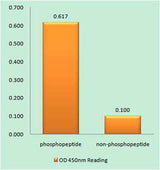
| Validation evidence captions | Enzyme-Linked Immunosorbent Assay (Phospho-ELISA) for Immunogen Phosphopeptide (Phospho-left) and Non-Phosphopeptide (Phospho-right), using Ataxin 1 (Phospho-Ser776) Antibody | Immunofluorescence analysis of NIH/3T3 cells, using Ataxin 1 (Phospho-Ser776) Antibody. The picture on the right is blocked with the phospho peptide. | Western blot analysis of lysates from HepG2 cells treated with Adriamycin 0.5uM 5h, using Ataxin 1 (Phospho-Ser776) Antibody. The lane on the right is blocked with the phospho peptide. | Immunohistochemical analysis of paraffin-embedded human liver cancer. 1, Antibody was diluted at 1:200(4° overnight). 2, Tris-EDTA,pH9.0 was used for antigen retrieval. 3,Secondary antibody was diluted at 1:200(room temperature, 45min). |
| Collaborator | ELK Biotechnology |
| Partner model | ES7119 |
| Target | Ataxin-1 |
| Research areas | >>Notch signaling pathway, >>Spinocerebellar ataxia, >>Pathways of neurodegeneration - multiple diseases |
| Reactivity | Human,Mouse |
| Applications | WB,IHC,IF,ELISA |
| Conjugation | Unconjugated |
| Dilution range | Western Blot: 1/500 - 1/2000. Immunohistochemistry: 1/100 - 1/300. Immunofluorescence: 1/200 - 1/1000. ELISA: 1/10000. Not yet tested in other applications. |
| Host | Rabbit |
| Clonality | Polyclonal |
| Isotype | IgG |
| Immunogen | The antiserum was produced against synthesized peptide derived from human Ataxin 1 around the phosphorylation site of Ser776. AA range:742-791 |
| Concentration | 1 mg/ml |
| Purification | The antibody was affinity-purified from rabbit antiserum by affinity-chromatography using epitope-specific immunogen. |
| Assay type | Antibody validation/application |
| Expression system | Widely expressed throughout the body. |
| Purity | The antibody was affinity-purified from rabbit antiserum by affinity-chromatography using epitope-specific immunogen. |
| Species | WB | IHC | IF | ELISA | IP | FCM | ChIP |
|---|---|---|---|---|---|---|---|
| Human | |||||||
| Mouse |
| Species | Dilution | Notes |
|---|---|---|
| Human | Western Blot: 1/500 - 1/2000. Immunohistochemistry: 1/100 - 1/300. Immunofluorescence: 1/200 - 1/1000. ELISA: 1/10000. Not yet tested in other applications. | — |
| Mouse | — | — |
| Species | Dilution | Notes |
|---|
| Species | Dilution | Notes |
|---|
| Species | Dilution | Notes |
|---|
Collaborator meets ABMIUM quality standards and overall product performance standards have been met.
Quality management certification.
For research applications. Not for diagnostic use.
No customer reviews yet.
