
Ribosomal Protein S6 (phospho Ser235) rabbit pAb from ELK Biotechnology Read more ›

Ribosomal Protein S6 (phospho Ser235) rabbit pAb is a research-use antibody from ELK Biotechnology for studying Ribosomal Protein S6 in WB, IHC, ELISA workflows with listed reactivity for Human, Mouse, Rat. Specifications and supporting documents below should be reviewed when planning the experiment.
Ribosomes, the organelles that catalyze protein synthesis, consist of a small 40S subunit and a large 60S subunit. Together these subunits are composed of 4 RNA species and approximately 80 structurally distinct proteins. This gene encodes a cytoplasmic ribosomal protein that is a component of the 40S subunit. The protein belongs to the S6E family of ribosomal proteins. It is the major substrate of protein kinases in the ribosome, with subsets of five C-terminal serine residues phosphorylated by different protein kinases. Phosphorylation is induced by a wide range of stimuli, including growth factors, tumor-promoting agents, and mitogens. Dephosphorylation occurs at growth arrest. The protein may contribute to the control of cell growth and proliferation through the selective translation of particular classes of mRNA. As is typical for genes encoding ribosomal proteins, there are multiple processed
| Specificity | Phospho-Ribosomal Protein S6 (S235) Polyclonal Antibody detects endogenous levels of Ribosomal Protein S6 protein only when phosphorylated at S235. |
|---|---|
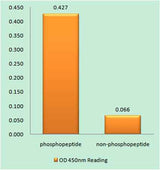
| Validation evidence captions | Enzyme-Linked Immunosorbent Assay (Phospho-ELISA) for Immunogen Phosphopeptide (Phospho-left) and Non-Phosphopeptide (Phospho-right), using S6 Ribosomal Protein (Phospho-Ser235) Antibody | Western blot analysis of lysates from 293 cells treated with serum 10% 15', using S6 Ribosomal Protein (Phospho-Ser235) Antibody. The lane on the right is blocked with the phospho peptide. | Immunohistochemical analysis of paraffin-embedded human Gastric adenocarcinoma. 1, Antibody was diluted at 1:200(4° overnight). 2, Tris-EDTA,pH9.0 was used for antigen retrieval. 3,Secondary antibody was diluted at 1:200(room temperature, 45min). |
| Collaborator | ELK Biotechnology |
| Partner model | ES7076 |
| Target | Ribosomal Protein S6 |
| Research areas | >>EGFR tyrosine kinase inhibitor resistance, >>Ribosome, >>HIF-1 signaling pathway, >>mTOR signaling pathway, >>PI3K-Akt signaling pathway, >>Apelin signaling pathway, >>Thermogenesis, >>Insulin signaling pathway, >>Coronavirus disease - COVID-19, >>Proteoglycans in cancer |
| Reactivity | Human,Mouse,Rat |
| Applications | WB,IHC,ELISA |
| Conjugation | Unconjugated |
| Dilution range | WB 1:500-2000;IHC-p 1:50-300; ELISA 2000-20000 |
| Host | Rabbit |
| Clonality | Polyclonal |
| Isotype | IgG |
| Immunogen | The antiserum was produced against synthesized peptide derived from human S6 Ribosomal Protein around the phosphorylation site of Ser235. AA range:200-249 |
| Concentration | 1 mg/ml |
| Purification | The antibody was affinity-purified from rabbit antiserum by affinity-chromatography using epitope-specific immunogen. |
| Assay type | Antibody validation/application |
| Expression system | Brain,Colon,Colon adenocarcinoma,Epithelium,Muscle,Ovary,Pancreas,Placenta,Skin,Tes |
| Purity | The antibody was affinity-purified from rabbit antiserum by affinity-chromatography using epitope-specific immunogen. |
| Species | WB | IHC | IF | ELISA | IP | FCM | ChIP |
|---|---|---|---|---|---|---|---|
| Human | |||||||
| Mouse | |||||||
| Rat |
| Species | Dilution | Notes |
|---|---|---|
| Human | WB 1:500-2000;IHC-p 1:50-300; ELISA 2000-20000 | — |
| Mouse | — | — |
| Rat | — | — |
| Species | Dilution | Notes |
|---|
| Species | Dilution | Notes |
|---|
Collaborator meets ABMIUM quality standards and overall product performance standards have been met.
Quality management certification.
For research applications. Not for diagnostic use.
No customer reviews yet.
