
PKC δ (phospho Thr507) rabbit pAb from ELK Biotechnology Read more ›

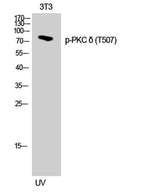
PKC δ (phospho Thr507) rabbit pAb is a research-use antibody from ELK Biotechnology for studying PKC δ in WB, IHC, IF, ELISA workflows with listed reactivity for Human, Mouse, Rat. Specifications and supporting documents below should be reviewed when planning the experiment.
Protein kinase C (PKC) is a family of serine- and threonine-specific protein kinases that can be activated by calcium and the second messenger diacylglycerol. PKC family members phosphorylate a wide variety of protein targets and are known to be involved in diverse cellular signaling pathways. PKC family members also serve as major receptors for phorbol esters, a class of tumor promoters. Each member of the PKC family has a specific expression profile and is believed to play distinct roles in cells. The protein encoded by this gene is one of the PKC family members. Studies both in human and mice demonstrate that this kinase is involved in B cell signaling and in the regulation of growth, apoptosis, and differentiation of a variety of cell types. Alternatively spliced transcript variants encoding the same protein have been observed. [provided by RefSeq, Jul 2008],
| Specificity | Phospho-PKC δ (T507) Polyclonal Antibody detects endogenous levels of PKC δ protein only when phosphorylated at T507. |
|---|---|
| Validation evidence captions | Western Blot analysis of 3T3 cells using Phospho-PKC δ (T507) Polyclonal Antibody | Enzyme-Linked Immunosorbent Assay (Phospho-ELISA) for Immunogen Phosphopeptide (Phospho-left) and Non-Phosphopeptide (Phospho-right), using PKC delta (Phospho-Thr505) Antibody | Immunohistochemistry analysis of paraffin-embedded human breast carcinoma, using PKC delta (Phospho-Thr505) Antibody. The picture on the right is blocked with the phospho peptide. | Western blot analysis of lysates from NIH/3T3 cells treated with UV 15', using PKC delta (Phospho-Thr505) Antibody. The lane on the right is blocked with the phospho peptide. |
| Collaborator | ELK Biotechnology |
| Partner model | ES6772 |
| Target | PKC δ |
| Research areas | >>Chemokine signaling pathway, >>Autophagy - animal, >>Vascular smooth muscle contraction, >>NOD-like receptor signaling pathway, >>C-type lectin receptor signaling pathway, >>Fc gamma R-mediated phagocytosis, >>Neurotrophin signaling pathway, >>Inflammatory mediator regulation of TRP channels, >>GnRH signaling pathway, >>Estrogen signaling pathway, >>Type II diabetes mellitus, >>Insulin resistance, >>AGE-RAGE signaling pathway in diabetic complications, >>Prion disease, >>Shigellosis, >>Chemical carcinogenesis - reactive oxygen species, >>Diabetic cardiomyopathy |
| Reactivity | Human,Mouse,Rat |
| Applications | WB,IHC,IF,ELISA |
| Conjugation | Unconjugated |
| Dilution range | Western Blot: 1/500 - 1/2000. Immunohistochemistry: 1/100 - 1/300. ELISA: 1/20000. Not yet tested in other applications. |
| Host | Rabbit |
| Clonality | Polyclonal |
| Isotype | IgG |
| Immunogen | The antiserum was produced against synthesized peptide derived from human PKC delta around the phosphorylation site of Thr505. AA range:471-520 |
| Concentration | 1 mg/ml |
| Purification | The antibody was affinity-purified from rabbit antiserum by affinity-chromatography using epitope-specific immunogen. |
| Assay type | Antibody validation/application |
| Expression system | Epithelium,Hippocampus,Liver,Platelet,Skin, |
| Purity | The antibody was affinity-purified from rabbit antiserum by affinity-chromatography using epitope-specific immunogen. |
| Species | WB | IHC | IF | ELISA | IP | FCM | ChIP |
|---|---|---|---|---|---|---|---|
| Human | |||||||
| Mouse | |||||||
| Rat |
| Species | Dilution | Notes |
|---|---|---|
| Human | Western Blot: 1/500 - 1/2000. Immunohistochemistry: 1/100 - 1/300. ELISA: 1/20000. Not yet tested in other applications. | — |
| Mouse | — | — |
| Rat | — | — |
| Species | Dilution | Notes |
|---|
| Species | Dilution | Notes |
|---|
| Species | Dilution | Notes |
|---|
Collaborator meets ABMIUM quality standards and overall product performance standards have been met.
Quality management certification.
For research applications. Not for diagnostic use.
No customer reviews yet.
