
TRAP220 (phospho Thr1457) rabbit pAb from ELK Biotechnology Read more ›

TRAP220 (phospho Thr1457) rabbit pAb is a research-use antibody from ELK Biotechnology for studying TRAP220 in WB, IHC, IF, ELISA workflows with listed reactivity for Human, Mouse, Monkey. Specifications and supporting documents below should be reviewed when planning the experiment.
The activation of gene transcription is a multistep process that is triggered by factors that recognize transcriptional enhancer sites in DNA. These factors work with co-activators to direct transcriptional initiation by the RNA polymerase II apparatus. The protein encoded by this gene is a subunit of the CRSP (cofactor required for SP1 activation) complex, which, along with TFIID, is required for efficient activation by SP1. This protein is also a component of other multisubunit complexes e.g. thyroid hormone receptor-(TR-) associated proteins which interact with TR and facilitate TR function on DNA templates in conjunction with initiation factors and cofactors. It also regulates p53-dependent apoptosis and it is essential for adipogenesis. This protein is known to have the ability to self-oligomerize. [provided by RefSeq, Jul 2008],
| Specificity | Phospho-TRAP220 (T1457) Polyclonal Antibody detects endogenous levels of TRAP220 protein only when phosphorylated at T1457. |
|---|---|
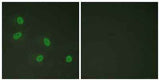
| Validation evidence captions | Immunofluorescence analysis of HeLa cells, using PPAR-BP (Phospho-Thr1457) Antibody. The picture on the right is blocked with the phospho peptide. | Immunohistochemistry analysis of paraffin-embedded human heart, using PPAR-BP (Phospho-Thr1457) Antibody. The picture on the right is blocked with the phospho peptide. | Western blot analysis of lysates from HUVEC cells treated with Serum 20% 30', using PPAR-BP (Phospho-Thr1457) Antibody. The lane on the right is blocked with the phospho peptide. |
| Collaborator | ELK Biotechnology |
| Partner model | ES6670 |
| Target | TRAP220 |
| Research areas | >>Endocrine resistance, >>Thyroid hormone signaling pathway |
| Reactivity | Human,Mouse,Monkey |
| Applications | WB,IHC,IF,ELISA |
| Conjugation | Unconjugated |
| Dilution range | Western Blot: 1/500 - 1/2000. Immunohistochemistry: 1/100 - 1/300. Immunofluorescence: 1/200 - 1/1000. ELISA: 1/5000. Not yet tested in other applications. |
| Host | Rabbit |
| Clonality | Polyclonal |
| Isotype | IgG |
| Immunogen | The antiserum was produced against synthesized peptide derived from human PPAR-BP around the phosphorylation site of Thr1457. AA range:1423-1472 |
| Concentration | 1 mg/ml |
| Purification | The antibody was affinity-purified from rabbit antiserum by affinity-chromatography using epitope-specific immunogen. |
| Assay type | Antibody validation/application |
| Expression system | Ubiquitously expressed. |
| Purity | The antibody was affinity-purified from rabbit antiserum by affinity-chromatography using epitope-specific immunogen. |
| Species | WB | IHC | IF | ELISA | IP | FCM | ChIP |
|---|---|---|---|---|---|---|---|
| Human | |||||||
| Mouse | |||||||
| Monkey |
| Species | Dilution | Notes |
|---|---|---|
| Human | Western Blot: 1/500 - 1/2000. Immunohistochemistry: 1/100 - 1/300. Immunofluorescence: 1/200 - 1/1000. ELISA: 1/5000. Not yet tested in other applications. | — |
| Mouse | — | — |
| Monkey | — | — |
| Species | Dilution | Notes |
|---|
| Species | Dilution | Notes |
|---|
| Species | Dilution | Notes |
|---|
Collaborator meets ABMIUM quality standards and overall product performance standards have been met.
Quality management certification.
For research applications. Not for diagnostic use.
No customer reviews yet.
