
PAKγ (phospho Ser192) rabbit pAb from ELK Biotechnology Read more ›

PAKγ (phospho Ser192) rabbit pAb is a research-use antibody from ELK Biotechnology for studying PAK2 in WB, ELISA workflows with listed reactivity for Human, Mouse, Rat. Specifications and supporting documents below should be reviewed when planning the experiment.
The p21 activated kinases (PAK) are critical effectors that link Rho GTPases to cytoskeleton reorganization and nuclear signaling. The PAK proteins are a family of serine/threonine kinases that serve as targets for the small GTP binding proteins, CDC42 and RAC1, and have been implicated in a wide range of biological activities. The protein encoded by this gene is activated by proteolytic cleavage during caspase-mediated apoptosis, and may play a role in regulating the apoptotic events in the dying cell. [provided by RefSeq, Jul 2008],
| Specificity | Phospho-PAKγ (S192) Polyclonal Antibody detects endogenous levels of PAKγ protein only when phosphorylated at S192. |
|---|---|
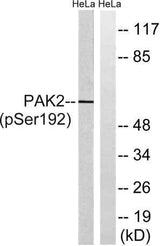
| Validation evidence captions | Western blot analysis of lysates from HeLa cells, using PAK2 (Phospho-Ser192) Antibody. The lane on the right is blocked with the phospho peptide. |
| Collaborator | ELK Biotechnology |
| Partner model | ES6467 |
| Target | PAK2 |
| Research areas | >>MAPK signaling pathway, >>ErbB signaling pathway, >>Ras signaling pathway, >>Axon guidance, >>Focal adhesion, >>T cell receptor signaling pathway, >>Regulation of actin cytoskeleton, >>Pathogenic Escherichia coli infection, >>Human immunodeficiency virus 1 infection, >>Renal cell carcinoma |
| Reactivity | Human,Mouse,Rat |
| Applications | WB,ELISA |
| Conjugation | Unconjugated |
| Dilution range | Western Blot: 1/500 - 1/2000. ELISA: 1/5000. Not yet tested in other applications. |
| Host | Rabbit |
| Clonality | Polyclonal |
| Isotype | IgG |
| Immunogen | The antiserum was produced against synthesized peptide derived from human PAK2 around the phosphorylation site of Ser192. AA range:158-207 |
| Concentration | 1 mg/ml |
| Purification | The antibody was affinity-purified from rabbit antiserum by affinity-chromatography using epitope-specific immunogen. |
| Assay type | Antibody validation/application |
| Expression system | Ubiquitously expressed. Higher levels seen in skeletal muscle, ovary, thymus and spleen. |
| Purity | The antibody was affinity-purified from rabbit antiserum by affinity-chromatography using epitope-specific immunogen. |
| Species | WB | IHC | IF | ELISA | IP | FCM | ChIP |
|---|---|---|---|---|---|---|---|
| Human | |||||||
| Mouse | |||||||
| Rat |
| Species | Dilution | Notes |
|---|---|---|
| Human | Western Blot: 1/500 - 1/2000. ELISA: 1/5000. Not yet tested in other applications. | — |
| Mouse | — | — |
| Rat | — | — |
| Species | Dilution | Notes |
|---|
Collaborator meets ABMIUM quality standards and overall product performance standards have been met.
Quality management certification.
For research applications. Not for diagnostic use.
No customer reviews yet.
