ROM-K (phospho Ser44) rabbit pAb from ELK Biotechnology Read more ›

ROM-K (phospho Ser44) rabbit pAb is a research-use antibody from ELK Biotechnology for studying ROM-K in IHC, IF, ELISA workflows with listed reactivity for Human, Mouse, Rat. Specifications and supporting documents below should be reviewed when planning the experiment.
Potassium channels are present in most mammalian cells, where they participate in a wide range of physiologic responses. The protein encoded by this gene is an integral membrane protein and inward-rectifier type potassium channel. It is activated by internal ATP and probably plays an important role in potassium homeostasis. The encoded protein has a greater tendency to allow potassium to flow into a cell rather than out of a cell. Mutations in this gene have been associated with antenatal Bartter syndrome, which is characterized by salt wasting, hypokalemic alkalosis, hypercalciuria, and low blood pressure. Multiple transcript variants encoding different isoforms have been found for this gene. [provided by RefSeq, Jul 2008],
| Specificity | Phospho-ROM-K (S44) Polyclonal Antibody detects endogenous levels of ROM-K protein only when phosphorylated at S44. |
|---|---|
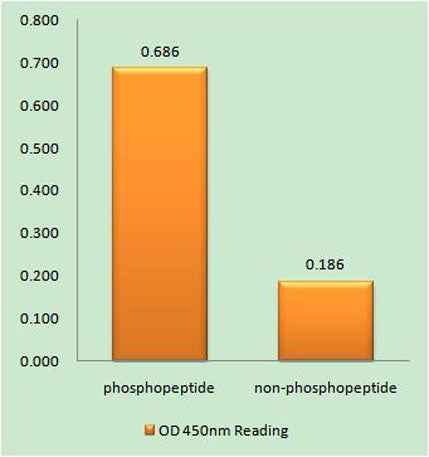
| Validation evidence captions | Enzyme-Linked Immunosorbent Assay (Phospho-ELISA) for Immunogen Phosphopeptide (Phospho-left) and Non-Phosphopeptide (Phospho-right), using ROMK/Kir1.1 (Phospho-Ser44/25) Antibody | Immunofluorescence analysis of A549 cells, using ROMK/Kir1.1 (Phospho-Ser44/25) Antibody. The picture on the right is blocked with the phospho peptide. | Immunohistochemistry analysis of paraffin-embedded human brain, using ROMK/Kir1.1 (Phospho-Ser44/25) Antibody. The picture on the right is blocked with the phospho peptide. |
| Collaborator | ELK Biotechnology |
| Partner model | ES6002 |
| Target | ROM-K |
| Research areas | >>Aldosterone-regulated sodium reabsorption, >>Gastric acid secretion |
| Reactivity | Human,Mouse,Rat |
| Applications | IHC,IF,ELISA |
| Conjugation | Unconjugated |
| Dilution range | Immunohistochemistry: 1/100 - 1/300. Immunofluorescence: 1/200 - 1/1000. ELISA: 1/5000. Not yet tested in other applications. |
| Host | Rabbit |
| Clonality | Polyclonal |
| Isotype | IgG |
| Immunogen | The antiserum was produced against synthesized peptide derived from human ROMK/Kir1.1 around the phosphorylation site of Ser44/25. AA range:11-60 |
| Concentration | 1 mg/ml |
| Purification | The antibody was affinity-purified from rabbit antiserum by affinity-chromatography using epitope-specific immunogen. |
| Assay type | Antibody validation/application |
| Expression system | In the kidney and pancreatic islets. Lower levels in skeletal muscle, pancreas, spleen, brain, heart and liver. |
| Purity | The antibody was affinity-purified from rabbit antiserum by affinity-chromatography using epitope-specific immunogen. |
| Species | WB | IHC | IF | ELISA | IP | FCM | ChIP |
|---|---|---|---|---|---|---|---|
| Human | |||||||
| Mouse | |||||||
| Rat |
| Species | Dilution | Notes |
|---|---|---|
| Human | Immunohistochemistry: 1/100 - 1/300. Immunofluorescence: 1/200 - 1/1000. ELISA: 1/5000. Not yet tested in other applications. | — |
| Mouse | — | — |
| Rat | — | — |
| Species | Dilution | Notes |
|---|
| Species | Dilution | Notes |
|---|
Collaborator meets ABMIUM quality standards and overall product performance standards have been met.
Quality management certification.
For research applications. Not for diagnostic use.
No customer reviews yet.