
AT1 rabbit pAb from ELK Biotechnology Read more ›

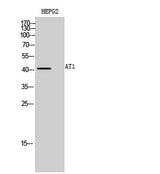
AT1 rabbit pAb is a research-use antibody from ELK Biotechnology for studying AGTR1 in WB, IHC, IF, ELISA workflows with listed reactivity for Human, Mouse, Rat. Specifications and supporting documents below should be reviewed when planning the experiment.
Angiotensin II is a potent vasopressor hormone and a primary regulator of aldosterone secretion. It is an important effector controlling blood pressure and volume in the cardiovascular system. It acts through at least two types of receptors. This gene encodes the type 1 receptor which is thought to mediate the major cardiovascular effects of angiotensin II. This gene may play a role in the generation of reperfusion arrhythmias following restoration of blood flow to ischemic or infarcted myocardium. It was previously thought that a related gene, denoted as AGTR1B, existed; however, it is now believed that there is only one type 1 receptor gene in humans. Multiple alternatively spliced transcript variants have been reported for this gene. [provided by RefSeq, Jul 2012],
| Specificity | AT1 Polyclonal Antibody detects endogenous levels of AT1 protein. |
|---|---|
| Validation evidence captions | Western Blot analysis of HEPG2 cells using AT1 Polyclonal Antibody diluted at 1:500 | Immunofluorescence analysis of MCF7 cells, using AGTR1 Antibody. The picture on the right is blocked with the synthesized peptide. | Western blot analysis of lysates from K562 cells, using AGTR1 Antibody. The lane on the right is blocked with the synthesized peptide. | Western blot analysis of the lysates from HeLa cells using AGTR1 antibody. |
| Collaborator | ELK Biotechnology |
| Partner model | ES5032 |
| Target | AGTR1 |
| Research areas | >>Calcium signaling pathway, >>cGMP-PKG signaling pathway, >>Phospholipase D signaling pathway, >>Neuroactive ligand-receptor interaction, >>Adrenergic signaling in cardiomyocytes, >>Vascular smooth muscle contraction, >>Apelin signaling pathway, >>Renin-angiotensin system, >>Renin secretion, >>Aldosterone synthesis and secretion, >>Cortisol synthesis and secretion, >>AGE-RAGE signaling pathway in diabetic complications, >>Cushing syndrome, >>Coronavirus disease - COVID-19, >>Pathways in cancer, >>Diabetic cardiomyopathy |
| Reactivity | Human,Mouse,Rat |
| Applications | WB,IHC,IF,ELISA |
| Conjugation | Unconjugated |
| Dilution range | Western Blot: 1/500 - 1/2000. Immunohistochemistry: 1/100 - 1/300. Immunofluorescence: 1/200 - 1/1000. ELISA: 1/10000. Not yet tested in other applications. |
| Host | Rabbit |
| Clonality | Polyclonal |
| Isotype | IgG |
| Immunogen | The antiserum was produced against synthesized peptide derived from human AGTR1. AA range:101-150 |
| Concentration | 1 mg/ml |
| Purification | The antibody was affinity-purified from rabbit antiserum by affinity-chromatography using epitope-specific immunogen. |
| Assay type | Antibody validation/application |
| Expression system | Liver, lung, adrenal and adrenocortical adenomas. |
| Purity | The antibody was affinity-purified from rabbit antiserum by affinity-chromatography using epitope-specific immunogen. |
| Species | WB | IHC | IF | ELISA | IP | FCM | ChIP |
|---|---|---|---|---|---|---|---|
| Human | |||||||
| Mouse | |||||||
| Rat |
| Species | Dilution | Notes |
|---|---|---|
| Human | Western Blot: 1/500 - 1/2000. Immunohistochemistry: 1/100 - 1/300. Immunofluorescence: 1/200 - 1/1000. ELISA: 1/10000. Not yet tested in other applications. | — |
| Mouse | — | — |
| Rat | — | — |
| Species | Dilution | Notes |
|---|
| Species | Dilution | Notes |
|---|
| Species | Dilution | Notes |
|---|
Collaborator meets ABMIUM quality standards and overall product performance standards have been met.
Quality management certification.
For research applications. Not for diagnostic use.
No customer reviews yet.
