
CB1 rabbit pAb from ELK Biotechnology Read more ›

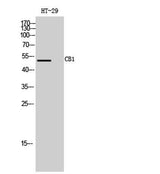
CB1 rabbit pAb is a research-use antibody from ELK Biotechnology for studying CB1 in WB, IHC, IF, ELISA workflows with listed reactivity for Human, Mouse, Rat, Monkey. Specifications and supporting documents below should be reviewed when planning the experiment.
This gene encodes one of two cannabinoid receptors. The cannabinoids, principally delta-9-tetrahydrocannabinol and synthetic analogs, are psychoactive ingredients of marijuana. The cannabinoid receptors are members of the guanine-nucleotide-binding protein (G-protein) coupled receptor family, which inhibit adenylate cyclase activity in a dose-dependent, stereoselective and pertussis toxin-sensitive manner. The two receptors have been found to be involved in the cannabinoid-induced CNS effects (including alterations in mood and cognition) experienced by users of marijuana. Multiple transcript variants encoding two different protein isoforms have been described for this gene. [provided by RefSeq, May 2009],
| Specificity | CB1 Polyclonal Antibody detects endogenous levels of CB1 protein. |
|---|---|
| Validation evidence captions | Western Blot analysis of HT-29 cells using CB1 Polyclonal Antibody | Immunofluorescence analysis of LOVO cells, using CNR1 Antibody. The picture on the right is blocked with the synthesized peptide. | Immunohistochemistry analysis of paraffin-embedded human brain tissue, using CNR1 Antibody. The picture on the right is blocked with the synthesized peptide. | Western blot analysis of lysates from HT-29 and COS7 cells, using CNR1 Antibody. The lane on the right is blocked with the synthesized peptide. |
| Collaborator | ELK Biotechnology |
| Partner model | ES4723 |
| Target | CB1 |
| Research areas | >>Rap1 signaling pathway, >>Neuroactive ligand-receptor interaction, >>Thermogenesis, >>Retrograde endocannabinoid signaling |
| Reactivity | Human,Mouse,Rat,Monkey |
| Applications | WB,IHC,IF,ELISA |
| Conjugation | Unconjugated |
| Dilution range | Western Blot: 1/500 - 1/2000. Immunohistochemistry: 1/100 - 1/300. Immunofluorescence: 1/200 - 1/1000. ELISA: 1/10000. Not yet tested in other applications. |
| Host | Rabbit |
| Clonality | Polyclonal |
| Isotype | IgG |
| Immunogen | The antiserum was produced against synthesized peptide derived from human CNR1. AA range:151-200 |
| Concentration | 1 mg/ml |
| Purification | The antibody was affinity-purified from rabbit antiserum by affinity-chromatography using epitope-specific immunogen. |
| Assay type | Antibody validation/application |
| Expression system | Widely expressed, with highest levels in fetal and adult brain. Expression levels of isoform 2 and isoform 3 are much lower than those of isoform 1. |
| Purity | The antibody was affinity-purified from rabbit antiserum by affinity-chromatography using epitope-specific immunogen. |
| Species | WB | IHC | IF | ELISA | IP | FCM | ChIP |
|---|---|---|---|---|---|---|---|
| Human | |||||||
| Mouse | |||||||
| Rat | |||||||
| Monkey |
| Species | Dilution | Notes |
|---|---|---|
| Human | Western Blot: 1/500 - 1/2000. Immunohistochemistry: 1/100 - 1/300. Immunofluorescence: 1/200 - 1/1000. ELISA: 1/10000. Not yet tested in other applications. | — |
| Mouse | — | — |
| Rat | — | — |
| Monkey | — | — |
| Species | Dilution | Notes |
|---|
| Species | Dilution | Notes |
|---|
| Species | Dilution | Notes |
|---|
Collaborator meets ABMIUM quality standards and overall product performance standards have been met.
Quality management certification.
For research applications. Not for diagnostic use.
No customer reviews yet.
