
Chemokine Receptor D6 rabbit pAb from ELK Biotechnology Read more ›

Chemokine Receptor D6 rabbit pAb is a research-use antibody from ELK Biotechnology for studying Chemokine Receptor D6 in IF, ELISA workflows with listed reactivity for Human, Rat, Mouse. Specifications and supporting documents below should be reviewed when planning the experiment.
This gene encodes a beta chemokine receptor, which is predicted to be a seven transmembrane protein similar to G protein-coupled receptors. Chemokines and their receptor-mediated signal transduction are critical for the recruitment of effector immune cells to the inflammation site. This gene is expressed in a range of tissues and hemopoietic cells. The expression of this receptor in lymphatic endothelial cells and overexpression in vascular tumors suggested its function in chemokine-driven recirculation of leukocytes and possible chemokine effects on the development and growth of vascular tumors. This receptor appears to bind the majority of beta-chemokine family members; however, its specific function remains unknown. This gene is mapped to chromosome 3p21.3, a region that includes a cluster of chemokine receptor genes. [provided by RefSeq, Jul 2008],
| Specificity | Chemokine Receptor D6 Polyclonal Antibody detects endogenous levels of Chemokine Receptor D6 protein. |
|---|---|
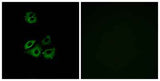
| Validation evidence captions | Immunofluorescence analysis of A549 cells, using CCBP2 Antibody. The picture on the right is blocked with the synthesized peptide. |
| Collaborator | ELK Biotechnology |
| Partner model | ES4713 |
| Target | Chemokine Receptor D6 |
| Research areas | Antibody Research |
| Reactivity | Human,Rat,Mouse |
| Applications | IF,ELISA |
| Conjugation | Unconjugated |
| Dilution range | Immunofluorescence: 1/200 - 1/1000. ELISA: 1/20000. Not yet tested in other applications. |
| Host | Rabbit |
| Clonality | Polyclonal |
| Isotype | IgG |
| Immunogen | The antiserum was produced against synthesized peptide derived from human CCBP2. AA range:335-384 |
| Concentration | 1 mg/ml |
| Purification | The antibody was affinity-purified from rabbit antiserum by affinity-chromatography using epitope-specific immunogen. |
| Assay type | Antibody validation/application |
| Expression system | Found in endothelial cells lining afferent lymphatics in dermis and lymph nodes. Also found in lymph nodes subcapsular and medullary sinuses, tonsillar lymphatic sinuses and lymphatics in mucosa and submucosa of small and large intestine and appendix. Also found in some malignant vascular tumors. Expressed at high levels in Kaposi sarcoma-related pathologies. Expressed on apoptotic neutrophils (at protein level). Expressed primarily in placenta and fetal liver, and found at very low levels in the lung and lymph node. |
| Purity | The antibody was affinity-purified from rabbit antiserum by affinity-chromatography using epitope-specific immunogen. |
| Species | WB | IHC | IF | ELISA | IP | FCM | ChIP |
|---|---|---|---|---|---|---|---|
| Human | |||||||
| Rat | |||||||
| Mouse |
| Species | Dilution | Notes |
|---|---|---|
| Human | Immunofluorescence: 1/200 - 1/1000. ELISA: 1/20000. Not yet tested in other applications. | — |
| Rat | — | — |
| Mouse | — | — |
| Species | Dilution | Notes |
|---|
Collaborator meets ABMIUM quality standards and overall product performance standards have been met.
Quality management certification.
For research applications. Not for diagnostic use.
No customer reviews yet.
