
AKAP 220 rabbit pAb from ELK Biotechnology Read more ›

AKAP 220 rabbit pAb is a research-use antibody from ELK Biotechnology for studying AKAP 220 in IHC, IF, ELISA workflows with listed reactivity for Human, Rat, Mouse. Specifications and supporting documents below should be reviewed when planning the experiment.
The A-kinase anchor proteins (AKAPs) are a group of structurally diverse proteins, which have the common function of binding to the regulatory subunit of protein kinase A (PKA) and confining the holoenzyme to discrete locations within the cell. This gene encodes a member of the AKAP family. The encoded protein is expressed at high levels throughout spermatogenesis and in mature sperm. It binds the RI and RII subunits of PKA in testis. It may serve a function in cell cycle control of both somatic cells and germ cells in addition to its putative role in spermatogenesis and sperm function. [provided by RefSeq, Jul 2008],
| Specificity | AKAP 220 Polyclonal Antibody detects endogenous levels of AKAP 220 protein. |
|---|---|
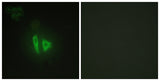
| Validation evidence captions | Immunofluorescence analysis of HepG2 cells, using AKAP11 Antibody. The picture on the right is blocked with the synthesized peptide. | Immunohistochemistry analysis of paraffin-embedded human brain tissue, using AKAP11 Antibody. The picture on the right is blocked with the synthesized peptide. |
| Collaborator | ELK Biotechnology |
| Partner model | ES4618 |
| Target | AKAP 220 |
| Research areas | Antibody Research |
| Reactivity | Human,Rat,Mouse |
| Applications | IHC,IF,ELISA |
| Conjugation | Unconjugated |
| Dilution range | Immunohistochemistry: 1/100 - 1/300. Immunofluorescence: 1/200 - 1/1000. ELISA: 1/10000. Not yet tested in other applications. |
| Host | Rabbit |
| Clonality | Polyclonal |
| Isotype | IgG |
| Immunogen | The antiserum was produced against synthesized peptide derived from human AKAP11. AA range:1761-1810 |
| Concentration | 1 mg/ml |
| Purification | The antibody was affinity-purified from rabbit antiserum by affinity-chromatography using epitope-specific immunogen. |
| Assay type | Antibody validation/application |
| Expression system | Expressed in heart, brain, lung, liver, kidney, testis and ovary. Weakly expressed in skeletal muscle, pancreas and spleen. |
| Purity | The antibody was affinity-purified from rabbit antiserum by affinity-chromatography using epitope-specific immunogen. |
| Species | WB | IHC | IF | ELISA | IP | FCM | ChIP |
|---|---|---|---|---|---|---|---|
| Human | |||||||
| Rat | |||||||
| Mouse |
| Species | Dilution | Notes |
|---|---|---|
| Human | Immunohistochemistry: 1/100 - 1/300. Immunofluorescence: 1/200 - 1/1000. ELISA: 1/10000. Not yet tested in other applications. | — |
| Rat | — | — |
| Mouse | — | — |
| Species | Dilution | Notes |
|---|
| Species | Dilution | Notes |
|---|
Collaborator meets ABMIUM quality standards and overall product performance standards have been met.
Quality management certification.
For research applications. Not for diagnostic use.
No customer reviews yet.
