
GHR rabbit pAb from ELK Biotechnology Read more ›

GHR rabbit pAb is a research-use antibody from ELK Biotechnology for studying GHR in WB, ELISA workflows with listed reactivity for Human, Mouse, Rat. Specifications and supporting documents below should be reviewed when planning the experiment.
This gene encodes a member of the type I cytokine receptor family, which is a transmembrane receptor for growth hormone. Binding of growth hormone to the receptor leads to receptor dimerization and the activation of an intra- and intercellular signal transduction pathway leading to growth. Mutations in this gene have been associated with Laron syndrome, also known as the growth hormone insensitivity syndrome (GHIS), a disorder characterized by short stature. In humans and rabbits, but not rodents, growth hormone binding protein (GHBP) is generated by proteolytic cleavage of the extracellular ligand-binding domain from the mature growth hormone receptor protein. Multiple alternatively spliced transcript variants have been found for this gene.[provided by RefSeq, Jun 2011],
| Specificity | GHR Polyclonal Antibody detects endogenous levels of GHR protein. |
|---|---|
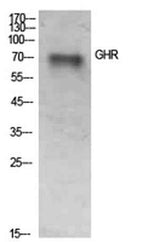
| Validation evidence captions | Western Blot analysis of SKOV3 cells using GHR Polyclonal Antibody. Secondary antibody(catalog#:RS0002) was diluted at 1:20000 |
| Collaborator | ELK Biotechnology |
| Partner model | ES4303 |
| Target | GHR |
| Research areas | >>Cytokine-cytokine receptor interaction, >>Neuroactive ligand-receptor interaction, >>PI3K-Akt signaling pathway, >>JAK-STAT signaling pathway, >>Growth hormone synthesis, secretion and action |
| Reactivity | Human,Mouse,Rat |
| Applications | WB,ELISA |
| Conjugation | Unconjugated |
| Dilution range | Western Blot: 1/500 - 1/2000. ELISA: 1/10000. Not yet tested in other applications. |
| Host | Rabbit |
| Clonality | Polyclonal |
| Isotype | IgG |
| Immunogen | The antiserum was produced against synthesized peptide derived from the N-terminal region of human GHR. AA range:21-70 |
| Concentration | 1 mg/ml |
| Purification | The antibody was affinity-purified from rabbit antiserum by affinity-chromatography using epitope-specific immunogen. |
| Assay type | Antibody validation/application |
| Expression system | Expressed in various tissues with high expression in liver and skeletal muscle. Isoform 4 is predominantly expressed in kidney, bladder, adrenal gland and brain stem. Isoform 1 expression in placenta is predominant in chorion and decidua. Isoform 4 is highly expressed in placental villi. Isoform 2 is expressed in lung, stomach and muscle. Low levels in liver. |
| Purity | The antibody was affinity-purified from rabbit antiserum by affinity-chromatography using epitope-specific immunogen. |
| Species | WB | IHC | IF | ELISA | IP | FCM | ChIP |
|---|---|---|---|---|---|---|---|
| Human | |||||||
| Mouse | |||||||
| Rat |
| Species | Dilution | Notes |
|---|---|---|
| Human | Western Blot: 1/500 - 1/2000. ELISA: 1/10000. Not yet tested in other applications. | — |
| Mouse | — | — |
| Rat | — | — |
| Species | Dilution | Notes |
|---|
Collaborator meets ABMIUM quality standards and overall product performance standards have been met.
Quality management certification.
For research applications. Not for diagnostic use.
No customer reviews yet.
