
PI 3-Kinase p110δ rabbit pAb from ELK Biotechnology Read more ›

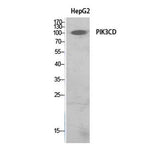
PI 3-Kinase p110δ rabbit pAb is a research-use antibody from ELK Biotechnology for studying PI 3-Kinase p110δ in WB, IHC, IF, ELISA workflows with listed reactivity for Human, Mouse. Specifications and supporting documents below should be reviewed when planning the experiment.
Phosphoinositide 3-kinases (PI3Ks) phosphorylate inositol lipids and are involved in the immune response. The protein encoded by this gene is a class I PI3K found primarily in leukocytes. Like other class I PI3Ks (p110-alpha p110-beta, and p110-gamma), the encoded protein binds p85 adapter proteins and GTP-bound RAS. However, unlike the other class I PI3Ks, this protein phosphorylates itself, not p85 protein.[provided by RefSeq, Jul 2010],
| Specificity | PI 3-Kinase p110δ Polyclonal Antibody detects endogenous levels of PI 3-Kinase p110δ protein. |
|---|---|
| Validation evidence captions | Western Blot analysis of HepG2 cells using PI 3-Kinase p110δ Polyclonal Antibody. Secondary antibody(catalog#:RS0002) was diluted at 1:20000 | Immunohistochemical analysis of paraffin-embedded mouse-brain, antibody was diluted at 1:100 |
| Collaborator | ELK Biotechnology |
| Partner model | ES4267 |
| Target | PI 3-Kinase p110δ |
| Research areas | >>Inositol phosphate metabolism, >>Metabolic pathways, >>EGFR tyrosine kinase inhibitor resistance, >>Endocrine resistance, >>Platinum drug resistance, >>ErbB signaling pathway, >>Ras signaling pathway, >>Rap1 signaling pathway, >>cAMP signaling pathway, >>Chemokine signaling pathway, >>HIF-1 signaling pathway, >>FoxO signaling pathway, >>Phosphatidylinositol signaling system, >>Sphingolipid signaling pathway, >>Phospholipase D signaling pathway, >>Autophagy - animal, >>mTOR signaling pathway, >>PI3K-Akt signaling pathway, >>AMPK signaling pathway, >>Apoptosis, >>Longevity regulating pathway, >>Longevity regulating pathway - multiple species, >>Cellular senescence, >>Axon guidance, >>VEGF signaling pathway, >>Osteoclast differentiation, >>Focal adhesion, >>Signaling pathways regulating pluripotency of stem cells, >>Platelet activation, >>Neutrophil extracellular trap formation, >>Toll-like receptor signaling pathway, >>C-type lectin receptor signaling pathway, >>JAK-STAT signaling pathway, >>Natural killer cell mediat |
| Reactivity | Human,Mouse |
| Applications | WB,IHC,IF,ELISA |
| Conjugation | Unconjugated |
| Dilution range | Western Blot: 1/500 - 1/2000. IHC-p: 1:100-1:300. ELISA: 1/20000. Not yet tested in other applications. |
| Host | Rabbit |
| Clonality | Polyclonal |
| Isotype | IgG |
| Immunogen | The antiserum was produced against synthesized peptide derived from the N-terminal region of human PIK3CD. AA range:41-90 |
| Concentration | 1 mg/ml |
| Purification | The antibody was affinity-purified from rabbit antiserum by affinity-chromatography using epitope-specific immunogen. |
| Assay type | Antibody validation/application |
| Expression system | In humans, the highest levels of expression are seen in peripheral blood mononuclear cells, spleen, and thymus, and low levels of expression in testes, uterus, colon, and small intestine but not in other tissues examined including prostate, heart, brain, and liver (PubMed:9235916). Isoform 2 is expressed in normal thymus, lung and spleen tissues, and is detected at low levels in normal lysates from colon and ovarian biopsies, at elevated levels in lysates from colorectal tumors and is abundantly expressed in some ovarian tumors (at protein level). Both isoform 1 and isoform 2 are widely expressed. Isoform 1 is expressed predominantly in leukocytes. |
| Purity | The antibody was affinity-purified from rabbit antiserum by affinity-chromatography using epitope-specific immunogen. |
| Species | WB | IHC | IF | ELISA | IP | FCM | ChIP |
|---|---|---|---|---|---|---|---|
| Human | |||||||
| Mouse |
| Species | Dilution | Notes |
|---|---|---|
| Human | Western Blot: 1/500 - 1/2000. IHC-p: 1:100-1:300. ELISA: 1/20000. Not yet tested in other applications. | — |
| Mouse | — | — |
| Species | Dilution | Notes |
|---|
| Species | Dilution | Notes |
|---|
| Species | Dilution | Notes |
|---|
Collaborator meets ABMIUM quality standards and overall product performance standards have been met.
Quality management certification.
For research applications. Not for diagnostic use.
No customer reviews yet.
