
ASIC3 rabbit pAb from ELK Biotechnology Read more ›

ASIC3 rabbit pAb is a research-use antibody from ELK Biotechnology for studying ASIC3 in WB, ELISA workflows with listed reactivity for Human, Rat, Mouse. Specifications and supporting documents below should be reviewed when planning the experiment.
This gene encodes a member of the degenerin/epithelial sodium channel (DEG/ENaC) superfamily. The members of this family are amiloride-sensitive sodium channels that contain intracellular N and C termini, two hydrophobic transmembrane regions, and a large extracellular loop, which has many cysteine residues with conserved spacing. The member encoded by this gene is an acid sensor and may play an important role in the detection of lasting pH changes. In addition, a heteromeric association between this member and acid-sensing (proton-gated) ion channel 2 has been observed as proton-gated channels sensitive to gadolinium. Alternatively spliced transcript variants have been described. [provided by RefSeq, Feb 2012],
| Specificity | ASIC3 Polyclonal Antibody detects endogenous levels of ASIC3 protein. |
|---|---|
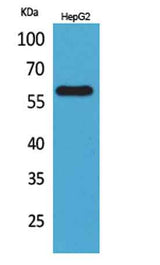
| Validation evidence captions | Western Blot analysis of HepG2 cells using ASIC3 Polyclonal Antibody. Secondary antibody(catalog#:RS0002) was diluted at 1:20000 | Western blot analysis of lysate from HepG2 cells, using ASIC3 Antibody. |
| Collaborator | ELK Biotechnology |
| Partner model | ES3930 |
| Target | ASIC3 |
| Research areas | >>Inflammatory mediator regulation of TRP channels |
| Reactivity | Human,Rat,Mouse |
| Applications | WB,ELISA |
| Conjugation | Unconjugated |
| Dilution range | Western Blot: 1/500 - 1/2000. ELISA: 1/20000. Not yet tested in other applications. |
| Host | Rabbit |
| Clonality | Polyclonal |
| Isotype | IgG |
| Immunogen | The antiserum was produced against synthesized peptide derived from the Internal region of human ASIC3. AA range:191-240 |
| Concentration | 1 mg/ml |
| Purification | The antibody was affinity-purified from rabbit antiserum by affinity-chromatography using epitope-specific immunogen. |
| Assay type | Antibody validation/application |
| Expression system | Expressed by sensory neurons. Strongly expressed in brain, spinal chord, lung, lymph nodes, kidney, pituitary, heart and testis. |
| Purity | The antibody was affinity-purified from rabbit antiserum by affinity-chromatography using epitope-specific immunogen. |
| Species | WB | IHC | IF | ELISA | IP | FCM | ChIP |
|---|---|---|---|---|---|---|---|
| Human | |||||||
| Rat | |||||||
| Mouse |
| Species | Dilution | Notes |
|---|---|---|
| Human | Western Blot: 1/500 - 1/2000. ELISA: 1/20000. Not yet tested in other applications. | — |
| Rat | — | — |
| Mouse | — | — |
| Species | Dilution | Notes |
|---|
Collaborator meets ABMIUM quality standards and overall product performance standards have been met.
Quality management certification.
For research applications. Not for diagnostic use.
No customer reviews yet.
