
DDR1 (phospho Tyr513) rabbit pAb from ELK Biotechnology Read more ›

DDR1 (phospho Tyr513) rabbit pAb is a research-use antibody from ELK Biotechnology for studying DDR1 in WB, IHC, IF, ELISA workflows with listed reactivity for Human, Mouse, Rat. Specifications and supporting documents below should be reviewed when planning the experiment.
Receptor tyrosine kinases play a key role in the communication of cells with their microenvironment. These kinases are involved in the regulation of cell growth, differentiation and metabolism. The protein encoded by this gene belongs to a subfamily of tyrosine kinase receptors with homology to Dictyostelium discoideum protein discoidin I in their extracellular domain, and that are activated by various types of collagen. Expression of this protein is restricted to epithelial cells, particularly in the kidney, lung, gastrointestinal tract, and brain. In addition, it has been shown to be significantly overexpressed in several human tumors. Alternatively spliced transcript variants encoding different isoforms have been described for this gene. [provided by RefSeq, Feb 2011],
| Specificity | Phospho-DDR1 (Y513) Polyclonal Antibody detects endogenous levels of DDR1 protein only when phosphorylated at Y513. |
|---|---|
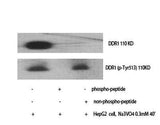
| Validation evidence captions | Western Blot analysis of various cells using Phospho-DDR1 (Y513) Polyclonal Antibody | Enzyme-Linked Immunosorbent Assay (Phospho-ELISA) for Immunogen Phosphopeptide (Phospho-left) and Non-Phosphopeptide (Phospho-right), using DDR1 (Phospho-Tyr513) Antibody | Immunohistochemistry analysis of paraffin-embedded human brain, using DDR1 (Phospho-Tyr513) Antibody. The picture on the right is blocked with the phospho peptide. | Western blot analysis of lysates from HepG2 cells treated with Na3VO4 0.3mM 40', using DDR1 (Phospho-Tyr513) Antibody. The lane on the right is blocked with the phospho peptide. |
| Collaborator | ELK Biotechnology |
| Partner model | ES1497 |
| Target | DDR1 |
| Research areas | Antibody Research |
| Reactivity | Human,Mouse,Rat |
| Applications | WB,IHC,IF,ELISA |
| Conjugation | Unconjugated |
| Dilution range | Western Blot: 1/500 - 1/2000. Immunohistochemistry: 1/100 - 1/300. ELISA: 1/10000. Not yet tested in other applications. |
| Host | Rabbit |
| Clonality | Polyclonal |
| Isotype | IgG |
| Immunogen | The antiserum was produced against synthesized peptide derived from human DDR1 around the phosphorylation site of Tyr513. AA range:479-528 |
| Concentration | 1 mg/ml |
| Purification | The antibody was affinity-purified from rabbit antiserum by affinity-chromatography using epitope-specific immunogen. |
| Assay type | Antibody validation/application |
| Expression system | Detected in T-47D, MDA-MB-175 and HBL-100 breast carcinoma cells, A-431 epidermoid carcinoma cells, SW48 and SNU-C2B colon carcinoma cells and Hs 294T melanoma cells (at protein level). Expressed at low levels in most adult tissues and is highest in the brain, lung, placenta and kidney. Lower levels of expression are detected in melanocytes, heart, liver, skeletal muscle and pancreas. Abundant in breast carcinoma cell lines. In the colonic mucosa, expressed in epithelia but not in the connective tissue of the lamina propria. In the thyroid gland, expressed in the epithelium of the thyroid follicles. In pancreas, expressed in the islets of Langerhans cells, but not in the surrounding epithelial cells of the exocrine pancreas. In kidney, expressed in the epithelia of the distal tubules. Not |
| Purity | The antibody was affinity-purified from rabbit antiserum by affinity-chromatography using epitope-specific immunogen. |
| Species | WB | IHC | IF | ELISA | IP | FCM | ChIP |
|---|---|---|---|---|---|---|---|
| Human | |||||||
| Mouse | |||||||
| Rat |
| Species | Dilution | Notes |
|---|---|---|
| Human | Western Blot: 1/500 - 1/2000. Immunohistochemistry: 1/100 - 1/300. ELISA: 1/10000. Not yet tested in other applications. | — |
| Mouse | — | — |
| Rat | — | — |
| Species | Dilution | Notes |
|---|
| Species | Dilution | Notes |
|---|
| Species | Dilution | Notes |
|---|
Collaborator meets ABMIUM quality standards and overall product performance standards have been met.
Quality management certification.
For research applications. Not for diagnostic use.
No customer reviews yet.
