
Catenin-β (phospho Ser37) rabbit pAb from ELK Biotechnology Read more ›

Catenin-β (phospho Ser37) rabbit pAb is a research-use antibody from ELK Biotechnology for studying Catenin-β in WB, IHC, IF, ELISA workflows with listed reactivity for Human, Mouse, Rat. Specifications and supporting documents below should be reviewed when planning the experiment.
The protein encoded by this gene is part of a complex of proteins that constitute adherens junctions (AJs). AJs are necessary for the creation and maintenance of epithelial cell layers by regulating cell growth and adhesion between cells. The encoded protein also anchors the actin cytoskeleton and may be responsible for transmitting the contact inhibition signal that causes cells to stop dividing once the epithelial sheet is complete. Finally, this protein binds to the product of the APC gene, which is mutated in adenomatous polyposis of the colon. Mutations in this gene are a cause of colorectal cancer (CRC), pilomatrixoma (PTR), medulloblastoma (MDB), and ovarian cancer. Alternative splicing results in multiple transcript variants. [provided by RefSeq, Aug 2016],
| Specificity | Phospho-Catenin-β (S37) Polyclonal Antibody detects endogenous levels of Catenin-β protein only when phosphorylated at S37. |
|---|---|
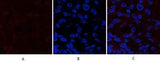
| Validation evidence captions | Immunofluorescence analysis of human-liver-cancer tissue. 1,Catenin-β (phospho Ser37) Polyclonal Antibody(red) was diluted at 1:200(4°C,overnight). 2, Cy3 labled Secondary antibody was diluted at 1:300(room temperature, 50min).3, Picture B: DAPI(blue) 10min. Picture A:Target. Picture B: DAPI. Picture C: merge of A+B | Immunofluorescence analysis of human-liver-cancer tissue. 1,Catenin-β (phospho Ser37) Polyclonal Antibody(red) was diluted at 1:200(4°C,overnight). 2, Cy3 labled Secondary antibody was diluted at 1:300(room temperature, 50min).3, Picture B: DAPI(blue) 10min. Picture A:Target. Picture B: DAPI. Picture C: merge of A+B | Immunofluorescence analysis of human-kidney tissue. 1,Catenin-β (phospho Ser37) Polyclonal Antibody(red) was diluted at 1:200(4°C,overnight). 2, Cy3 labled Secondary antibody was diluted at 1:300(room temperature, 50min).3, Picture B: DAPI(blue) 10min. Picture A:Target. Picture B: DAPI. Picture C: merge of A+B | Immunofluorescence analysis of human-kidney tissue. 1,Catenin-β (phospho Ser37) Polyclonal Antibody(red) was diluted at 1:200(4°C,overnight). 2, Cy3 labled Secondary antibody was diluted at 1:300(room temperature, 50min).3, Picture B: DAPI(blue) 10min. Picture A:Target. Picture B: DAPI. Picture C: merge of A+B |
| Collaborator | ELK Biotechnology |
| Partner model | ES1277 |
| Target | Catenin-β |
| Research areas | >>Rap1 signaling pathway, >>Wnt signaling pathway, >>Hippo signaling pathway, >>Focal adhesion, >>Adherens junction, >>Signaling pathways regulating pluripotency of stem cells, >>Leukocyte transendothelial migration, >>Melanogenesis, >>Thyroid hormone signaling pathway, >>Cushing syndrome, >>Alcoholic liver disease, >>Alzheimer disease, >>Pathways of neurodegeneration - multiple diseases, >>Bacterial invasion of epithelial cells, >>Salmonella infection, >>Hepatitis C, >>Human cytomegalovirus infection, >>Human papillomavirus infection, >>Kaposi sarcoma-associated herpesvirus infection, >>Pathways in cancer, >>Proteoglycans in cancer, >>Colorectal cancer, >>Endometrial cancer, >>Prostate cancer, >>Thyroid cancer, >>Basal cell carcinoma, >>Breast cancer, >>Hepatocellular carcinoma, >>Gastric cancer, >>Arrhythmogenic right ventricular cardiomyopathy, >>Fluid shear stress and atherosclerosis |
| Reactivity | Human,Mouse,Rat |
| Applications | WB,IHC,IF,ELISA |
| Conjugation | Unconjugated |
| Dilution range | Western Blot: 1/500 - 1/2000. Immunohistochemistry: 1/100 - 1/300. Immunofluorescence: 1/200 - 1/1000. ELISA: 1/40000. Not yet tested in other applications. |
| Host | Rabbit |
| Clonality | Polyclonal |
| Isotype | IgG |
| Immunogen | The antiserum was produced against synthesized peptide derived from human Catenin-beta around the phosphorylation site of Ser37. AA range:3-52 |
| Concentration | 1 mg/ml |
| Purification | The antibody was affinity-purified from rabbit antiserum by affinity-chromatography using epitope-specific immunogen. |
| Assay type | Antibody validation/application |
| Expression system | Expressed in several hair follicle cell types: basal and peripheral matrix cells, and cells of the outer and inner root sheaths. Expressed in colon. Present in cortical neurons (at protein level). Expressed in breast cancer tissues (at protein level) (PubMed:29367600). |
| Purity | The antibody was affinity-purified from rabbit antiserum by affinity-chromatography using epitope-specific immunogen. |
| Species | WB | IHC | IF | ELISA | IP | FCM | ChIP |
|---|---|---|---|---|---|---|---|
| Human | |||||||
| Mouse | |||||||
| Rat |
| Species | Dilution | Notes |
|---|---|---|
| Human | Western Blot: 1/500 - 1/2000. Immunohistochemistry: 1/100 - 1/300. Immunofluorescence: 1/200 - 1/1000. ELISA: 1/40000. Not yet tested in other applications. | — |
| Mouse | — | — |
| Rat | — | — |
| Species | Dilution | Notes |
|---|
| Species | Dilution | Notes |
|---|
| Species | Dilution | Notes |
|---|
Collaborator meets ABMIUM quality standards and overall product performance standards have been met.
Quality management certification.
For research applications. Not for diagnostic use.
No customer reviews yet.
