
Calnexin (phospho Ser583) rabbit pAb from ELK Biotechnology Read more ›

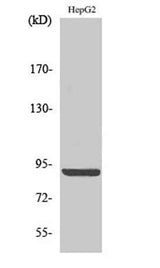
Calnexin (phospho Ser583) rabbit pAb is a research-use antibody from ELK Biotechnology for studying Calnexin in WB, IHC, IF, ELISA workflows with listed reactivity for Human, Mouse, Rat. Specifications and supporting documents below should be reviewed when planning the experiment.
This gene encodes a member of the calnexin family of molecular chaperones. The encoded protein is a calcium-binding, endoplasmic reticulum (ER)-associated protein that interacts transiently with newly synthesized N-linked glycoproteins, facilitating protein folding and assembly. It may also play a central role in the quality control of protein folding by retaining incorrectly folded protein subunits within the ER for degradation. Alternatively spliced transcript variants encoding the same protein have been described. [provided by RefSeq, Jul 2008],
| Specificity | Phospho-Calnexin (S583) Polyclonal Antibody detects endogenous levels of Calnexin protein only when phosphorylated at S583. |
|---|---|
| Validation evidence captions | Western Blot analysis of various cells using Phospho-Calnexin (S583) Polyclonal Antibody diluted at 1:2000 | Enzyme-Linked Immunosorbent Assay (Phospho-ELISA) for Immunogen Phosphopeptide (Phospho-left) and Non-Phosphopeptide (Phospho-right), using Calnexin (Phospho-Ser583) Antibody | Immunofluorescence analysis of HeLa cells, using Calnexin (Phospho-Ser583) Antibody. The picture on the right is blocked with the phospho peptide. | Immunohistochemistry analysis of paraffin-embedded human breast carcinoma, using Calnexin (Phospho-Ser583) Antibody. The picture on the right is blocked with the phospho peptide. |
| Collaborator | ELK Biotechnology |
| Partner model | ES1276 |
| Target | Calnexin |
| Research areas | >>Protein processing in endoplasmic reticulum, >>Phagosome, >>Antigen processing and presentation, >>Thyroid hormone synthesis, >>Human T-cell leukemia virus 1 infection |
| Reactivity | Human,Mouse,Rat |
| Applications | WB,IHC,IF,ELISA |
| Conjugation | Unconjugated |
| Dilution range | Western Blot: 1/500 - 1/2000. Immunohistochemistry: 1/100 - 1/300. Immunofluorescence: 1/200 - 1/1000. ELISA: 1/5000. Not yet tested in other applications. |
| Host | Rabbit |
| Clonality | Polyclonal |
| Isotype | IgG |
| Immunogen | The antiserum was produced against synthesized peptide derived from human Calnexin around the phosphorylation site of Ser583. AA range:543-592 |
| Concentration | 1 mg/ml |
| Purification | The antibody was affinity-purified from rabbit antiserum by affinity-chromatography using epitope-specific immunogen. |
| Assay type | Antibody validation/application |
| Expression system | B-cell lymphoma,Epithelium,Fibroblast,Keratinocyte,Kidney,Liver,Lymph,Placenta,Platelet, |
| Purity | The antibody was affinity-purified from rabbit antiserum by affinity-chromatography using epitope-specific immunogen. |
| Species | WB | IHC | IF | ELISA | IP | FCM | ChIP |
|---|---|---|---|---|---|---|---|
| Human | |||||||
| Mouse | |||||||
| Rat |
| Species | Dilution | Notes |
|---|---|---|
| Human | Western Blot: 1/500 - 1/2000. Immunohistochemistry: 1/100 - 1/300. Immunofluorescence: 1/200 - 1/1000. ELISA: 1/5000. Not yet tested in other applications. | — |
| Mouse | — | — |
| Rat | — | — |
| Species | Dilution | Notes |
|---|
| Species | Dilution | Notes |
|---|
| Species | Dilution | Notes |
|---|
Collaborator meets ABMIUM quality standards and overall product performance standards have been met.
Quality management certification.
For research applications. Not for diagnostic use.
No customer reviews yet.
