
ELAV1 rabbit pAb from ELK Biotechnology Read more ›

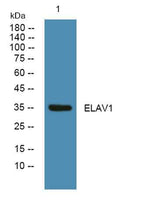
ELAV1 rabbit pAb is a research-use antibody from ELK Biotechnology for studying ELAV1 in WB, ELISA workflows with listed reactivity for Human, Mouse. Specifications and supporting documents below should be reviewed when planning the experiment.
ELAV like RNA binding protein 1(ELAVL1) Homo sapiens The protein encoded by this gene is a member of the ELAVL family of RNA-binding proteins that contain several RNA recognition motifs, and selectively bind AU-rich elements (AREs) found in the 3' untranslated regions of mRNAs. AREs signal degradation of mRNAs as a means to regulate gene expression, thus by binding AREs, the ELAVL family of proteins play a role in stabilizing ARE-containing mRNAs. This gene has been implicated in a variety of biological processes and has been linked to a number of diseases, including cancer. It is highly expressed in many cancers, and could be potentially useful in cancer diagnosis, prognosis, and therapy. [provided by RefSeq, Sep 2012],
| Specificity | ELAV1 Polyclonal Antibody detects endogenous levels of protein. |
|---|---|
| Validation evidence captions | Western blot analysis of lysates from Jarkat cells, primary antibody was diluted at 1:1000, 4°over night |
| Collaborator | ELK Biotechnology |
| Partner model | ES11889 |
| Target | ELAV1 |
| Research areas | >>AMPK signaling pathway, >>IL-17 signaling pathway |
| Reactivity | Human,Mouse |
| Applications | WB,ELISA |
| Conjugation | Unconjugated |
| Dilution range | WB 1:500-2000 ELISA 1:5000-20000 |
| Host | Rabbit |
| Clonality | Polyclonal |
| Isotype | IgG |
| Immunogen | Synthesized peptide derived from part region of human protein |
| Concentration | 1 mg/ml |
| Purification | The antibody was affinity-purified from rabbit antiserum by affinity-chromatography using epitope-specific immunogen. |
| Assay type | Antibody validation/application |
| Expression system | Ubiquitous. Detected in brain, liver, thymus and muscle. |
| Purity | The antibody was affinity-purified from rabbit antiserum by affinity-chromatography using epitope-specific immunogen. |
| Species | WB | IHC | IF | ELISA | IP | FCM | ChIP |
|---|---|---|---|---|---|---|---|
| Human | |||||||
| Mouse |
| Species | Dilution | Notes |
|---|---|---|
| Human | WB 1:500-2000 ELISA 1:5000-20000 | — |
| Mouse | — | — |
| Species | Dilution | Notes |
|---|
Collaborator meets ABMIUM quality standards and overall product performance standards have been met.
Quality management certification.
For research applications. Not for diagnostic use.
No customer reviews yet.
