
PINK1 rabbit pAb from ELK Biotechnology Read more ›

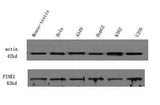
PINK1 rabbit pAb is a research-use antibody from ELK Biotechnology for studying PINK1 in WB, ELISA workflows with listed reactivity for Human, Mouse, Rat. Specifications and supporting documents below should be reviewed when planning the experiment.
This gene encodes a serine/threonine protein kinase that localizes to mitochondria. It is thought to protect cells from stress-induced mitochondrial dysfunction. Mutations in this gene cause one form of autosomal recessive early-onset Parkinson disease. [provided by RefSeq, Jul 2008],
| Specificity | PINK1 Polyclonal Antibody detects endogenous levels of protein. |
|---|---|
| Validation evidence captions | Western Blot analysis of various cell lysis. Primary Antibody was diluted at 1:1000. Secondary antibody(catalog#:RS23920 was diluted at 1:10000 |
| Collaborator | ELK Biotechnology |
| Partner model | ES10983 |
| Target | PINK1 |
| Research areas | >>Mitophagy - animal, >>Parkinson disease, >>Amyotrophic lateral sclerosis, >>Pathways of neurodegeneration - multiple diseases |
| Reactivity | Human,Mouse,Rat |
| Applications | WB,ELISA |
| Conjugation | Unconjugated |
| Dilution range | WB 1:500-2000 ELISA 1:5000-20000 |
| Host | Rabbit |
| Clonality | Polyclonal |
| Isotype | IgG |
| Immunogen | Synthesized peptide derived from part region of human protein |
| Concentration | 1 mg/ml |
| Purification | The antibody was affinity-purified from rabbit antiserum by affinity-chromatography using epitope-specific immunogen. |
| Assay type | Antibody validation/application |
| Expression system | Highly expressed in heart, skeletal muscle and testis, and at lower levels in brain, placenta, liver, kidney, pancreas, prostate, ovary and small intestine. Present in the embryonic testis from an early stage of development. |
| Purity | The antibody was affinity-purified from rabbit antiserum by affinity-chromatography using epitope-specific immunogen. |
| Species | WB | IHC | IF | ELISA | IP | FCM | ChIP |
|---|---|---|---|---|---|---|---|
| Human | |||||||
| Mouse | |||||||
| Rat |
| Species | Dilution | Notes |
|---|---|---|
| Human | WB 1:500-2000 ELISA 1:5000-20000 | — |
| Mouse | — | — |
| Rat | — | — |
| Species | Dilution | Notes |
|---|
Collaborator meets ABMIUM quality standards and overall product performance standards have been met.
Quality management certification.
For research applications. Not for diagnostic use.
No customer reviews yet.
