
VSX1 rabbit pAb from ELK Biotechnology Read more ›

VSX1 rabbit pAb is a research-use antibody from ELK Biotechnology for studying VSX1 in WB, ELISA workflows with listed reactivity for Human, Mouse. Specifications and supporting documents below should be reviewed when planning the experiment.
The protein encoded by this gene contains a paired-like homeodomain and binds to the core of the locus control region of the red/green visual pigment gene cluster. The encoded protein may regulate expression of the cone opsin genes early in development. Mutations in this gene can cause posterior polymorphous corneal dystrophy and keratoconus. Alternatively spliced transcript variants encoding different isoforms have been described. [provided by RefSeq, Jul 2008],
| Specificity | VSX1 Polyclonal Antibody detects endogenous levels of protein. |
|---|---|
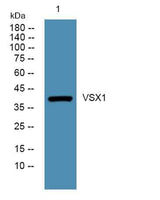
| Validation evidence captions | Western blot analysis of lysates from A431 cells, primary antibody was diluted at 1:1000, 4°over night |
| Collaborator | ELK Biotechnology |
| Partner model | ES10661 |
| Target | VSX1 |
| Research areas | Antibody Research |
| Reactivity | Human,Mouse |
| Applications | WB,ELISA |
| Conjugation | Unconjugated |
| Dilution range | WB 1:500-2000 ELISA 1:5000-20000 |
| Host | Rabbit |
| Clonality | Polyclonal |
| Isotype | IgG |
| Immunogen | Synthesized peptide derived from part region of human protein |
| Concentration | 1 mg/ml |
| Purification | The antibody was affinity-purified from rabbit antiserum by affinity-chromatography using epitope-specific immunogen. |
| Assay type | Antibody validation/application |
| Expression system | In the adult eye, expressed in lens, iris, ciliary body, choroid, optical nerve head and, most strongly, in retina, but not expressed in sclera and cornea. According to PubMed:11978762, expressed in adult retina but not in lens and cornea. Within adult retina, found exclusively in the inner nuclear layer. Isoform 1, isoform 2, isoform 3 and isoform 4 expressed in adult retina, but not in brain, heart, kidney, liver, lung, pancreas, placenta and skeletal muscle. Not expressed in thymus and spleen. Expressed in embryonic craniofacial tissue. Expressed in fetal (week 14) retina. Strongly expressed in neonatal retina, weakly in neonatal lens, choroid and cornea (day 1, 4; month 9). |
| Purity | The antibody was affinity-purified from rabbit antiserum by affinity-chromatography using epitope-specific immunogen. |
| Species | WB | IHC | IF | ELISA | IP | FCM | ChIP |
|---|---|---|---|---|---|---|---|
| Human | |||||||
| Mouse |
| Species | Dilution | Notes |
|---|---|---|
| Human | WB 1:500-2000 ELISA 1:5000-20000 | — |
| Mouse | — | — |
| Species | Dilution | Notes |
|---|
Collaborator meets ABMIUM quality standards and overall product performance standards have been met.
Quality management certification.
For research applications. Not for diagnostic use.
No customer reviews yet.
