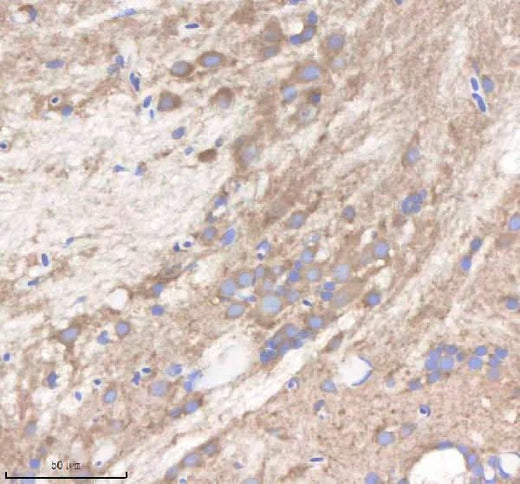
Primary Antibody supplied by Boster Bio Read more ›


Anti-Zebrafish PI4KB Antibody is a research-use antibody from Boster Bio for studying Phosphatidylinositol 4-kinase beta in IHC, IHC-P workflows with listed reactivity for Zebrafish. Specifications and supporting documents below should be reviewed when planning the experiment.
Boster Bio Anti-Zebrafish PI4KB Antibody catalog # AZQ49GP3. Tested in IHC applications. This antibody reacts with Zebrafish.Phosphatidylinositol 4-kinase beta is an enzyme that in humans is encoded by the PI4KB gene. Inositol phospholipids have an important role in intracellular signaling in response to hormones, growth factors and neurotransmitters. Phosphatidylinositol 4-kinase phosphorylates phosphatidylinositol (PI) to phosphatidylinositol-4-phosphate (PIP). In a second step, PIP is further phosphorylated to phosphatidylinositol-4,5-bisphosphate (PIP2), and PIP2 is subsequently hydrolyzed by phospholipase C, producing the two intracellular second messengers, inositol 1,4,5-triphosphate (IP3) and diacylglycerol (DAG). PI4K230, PI4K92 and PI4K55 are three PI4 kinase isoforms that have been characterized and classified according to their molecular weights of 230, 92 and 55 kD. Previously, PI4 kinases were classified into type II and III enzymes. All isoforms are located on distinct membranes and cellular compartments suggesting various tasks. PI4K230 is located at the endoplasmatic reticulum and outer membranes of mitochondria, PI4K92 at the Golgi apparatus and endoplasmatic reticulum, and PI4K55 at the plasma membrane and endosomes. PI4K230 is predominantly expressed in brain and moderately sensitive to wortmannin as well as specifically and irreversibly inhibited by cyclitol derivatives.
| Supplier | Boster Bio |
|---|---|
| ABMIUM evidence status | ABMIUM Verified™ collaborator-tested data |
| Catalogue reference | AZQ49GP3 |
| Product category | Primary Antibodies, Zebrafish Antibodies |
| Reactive species | Zebrafish |
| Tested applications | IHC, IHC-P |
| Available conjugations | Unconjugated, Biotin, Cy3, Fluoro488, Fluoro550, Fluoro594, FITC, HRP, APC, PE, Fluoro647 |
| Gene name | PI4KB |
| Protein name | Phosphatidylinositol 4-kinase beta |
| Immunogen | E.coli-derived zebrafish PI4KB recombinant protein (Position: D394-D690). |
| Host | Rabbit |
| Clonality | Polyclonal |
| Isotype | Rabbit IgG |
| Purification | Immunogen affinity purified. |
| Storage | At -20°C for one year from date of receipt. After reconstitution, at 4°C for one month. It can also be aliquotted and stored frozen at -20°C for six months. Avoid repeated freezing and thawing. |
| UniProt | Q49GP3 |
| NCBI Gene ID | 563201 |
| Conjugation | Size |
|---|---|
| Unconjugated | 100 μg/vial |
| Biotin | 100 μg/vial |
| Cy3 | 100 μg/vial |
| Fluoro488 | 100 μg/vial |
| Fluoro550 | 100 μg/vial |
| Fluoro594 | 100 μg/vial |
| FITC | 100 μg/vial |
| HRP | 100 μg/vial |
| APC | 100 μg/vial |
| PE | 100 μg/vial |
| Fluoro647 | 100 μg/vial |
| Collaborator | Boster Bio |
| Partner model | AZQ49GP3 |
| Target | Phosphatidylinositol 4-kinase beta |
| Reactivity | Zebrafish |
| Applications | IHC,IHC-P |
| Conjugation | Unconjugated|Biotin|Cy3|Fluoro488|Fluoro550|Fluoro594|FITC|HRP|APC|PE|Fluoro647 |
| Dilution range | Immunohistochemistry (Paraffin-embedded Section), 2-5 μg/ml, Zebrafish<br> |
| Host | Rabbit |
| Clonality | Polyclonal |
| Isotype | Rabbit IgG |
| Immunogen | E.coli-derived zebrafish PI4KB recombinant protein (Position: D394-D690). |
| Concentration | Adding 0.2 ml of distilled water will yield a concentration of 500 μg/ml. |
| Purification | Immunogen affinity purified. |
| Shelf life | At -20°C for one year from date of receipt. After reconstitution, at 4°C for one month. It can also be aliquotted and stored frozen at -20°C for six months. Avoid repeated freezing and thawing. |
| Availability | Available |
| Species | WB | IHC | IHC-P | IHC-F | IF/ICC | Flow Cytometry | ELISA | IP |
|---|---|---|---|---|---|---|---|---|
| Zebrafish |
Collaborator meets ABMIUM quality standards and overall product performance standards have been met.
For research applications. Not for diagnostic use.
No customer reviews yet.