Primary Antibody supplied by Boster Bio Read more ›

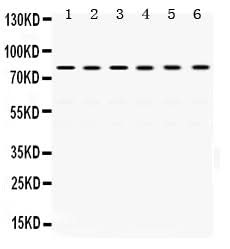
Anti-TRAP1 Antibody Picoband® is a research-use antibody from Boster Bio for studying Heat shock protein 75 kDa, mitochondrial in ELISA, Flow Cytometry, IHC, IHC-P, WB workflows with listed reactivity for Human, Rat. Specifications and supporting documents below should be reviewed when planning the experiment.
Boster Bio Anti-TRAP1 Antibody Picoband® catalog # PB9834. Tested in IHC, WB applications. This antibody reacts with Human, Rat. The brand Picoband indicates this is a premium antibody that guarantees superior quality, high affinity, and strong signals with minimal background in Western blot applications. Only our best-performing antibodies are designated as Picoband, ensuring unmatched performance.Heat shock protein 75 kDa, mitochondrial is a protein that in humans is encoded by the TRAP1 gene. It is mapped to 16p13.3. This gene encodes a mitochondrial chaperone protein that is member of the heat shock protein 90 (HSP90) family. The encoded protein has ATPase activity and interacts with tumor necrosis factor type I. And this protein may function in regulating cellular stress responses. In addition, it was found that TRAP1 interacted with the N-terminal half of TNFR1. Also, TRAP1 interacted with the C-terminal ends of the proteins encoded by both multiple exostoses-causing genes, EXT1 and EXT2, but not with EXTL1 or EXTL3.
| Collaborator | Boster Bio |
| Partner model | PB9834 |
| Target | Heat shock protein 75 kDa, mitochondrial |
| Reactivity | Human,Rat |
| Applications | ELISA,Flow Cytometry,IHC,IHC-P,WB |
| Conjugation | Unconjugated|Biotin|Cy3|Fluoro488|Fluoro550|Fluoro594|FITC|HRP|APC|PE|Fluoro647 |
| Cross-reactivity | No cross-reactivity with other proteins |
| Dilution range | Immunohistochemistry (Paraffin-embedded Section), 0.5-1μg/ml, Human <br>Western blot, 0.1-0.5μg/ml, Human, Rat<br> |
| Host | Rabbit |
| Clonality | Polyclonal |
| Isotype | Rabbit IgG |
| Immunogen | E.coli-derived human TRAP1 recombinant protein (Position: A571-H704). Human TRAP1 shares 91.7% and 94% amino acid (aa) sequence identity with mouse and rat TRAP1, respectively. |
| Concentration | Adding 0.2 ml of distilled water will yield a concentration of 500 μg/ml. |
| Purification | Immunogen affinity purified. |
| Purity | No cross reactivity with other proteins. |
| Shelf life | Store at -20℃ for one year from date of receipt. After reconstitution, at 4℃ for one month. It can also be aliquotted and stored frozen at -20℃ for six months. Avoid repeated freeze-thaw cycles. |
| Availability | Available |
| Species | WB | IHC | IHC-P | IHC-F | IF/ICC | Flow Cytometry | ELISA | IP |
|---|---|---|---|---|---|---|---|---|
| Human | ||||||||
| Rat |
Collaborator meets ABMIUM quality standards and overall product performance standards have been met.
For research applications. Not for diagnostic use.
No customer reviews yet.