Primary Antibody supplied by Boster Bio Read more ›

Anti-Staufen/STAU1 Antibody Picoband® is a research-use antibody from Boster Bio for studying Double-stranded RNA-binding protein Staufen homolog 1 in ELISA, Flow Cytometry, IF/ICC, IHC, IHC-P, WB workflows with listed reactivity for Human, Rat. Specifications and supporting documents below should be reviewed when planning the experiment.
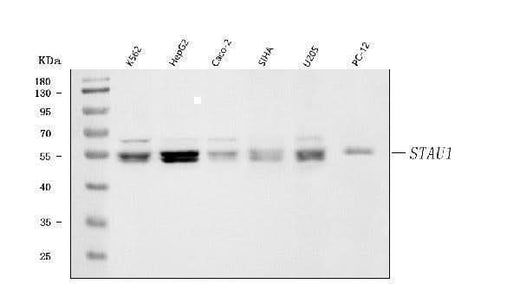
Boster Bio Anti-Staufen/STAU1 Antibody Picoband® catalog # PB9895. Tested in WB, ICC/IF applications. This antibody reacts with Human, Rat. The brand Picoband indicates this is a premium antibody that guarantees superior quality, high affinity, and strong signals with minimal background in Western blot applications. Only our best-performing antibodies are designated as Picoband, ensuring unmatched performance.Double-stranded RNA-binding protein Staufen homolog 1 is a protein that in humans is encoded by the STAU1 gene. Staufen is a member of the family of double-stranded RNA (dsRNA)-binding proteins involved in the transport and/or localization of mRNAs to different subcellular compartments and/or organelles. These proteins are characterized by the presence of multiple dsRNA-binding domains which are required to bind RNAs having double-stranded secondary structures. The human homologue of staufen encoded by STAU, in addition contains a microtubule- binding domain similar to that of microtubule-associated protein 1B, and binds tubulin. The STAU gene product has been shown to be present in the cytoplasm in association with the rough endoplasmic reticulum (RER), implicating this protein in the transport of mRNA via the microtubule network to the RER, the site of translation. Five transcript variants resulting from alternative splicing of STAU gene and encoding three isoforms have been described. Three of these variants encode the same isoform, however, differ in their 5'UTR.
| Collaborator | Boster Bio |
| Partner model | PB9895 |
| Target | Double-stranded RNA-binding protein Staufen homolog 1 |
| Reactivity | Human,Rat |
| Applications | ELISA,Flow Cytometry,IF/ICC,IHC,IHC-P,WB |
| Conjugation | Unconjugated|Biotin|Cy3|Fluoro488|Fluoro550|Fluoro594|FITC|HRP|APC|PE|Fluoro647 |
| Cross-reactivity | No cross-reactivity with other proteins. |
| Dilution range | Western blot, 0.1-0.5μg/ml, Human, Rat<br> Immunocytochemistry/Immunofluorescence, 5 μg/ml, Human<br> |
| Host | Rabbit |
| Clonality | Polyclonal |
| Isotype | Rabbit IgG |
| Immunogen | A synthetic peptide corresponding to a sequence at the C-terminus of human Staufen, identical to the related mouse sequence. |
| Concentration | Adding 0.2 ml of distilled water will yield a concentration of 500 μg/ml. |
| Purification | Immunogen affinity purified. |
| Purity | No cross reactivity with other proteins. |
| Shelf life | Store at -20℃ for one year from date of receipt. After reconstitution, at 4℃ for one month. It can also be aliquotted and stored frozen at -20℃ for six months. Avoid repeated freeze-thaw cycles. |
| Availability | Available |
| Species | WB | IHC | IHC-P | IHC-F | IF/ICC | Flow Cytometry | ELISA | IP |
|---|---|---|---|---|---|---|---|---|
| Human | ||||||||
| Rat |
Collaborator meets ABMIUM quality standards and overall product performance standards have been met.
For research applications. Not for diagnostic use.
No customer reviews yet.