
Primary Antibody supplied by Boster Bio Read more ›

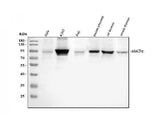
Anti-STAT5a Antibody Picoband® is a research-use antibody from Boster Bio for studying Signal transducer and activator of transcription 5A in ELISA, Flow Cytometry, IHC, IHC-P, WB workflows with listed reactivity for Human, Mouse, Rat. Specifications and supporting documents below should be reviewed when planning the experiment.
Boster Bio Anti-STAT5a Antibody catalog # PA1840. Tested in Flow Cytometry, WB applications. This antibody reacts with Human, Mouse, Rat. The brand Picoband indicates this is a premium antibody that guarantees superior quality, high affinity, and strong signals with minimal background in Western blot applications. Only our best-performing antibodies are designated as Picoband, ensuring unmatched performance.STAT5 (Signal transducer and activator of transcription 5) also known as STAT5A, MGF, is a protein that serve the dual function of signal transducers and activators of transcription in cells exposed to signaling polypeptides. Hou et al. (1995) cloned the human STAT5 cDNA from an umbilical vein endothelial cell library and found that it encodes a 794-amino acid polypeptide with a predicted mass of approximately 90.5 kD. To analyze the possible role of STAT5 in human GH-induced proliferation, Friedrichsen et al. (2001) expressed a dominant-negative STAT5 mutant, STAT5A-delta-749, in INS-1 cells under the control of a doxycycline-inducible promoter by stable transfection. Chromatin immunoprecipitation analysis confirmed binding of STAT5 to the HIF2A promoter 344 bp upstream of the HIF2A start site. STAT5 overexpression independently resulted in erythroid commitment in megakaryocytic-erythroid progenitors, which was abrogated by knockdown of GATA1. STAT5 is responsible for the immediate-early induction of the long isoform of the BCL2-related protein in erythroid cells through binding to the promoter of the BCLX gene.
| Supplier | Boster Bio |
|---|---|
| ABMIUM evidence status | ABMIUM Verified™ collaborator-tested data |
| Catalogue reference | PA1840 |
| Product category | Primary Antibodies |
| Reactive species | Human, Mouse, Rat |
| Tested applications | ELISA, Flow Cytometry, IHC, IHC-P, WB |
| Available conjugations | Unconjugated, Biotin, Cy3, Fluoro488, Fluoro550, Fluoro594, FITC, HRP, APC, PE, Fluoro647 |
| Gene name | STAT5A |
| Protein name | Signal transducer and activator of transcription 5A |
| Specificity | No cross reactivity with other proteins. |
| Immunogen | A synthetic peptide corresponding to a sequence at the C-terminus of human STAT5a. |
| Host | Rabbit |
| Clonality | Polyclonal |
| Isotype | Rabbit IgG |
| Purification | Immunogen affinity purified. |
| Storage | Store at -20℃ for one year from date of receipt. After reconstitution, at 4℃ for one month. It can also be aliquotted and stored frozen at -20℃ for six months. Avoid repeated freeze-thaw cycles. |
| UniProt | P42229 |
| NCBI Gene ID | 6776 |
| Conjugation | Size |
|---|---|
| Unconjugated | 100 μg/vial |
| Biotin | 100 μg/vial |
| Cy3 | 100 μg/vial |
| Fluoro488 | 100 μg/vial |
| Fluoro550 | 100 μg/vial |
| Fluoro594 | 100 μg/vial |
| FITC | 100 μg/vial |
| HRP | 100 μg/vial |
| APC | 100 μg/vial |
| PE | 100 μg/vial |
| Fluoro647 | 100 μg/vial |
| Collaborator | Boster Bio |
| Partner model | PA1840 |
| Target | Signal transducer and activator of transcription 5A |
| Reactivity | Human,Mouse,Rat |
| Applications | ELISA,Flow Cytometry,IHC,IHC-P,WB |
| Conjugation | Unconjugated|Biotin|Cy3|Fluoro488|Fluoro550|Fluoro594|FITC|HRP|APC|PE|Fluoro647 |
| Cross-reactivity | No cross-reactivity with other proteins |
| Dilution range | Western blot, 0.1-0.5μg/ml, Human, Mouse, Rat<br> Flow Cytometry (Fixed), 1-3μg/1x10<sup>6</sup> cells, Human |
| Host | Rabbit |
| Clonality | Polyclonal |
| Isotype | Rabbit IgG |
| Immunogen | A synthetic peptide corresponding to a sequence at the C-terminus of human STAT5a. |
| Concentration | Adding 0.2 ml of distilled water will yield a concentration of 500 μg/ml. |
| Purification | Immunogen affinity purified. |
| Purity | No cross reactivity with other proteins. |
| Shelf life | Store at -20℃ for one year from date of receipt. After reconstitution, at 4℃ for one month. It can also be aliquotted and stored frozen at -20℃ for six months. Avoid repeated freeze-thaw cycles. |
| Availability | Available |
| Species | WB | IHC | IHC-P | IHC-F | IF/ICC | Flow Cytometry | ELISA | IP |
|---|---|---|---|---|---|---|---|---|
| Human | ||||||||
| Mouse | ||||||||
| Rat |
Collaborator meets ABMIUM quality standards and overall product performance standards have been met.
For research applications. Not for diagnostic use.
No customer reviews yet.
