
Primary Antibody supplied by Boster Bio Read more ›

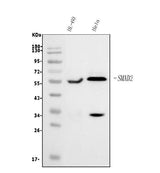
Anti-SMAD2 Antibody Picoband® (monoclonal, 3C4 is a research-use antibody from Boster Bio for studying Mothers against decapentaplegic homolog 2 in ELISA, Flow Cytometry, IHC, IHC-P, WB workflows with listed reactivity for Human. Specifications and supporting documents below should be reviewed when planning the experiment.
Boster Bio Anti-SMAD2 Antibody Picoband® (monoclonal, 3C4) catalog # M00090-3. Tested in Flow Cytometry, IHC, WB applications. This antibody reacts with Human. The brand Picoband indicates this is a premium antibody that guarantees superior quality, high affinity, and strong signals with minimal background in Western blot applications. Only our best-performing antibodies are designated as Picoband, ensuring unmatched performance.Smad2 (Mothers against decapentaplegic homolog 2), also known as MADR2, MADH2, SMAD family member 2 or SMAD2, is a protein that in humans is encoded by the SMAD2 gene. MAD homolog 2 belongs to the SMAD, a family of proteins similar to the gene products of the Drosophila gene 'mothers against decapentaplegic' (Mad) and the C. elegans gene Sma. Eppert et al. mapped the MADR2 gene close to DPC4 at 18q21, a region which is frequently deleted in colorectal cancers. Riggins et al. mapped the human MADH2 gene to 18q21. Nakao et al. refined the localization of the SMAD2 gene to 18q21.1, approximately 3 Mb proximal to DPC4, by fluorescence in situ hybridization. SMAD2 mediates the signal of the transforming growth factor (TGF)-beta, and thus regulates multiple cellular processes, such as cell proliferation, apoptosis, and differentiation. This protein is recruited to the TGF-beta receptors through its interaction with the SMAD anchor for receptor activation (SARA) protein. In response to TGF-beta signal, this protein is phosphorylated by the TGF-beta receptors.
| Collaborator | Boster Bio |
| Partner model | M00090-3 |
| Target | Mothers against decapentaplegic homolog 2 |
| Reactivity | Human |
| Applications | ELISA,Flow Cytometry,IHC,IHC-P,WB |
| Conjugation | Unconjugated|Biotin|Cy3|Fluoro488|Fluoro550|Fluoro594|FITC|HRP|APC|PE|Fluoro647 |
| Cross-reactivity | No cross-reactivity with other proteins. |
| Dilution range | Western blot, 0.25-0.5μg/ml, Human<br> Immunohistochemistry (Paraffin-embedded Section), 2-5μg/ml, Human<br> Flow Cytometry (Fixed), 1-3μg/1x10<sup>6</sup> cells, Human<br> |
| Host | Mouse |
| Clonality | Monoclonal |
| Clone | Clone: 3C4 |
| Isotype | Mouse IgG1 |
| Immunogen | E.coli-derived human SMAD2 recombinant protein (Position: E83-Q264). |
| Concentration | Adding 0.2 ml of distilled water will yield a concentration of 500 μg/ml. |
| Purification | Immunogen affinity purified. |
| Shelf life | Store at -20℃ for one year from date of receipt. After reconstitution, at 4℃ for one month. It can also be aliquotted and stored frozen at -20℃ for six months. Avoid repeated freeze-thaw cycles. |
| Availability | Available |
| Species | WB | IHC | IHC-P | IHC-F | IF/ICC | Flow Cytometry | ELISA | IP |
|---|---|---|---|---|---|---|---|---|
| Human |
Collaborator meets ABMIUM quality standards and overall product performance standards have been met.
For research applications. Not for diagnostic use.
No customer reviews yet.
